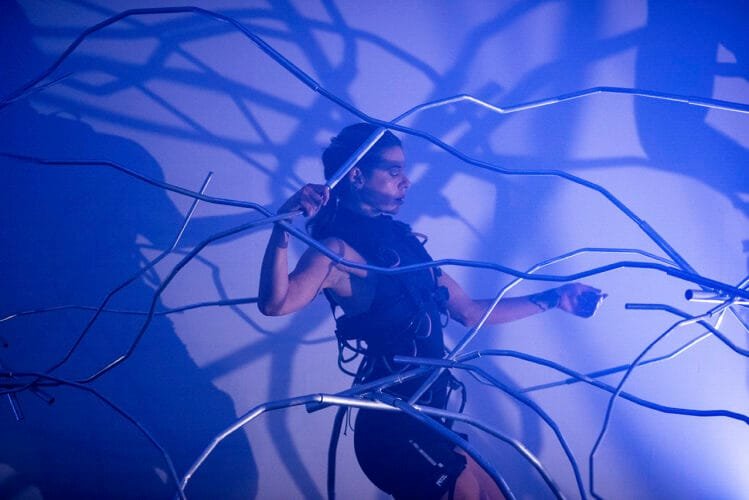
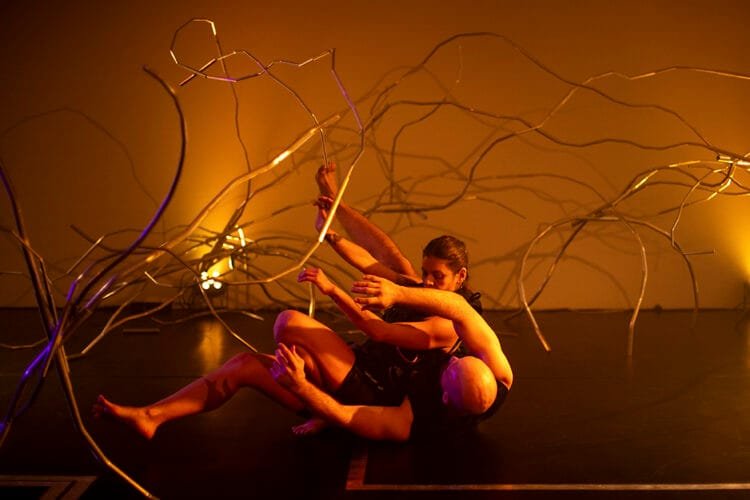
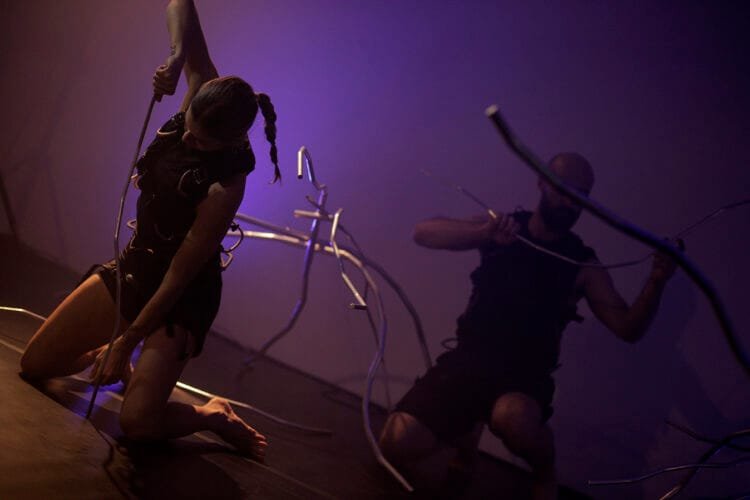
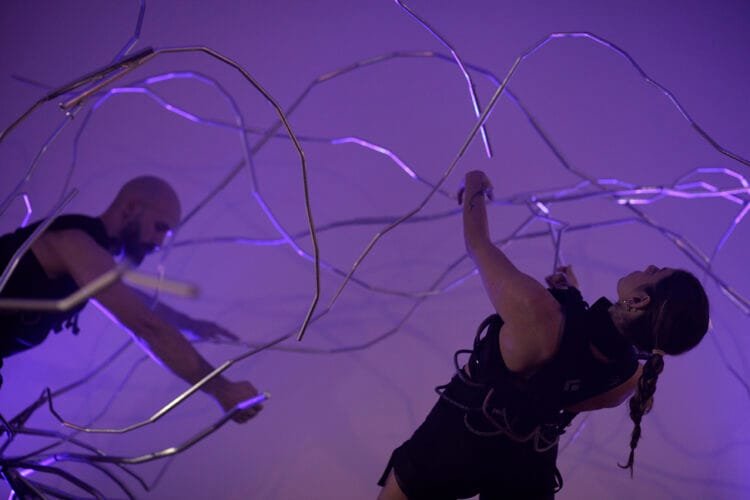
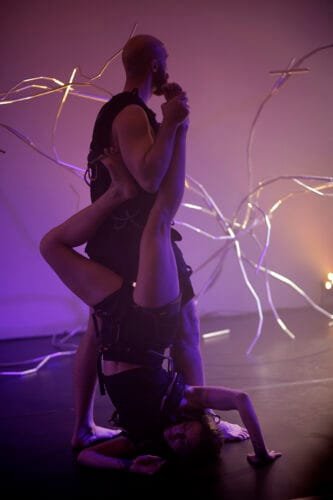
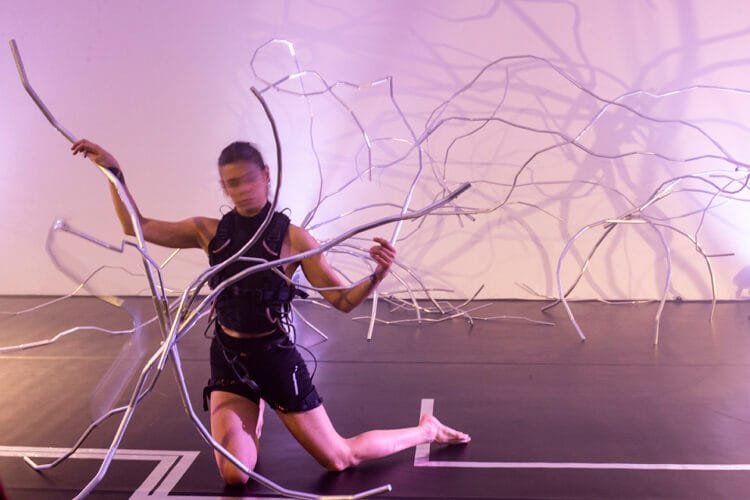
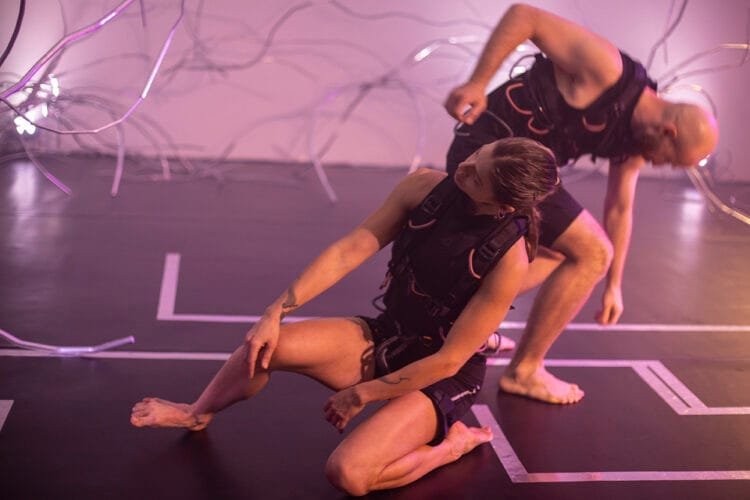
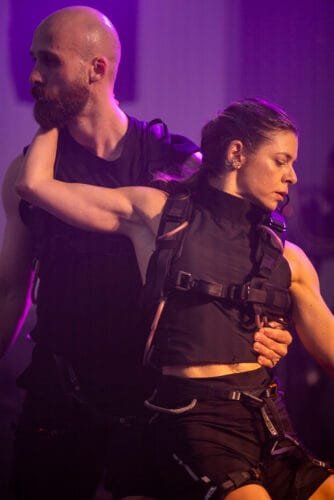
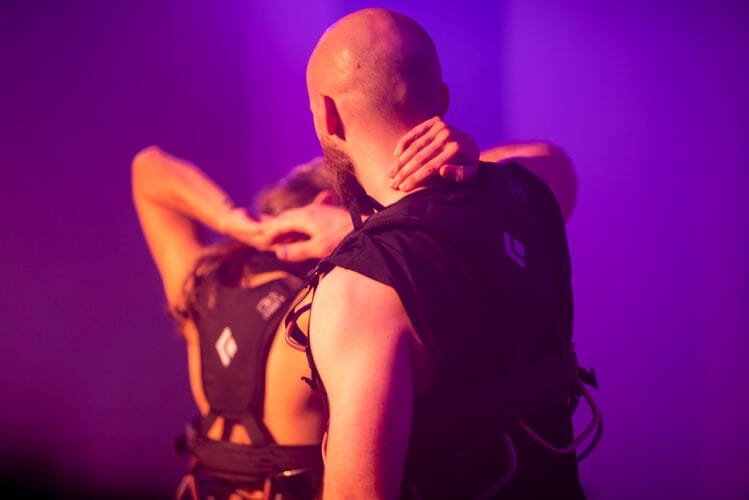
“Electric Somatic” was an interdisciplinary art project at the intersection of dance performance, sound art, interactive art, sound installation, and sound scenography. It was conceived and coordinated by choreographer Alexandra Gîrbea, who collaborated with a large artistic team consisting of: Denis Bolborea (choreography), Uțu Pascu (sound design), Nimbert Ambrus (installation), Andreea Novac (choreographic dramaturgy), Maria Sârbu (curatorial input), Mihai Toth (mediation), Claudia Negulici (visual direction & costume design), Cristian Popescu (light design), and Oana Kansoun (graphics).
The performance The boundary of my body, rather an event horizon, presented in Timișoara and Bucharest in October and November 2025, was the result of four research and creation residencies. The performances were based on a sound environment generated through dance, using an analog tactile interface system. The sculptural installation served to create an interactive stage environment, functioning as a metaphor for interconnectivity in a complex circuit, activated by the dynamic body and messenger.
Conceptually, the project aimed to open a discussion about ecology, understood as a network of relationships – with oneself, with others, with the environment. Awareness of this circuit begins in the body and reverberates outward, toward human and non-human entities.
The body is described in your performance concept as a “permeable membrane” that transforms tactile stimuli into sound and allows the transfer of energy. How did you relate to this idea choreographically? How did the body language come about? What was it based on?
We built the choreographic language around the concept of interbeing, a concept from Buddhist thought, according to which nothing has an independent existence, separate from other entities. We approached this concept through a change of perspective and perception that allows us to understand each element as an essential and defining part of the whole. We integrated into the language of improvisation this sensitivity that perceives and generates connections between all things, a mode of expression anchored in the connection with the other, with the stage, with the music, and with the entire performance.
In relation to music, our skin becomes a permeable membrane, conducting electricity and, with that, a component of the sound circuit generated by the interaction of the dancers with the stage. Through our touch, in an electronic system based on the principle of bio-feedback loop that connects the dance floor with MIDI controllers, the circuit closes in the body, which thus becomes a source of sound.
At the same time, we wanted to build a world reminiscent of nature, avoiding romanticization and choosing instead to explore and incorporate those aspects that sometimes provoke admiration, sometimes fear: mystery, the unknown, force, unpredictability, adaptation, destruction, collaboration, but also conflict. This direction created the atmosphere of the performance, in which we drew inspiration from the philosophy of Timothy Morton, a contemporary philosopher who proposes the development of ecological thinking at the ontological level as a driver of change in the way we understand nature, humans, and the relationships between them.
We worked extensively with unpredictability, which we introduced as an improvisation tool, creating a proximity in which dependence and independence, the known and the unknown overlap and coexist. We created a real-time composition system fed by these contraddictions – a kind of game in which decisions about how to act or react are made on the spot, instinctively or intuitively, deliberately or spontaneously, as long as an electrical impulse crosses the body.
The project was initiated by you, based on the concept of “interbeing” that you mentioned earlier, but also on the idea of social ecology. How did this perspective emerge and how did it develop as a result of the residency, the collaboration with Denis, Andreea, and the rest of the team?
I have been pursuing the idea of ecology for many years and have come to see it in a broader sense, as a psychological and social practice stemming from a comprehensive vision of existence and identity. Ecology is not just about ecosystems, forests, oceans; it is about connection and relationships, about belonging, about dependence, about togetherness, about interbeing. I don’t think we can talk about ecology beyond people; the social system is also an ecosystem in which it is essential to be aware of our attitudes and behaviors and their impact on ourselves and the environment.
Throughout the work process, the concept remained constant, thanks to Andreea Novac, who helped us merge methods and ideas, and find the necessary dynamics for constructing the performance. The boundary of my body, rather an event horizon can also be seen as an (eco)system in which people, concepts, methods, tools, ideas, and elements came together, each representing a separate system. The process was collaborative and non-hierarchical, which gave flexibility and complexity to the way the concept took shape. A performance, as a process and a result, always reveals itself in a surprising way, each project having its own personality given by the uniqueness of the team that creates together in a certain time. Together with Denis Bolborea, we created the choreographic system and opened the direction towards the sound environment created by Uțu Pascu, and with Claudia Negulici we worked on costume design and visual style.
The biggest unknown in the whole process was the modular metal installation created by Nimbert Ambrus. I say unknown because it was the first time I had worked with such a complex scenographic element. The installation had a strong presence in the space, which made it the central element of the performance. Thus, it became the materiality of the concept: an interconnected, modular, flexible, unpredictable, mobile structure that picks up and resonates with impulses, receptive to change, a mysterious and lively environment.
What were the most intense moments during rehearsals and, conversely, what were the most problematic aspects of the conceptual and physical construct?
The most intense moments marked the beginning and end of rehearsals, in different ways. The beginning of a choreographic project is always charged with enthusiasm and curiosity, generated by the creative potential of the team, which begins to take different directions and give the concept the opportunity to express itself and offer meanings that do not emerge prior to working in the studio. The final rehearsal period often comes with an increased amount of responsibility, the work process becomes more meticulous, involving fine-tuning those details that make a difference in the dramaturgical structure. I think that in our project the problems arose because it is a performance that uses technology and has this complex scenic element – the installation. The technical preparations necessary for the interactive system to function took up more rehearsal time than we expected. At the same time, the challenge was to construct a dramatic structure in which the three systems – dance, sound and installation – would play an equal role on stage, to flip the dialectic where music and decor serve as elements that support dance. We wanted to suggest the possibility of a non-hierarchical macrosystem, in which man is not the central element that controls the environment, but is in turn controlled and influenced by it. This direction was a novel challenge and a major topic in building the performance.
At the end of the residency, you had three shows, two in Timișoara and one in Bucharest. Prior to these, you presented a work in progress to the public at the Simultan Festival in Timișoara. How did you experience these encounters with the public? What reactions surprised you and how much did the audience’s feedback influence the evolution of the final performance? How much did you change the choreography from the work in progress to the premiere?
Meeting the public always has a strong effect on how you feel about the performance. Presenting the work in progress at the 20th anniversary edition of the Simultan Festival gave us the chance to test the performance and really get a feel for what worked and where we still needed to look for, change, or restructure certain details. Between this and the premiere events, we had almost two weeks, during which we worked on a new scene and the structure of the performance, rather than the choreography. We received constructive feedback from the audience, which helped us focus on the most important details and encouraged us to be confident in what we had built. We were happy to see that there were people in the audience who attended both performances in Timișoara and even the one in Bucharest. In Timișoara, we already have a loyal audience, who have attended our shows staged in recent years, and this time they were joined by people from the visual arts and experimental electronic music scenes. In Bucharest, we presented the performance at Scânteia Plus, where we had an audience specialized in choreographic art, but also a general audience, and the feedback from both sides was very welcome and constructive.
I know that you placed great importance on the educational component from the very beginning of the project. How did this educational program unfold? What impact do you think your meetings had on the young artists?
With this project, we have opened up a new direction that interests me greatly: involving students from various faculties – not only art, but also fields such as electronics and architecture – and introducing them to creative processes, to the real possibility of interacting with artists in the process of creation. I initiated this dialogue together with Mihai Toth, a cultural mediator and artist with a passion for performance art, who developed and coordinated the mediation program between the performance at the Simultan Festival and the premieres in Timișoara, the most intense stage of the project.
Mihai facilitated an authentic relationship between the students and our team, and in return we received surprising and valuable perspectives. Although the impact on each participant is difficult to estimate, even those who attended only once gained a key to understanding the performance and were able to connect with it more deeply once they understood the theatrical context and how the three performative systems – dancers, sound and installation – communicate.
At the end of the project, we organized a feedback circle in which the students told us what participating meant to them and how they related to the project, depending on their background and creative practices. It was moving to see how openly and sincerely they experienced it. The way they were inspired by our work made our interactions a source of inspiration for us, especially in terms of how we can develop cultural mediation in contemporary dance and performance projects.
How do you perceive the contemporary dance scene in Romania? What motivates you to continue contributing to the development of a contemporary dance scene in Timișoara?
I approached this scene 18 years ago, at a time when it seemed like a strange environment to me and, precisely because of that, deeply appealing. I have always been drawn to experimental areas, and Romanian contemporary dance in the early 2000s had the character of a radical experiment, with an almost revolutionary energy in the way it questioned political and philosophical themes, along with other social concepts and constructs.
Later, I traveled a lot and distanced myself a little from the practices and scene in Romania. Because I don’t live in Bucharest, my contact with other choreographers and dancers is more sporadic than I would like. However, I am glad that I can support and represent the development of contemporary dance in Timișoara, where over the last five years I have developed artistic projects focused on the themes of ecology and the relationship between dance and sound. It is a field that is growing exponentially, in increasingly diverse directions. I am particularly fascinated by artistic trends in contemporary dance and local performance; I like abstract and conceptual approaches, and I have deep admiration for some of my fellow choreographers, especially since I am aware of the difficulties and challenges of building a sustainable career as an independent artist.
These difficulties sometimes make me question the sustainability of this profession, in a socio-political context that does not truly support independent artists. I face the same conflict that many artists in Romania experience: between the precariousness of the professional environment and a strong passion for an art that, for me, remains the most authentic form of expression.
In the coming years, I would like to get closer to the community of choreographers and dancers in Romania and see more interdisciplinary collaborations, bold experiments, and a much larger number of performances nationwide.
Translated by Marina Oprea


POSTED BY
Maria Sârbu
Maria Sârbu has a background in art history and theory at the Babeș-Bolyai University in Cluj-Napoca. She arrived in Timișoara in 2009, to continue her doctoral studies at the Faculty of Arts and D...
Comments are closed here.