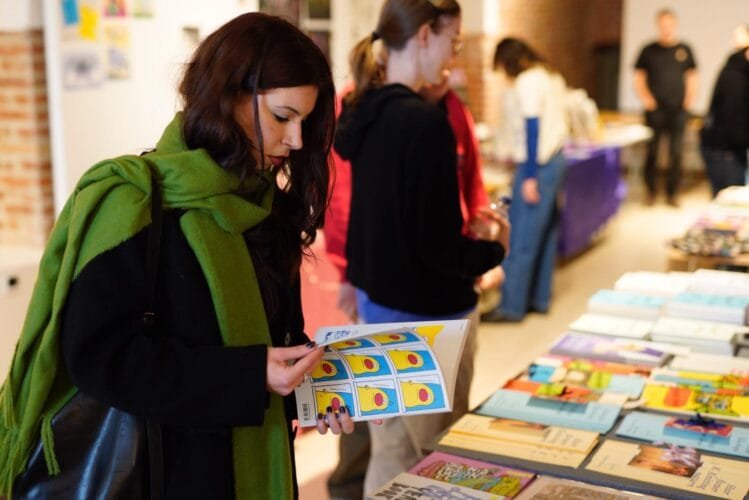
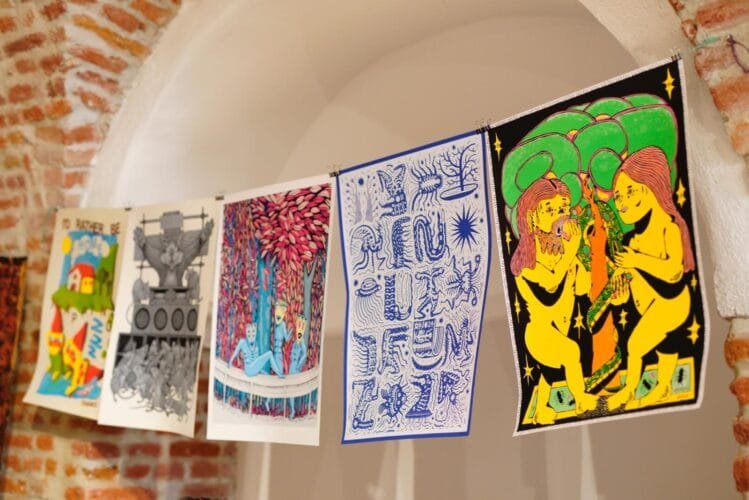
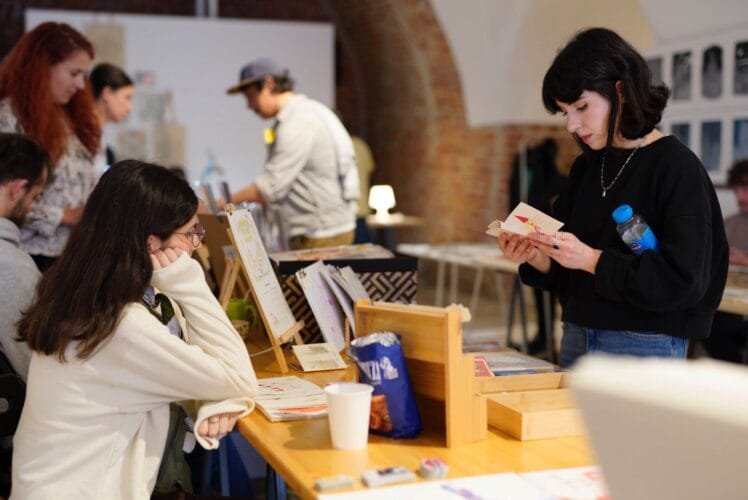
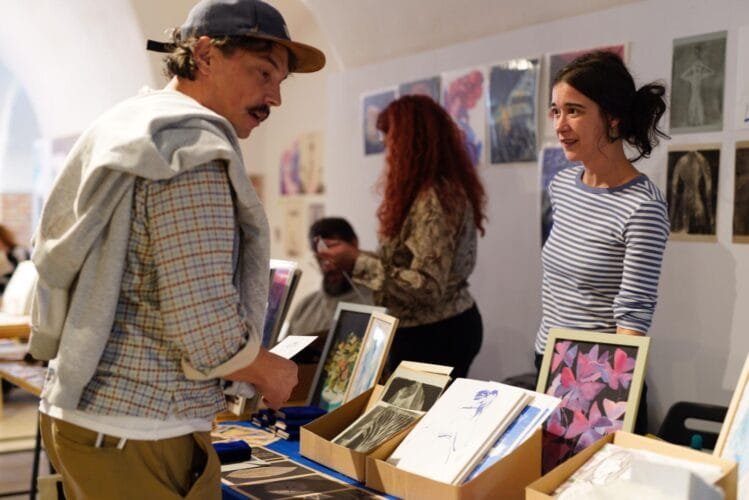
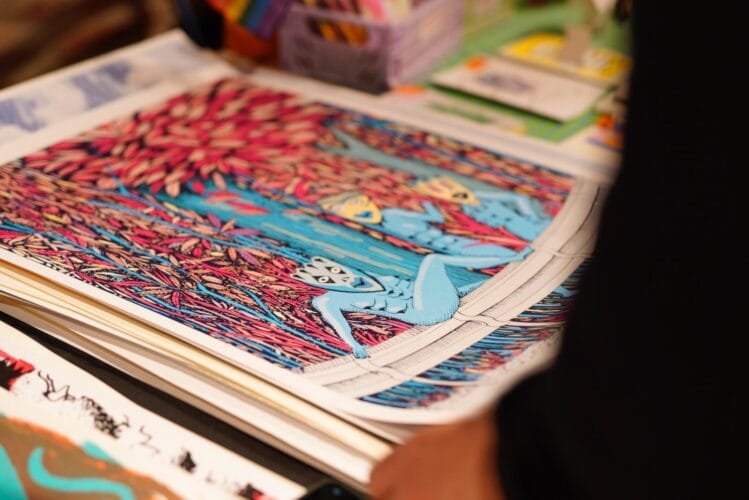
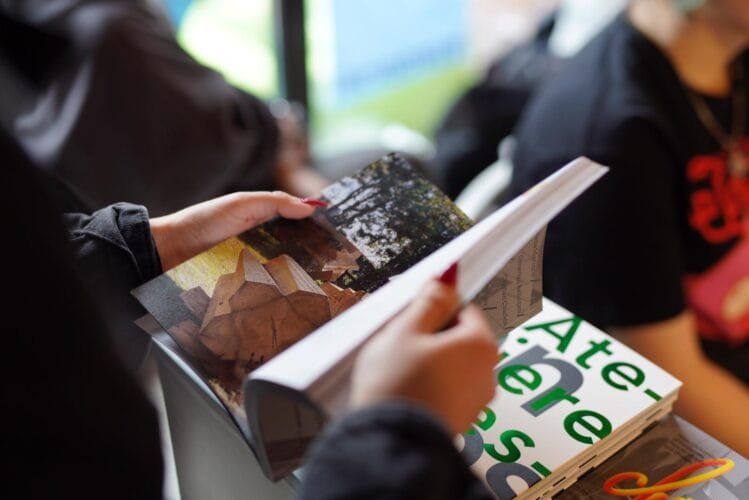
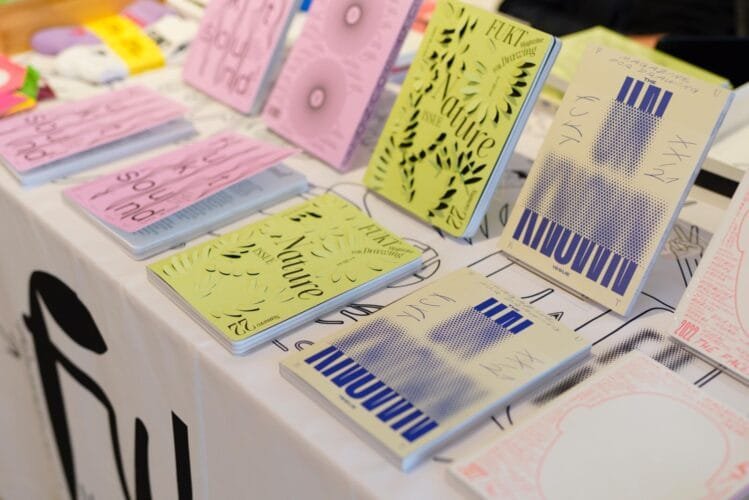
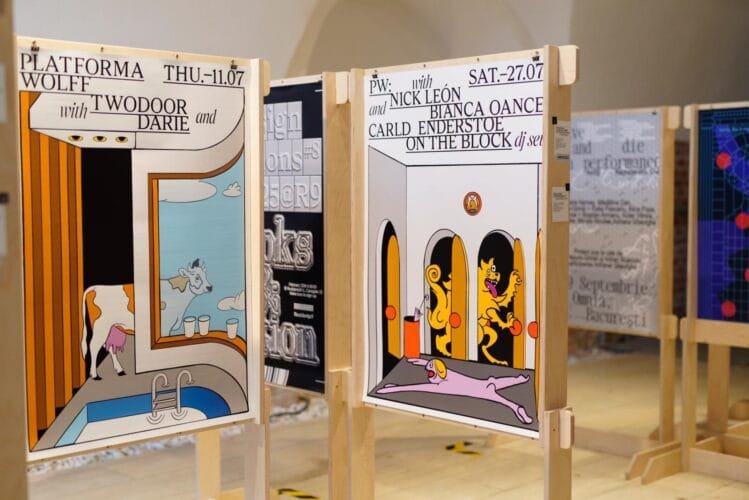
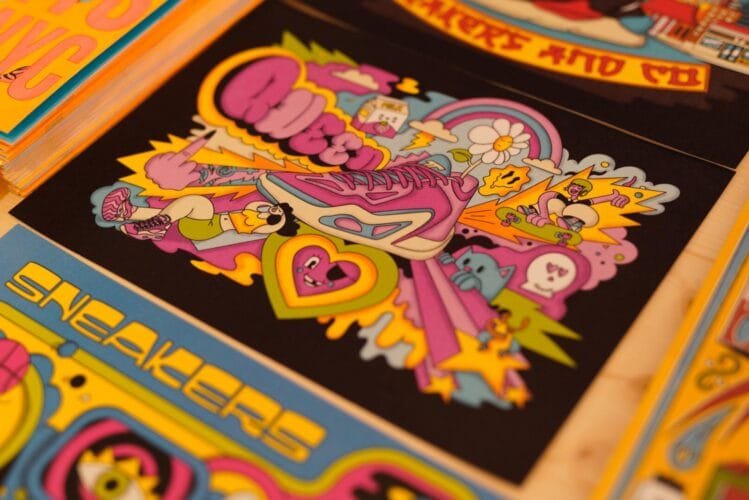
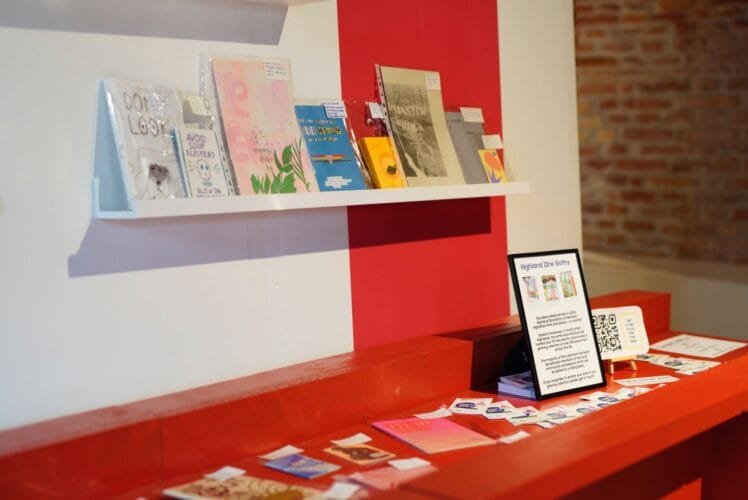
Sit+Read Artist Book Fair 2025 began for the general public on a Friday morning in October, with relatively cool weather and sporadic rain, perfect for a day of sitting and reading, like something out of a postcard. However, I believe that this year’s fair began on the last day of the 2024 fair; during this time, the event has grown in popularity and has become well known among those who print their art and books in studio apartments or small rented rooms, so much so that the end of October feels like a small celebration.
Speaking of beginnings, Sit+Read started in 2017, in a much more reduced form than it is today, with a visible focus on local artists and artisans. At a time when fanzines (small DIY publications, where the only rule was that you published without the backing of a publishing house) were not so prevalent, flo’ (Florin Fâra) was already organizing small similar fairs, under the auspices of The Secret Garden, directly linked to his own editorial project and, later, The Secret Garden Bookshop. I think it was at flo’ that I first saw a fanzine called a fanzine – because, according to him, people had been doing similar things for many years. It seemed natural to publish manifestos/texts/drawings in a magazine printed overnight at a photocopy shop, and what’s more, it was not only a cheap but also an effective way to show others what you were doing and what was bothering you. Perhaps more importantly, it is still a way to create contexts for action and discussion.
I first participated in Sit+Read when it was still relatively small, in a pub in Timișoara that unfortunately no longer exists, before the pandemic. Curious and somewhat fascinated by the objects I encountered, as time passed, I suddenly found myself more directly involved in 2022, when I was responsible for a publishing house’s stand. In 2023, I started to take care of the presentation program and, at times, the good mood of the participants. My curiosity turned into an obsession that I can’t even explain and, to a certain extent, I don’t even want to, much to the despair of my bookshelves, which are overflowing with books and booklets collected over the years. I also ended up producing my own zines, together with my colleagues from Balamuc and afterhoursworkclub, but I will speak here mostly from a biased position, as I am quite involved in the whole story, as well as from that of a collector, more than anything else.
I see the world of independent publications as another component of the art world, often easier to penetrate and interact with, because we are talking about a fairly long time that publishers spend with the object. The enthusiasm, which is easily transmitted, seems to push one to do something to make it happen. I don’t know what that something is, maybe it’s anything. The only rule would be printing, the only limitation would be paper. This world may seem totally parallel, because the limitations (or privileges) remain visible. Whether it’s access to various printing technologies, the types of discourse one adopts, sometimes even the methods of distribution and dissemination, things are not that simple.
I will not attempt to review the fair, as I would rather talk about what it means, as a creator of publications or as a member of the public, to actively participate with this world, and I will offer some example of editorial practices as seen in some of this year’s participants.
What I sometimes feel in the air at Sit+Read now, after this year’s edition, seems to me to resemble one of the events organized by Kuš! in Lithuania, an exhibition (which has traveled several times), “The Last Match,” which took place sometime in 2009. The premise of the exhibition starts from a question that is very familiar in our geopolitical space, from back then until now, although it may seem to carry more weight today. What do you do when you have no funds for an exhibition, even though you want to do something important and meaningful? A crisis solution emerges, where over time around 300 drawings the size of a matchbox have been collected, each attached to the wall with a match. I am often impressed by the determination of some to continue doing what they do, despite multiple obstacles, where today there is a lot of talk about the high costs of paper and transport. Books are becoming increasingly expensive and, as several participants noted, the work of publishers and creators is also expanding into the physical realm, moving hundreds of books from one place to another and from one fair to another.
Vlad Mihai from Paper Traffic made a remark in his presentation that I noted down, that we probably read at a speed proportional to each person’s potential volume of information accumulation. We read at our own pace and in our own time, and the inclination towards an analog medium of information dispersion also has the ability to slow us down a little. This heightened attention can also be a sign of concern for the object or receiver. The directions of communication are quite fluid and branch out easily anyway, and people are left to discuss or plan a possible future publication.
At a glance, it would seem difficult to understand why everyone continues to make their publications and prints. Sometimes the reasons are super pragmatic; when Woman Cave Collective started publishing Woman Cave Journal, they said that in France, when you want to put an ISBN on a personal publication, you actually have to buy a set of 10 numbers, even if you don’t need to use them all. It seems like a kind of self-imposed constraint, but they said they would publish 10 issues. However, there is another nuance to this anecdote, where they said that they are still waiting to put an end to the project, considering a much more visible repressive and violent wave coming from politicians and part of the public towards projects that are called feminist from the outset, a change that has occurred in the last 5 years that they did not necessarily expect. Independents feel the shifts in discourse with a particular sensitivity compared to those who play the more “official” game, so to speak; or perhaps they just perceive it more quickly.
I don’t think that a political-economic-cultural crisis is just a speculative fabrication, but rather a reality that is gradually unfolding and affecting us at different times, depending on the level of protection we have been able to build for ourselves. The crisis is also visible in museums and galleries; huge, white, sterile spaces with four or five images on the walls herald an imminent recession. These are experiences that hesitate to activate at a discursive level in the art world, in an attempt to preserve as much of their accumulated capital as possible.
I would not want to fetishize studio apartments, bedroom prints, cold workshops, or marathon editors, because I would risk casting a strange light on a kind of attitude toward work that could have long-term repercussions. Because, in the community of independent printers, so to speak, most of the work is done after hours. Nevertheless, they keep popping up, collaborating more and more and participating in events like this with greater determination. Timișoara is home to the only fair of its kind at the moment, and I think there are only a handful of printing houses that are open to experimentation. Only when you walk among the stands do you realize just how much more we could actually achieve and invest in this direction.
Fanzines and the communities that gather around them also have a social character, if we were to take stock of the multiple aspects we have already mentioned: work, time, community. Iona Gibson, the woman behind the Deziners online archive, is also one of the creators of The Highland Zine Bothy. A “bothy” is a type of shelter; it comes from the Gaelic word “bothan,” where such shelters came to be used in Scotland as refuges for workers on the road or in the field. This particular bothy was conceived as a social space, a place for co-creation and a fanzine library, outside the major centers. The classic fanzine model, a sheet of paper with a cut in the middle and folded like a magazine, becomes an interface, a medium of expression and communication for communities that would otherwise not have been able, or would not have known how, to communicate with each other and with the outside world – this is how some of these fanzines ended up being exhibited at Sit+Read this year.
I could not criticize such initiatives, nor could I easily describe them, make an inventory by days, events, launches. Sit+Read is a format that can exist anywhere, anytime, it does not depend so much on space or season. After a round of more visible editions, which also benefited from funding, I think we can figure out where we could go in the future if we join forces towards the same goal – at least that’s how it seems in just three days. If preparations for the next edition begin when the current edition ends, I think the harvest will take place on the first day of the next fair. Over the past few years, Sit+Read has created connections and friendships that have led to the emergence of other groups and projects, residencies, international collaborations, practice exchanges, internships, and so on. Those of us from the region (but not only!) meet here again to report back and catch up with our new friends. It is no longer just a place for the underground to hang out, but the discursive space I wanted, as well as a temporary place for the exchange of knowledge that can inform many other future actions. There are many economic and ideological obstacles that try to block the path of books, booklets, and fanzines, but even though they often succeed in diverting them, publishers, writers, artists, and printers seem to have the ability to adapt and reposition themselves in the world. I still believe that in a place like Sit+Read you can experience, for a moment, a more attentive and involved culture that takes risks and retains some of the enthusiasm of creation.
Translated by Marina Oprea


POSTED BY
Gavril Pop
Artist and cultural worker. He is part of the Balamuc and Indecis Artist Run Space collectives in Timisoara. He collaborates with independent spaces, foundations and artistic organizations, contribut...
Comments are closed here.