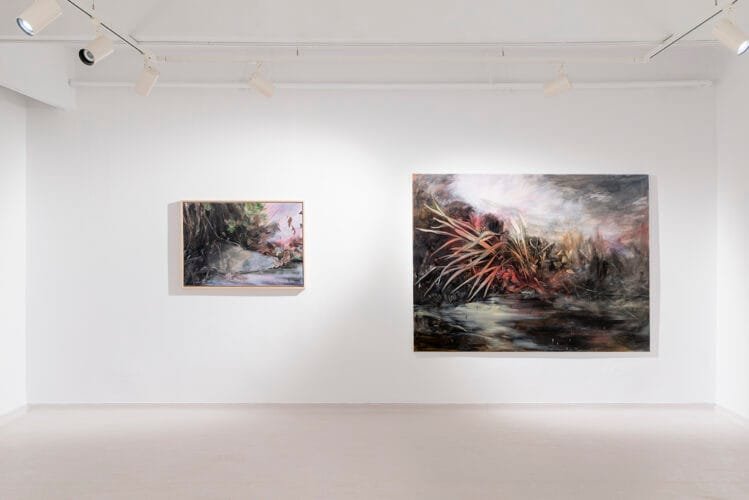
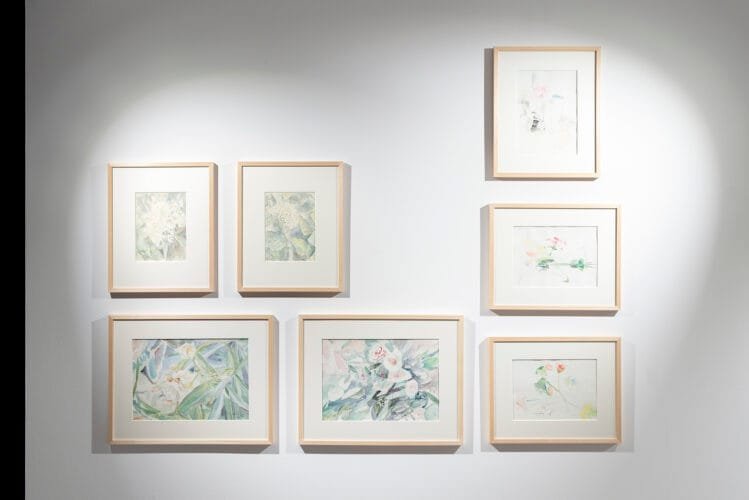
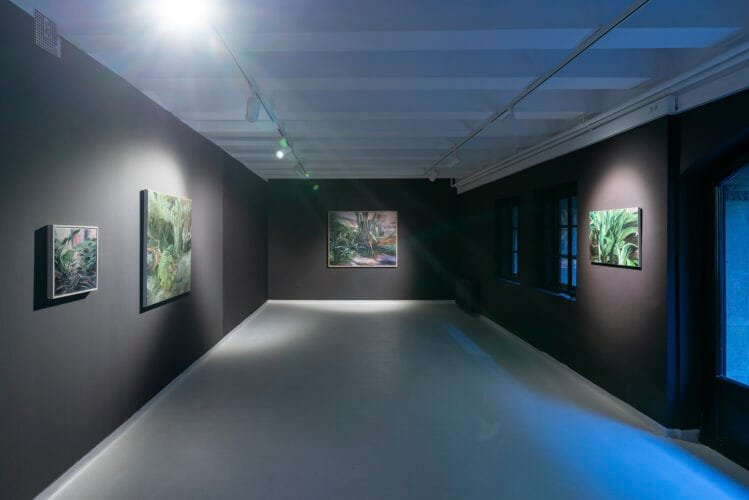
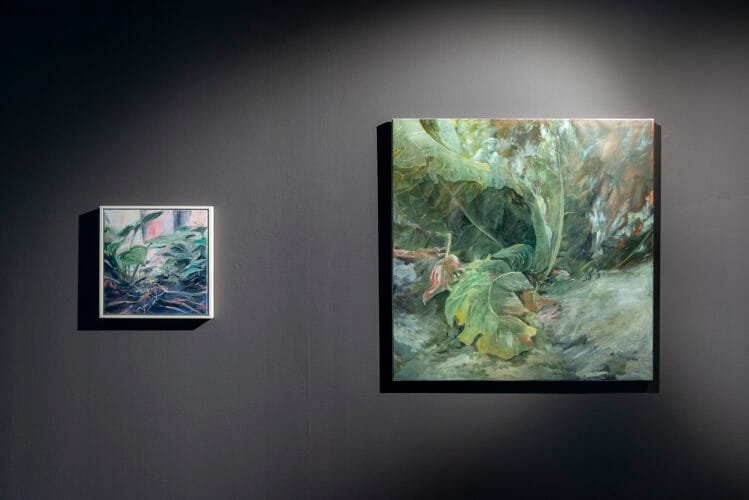
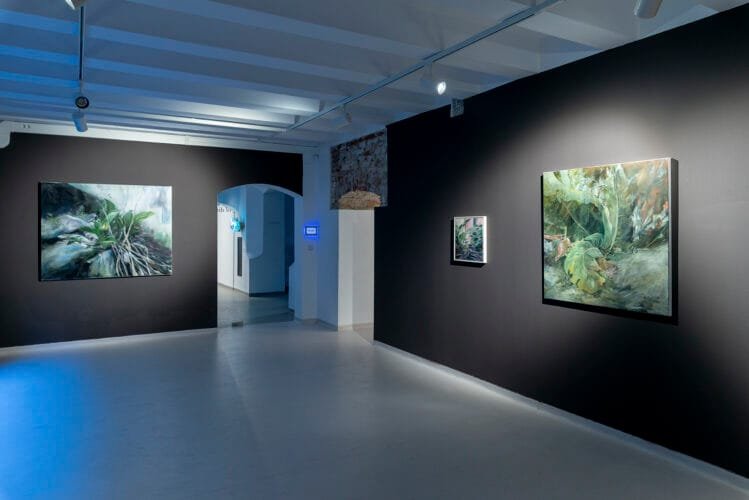
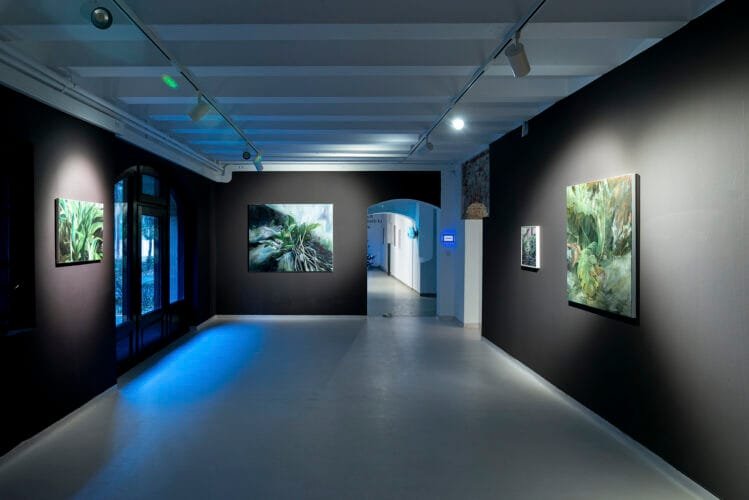
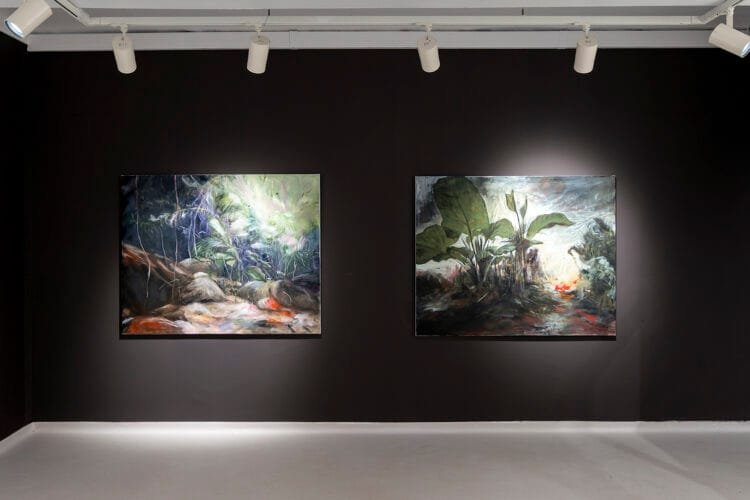
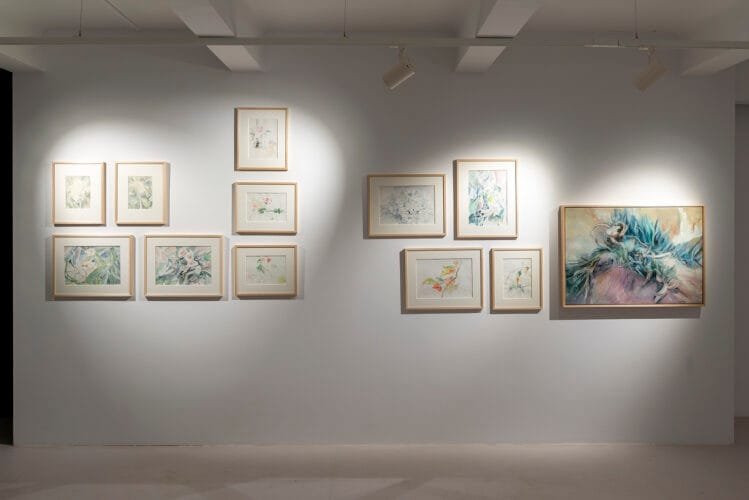
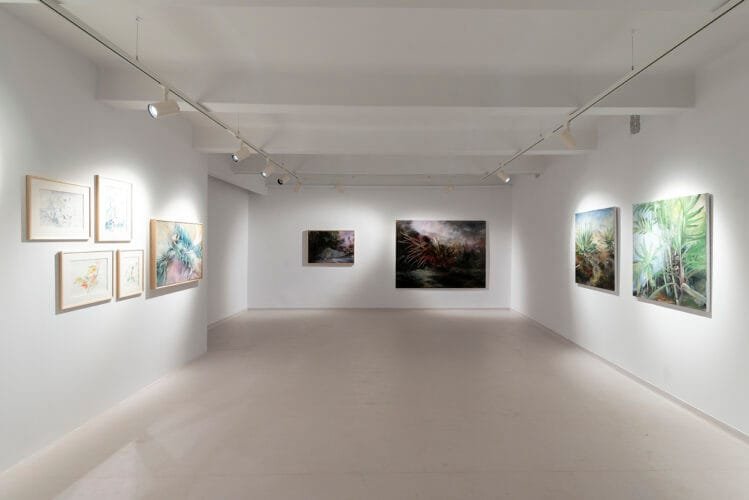
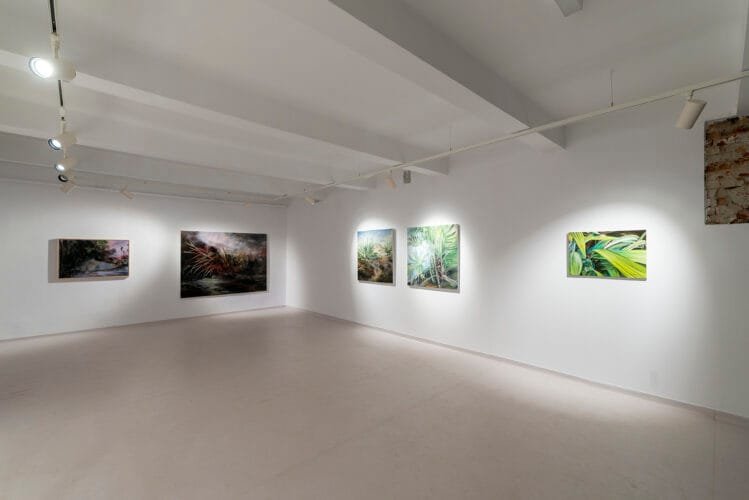
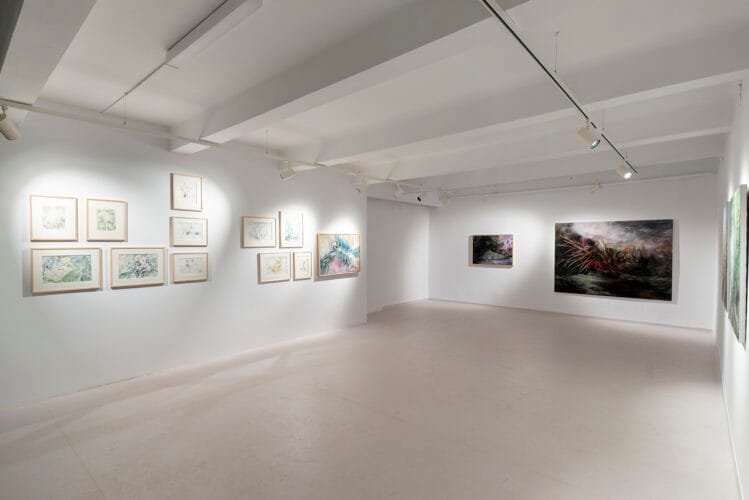
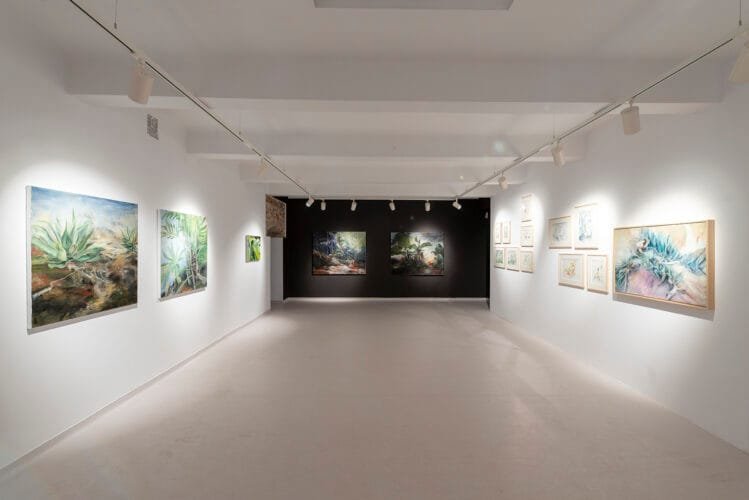
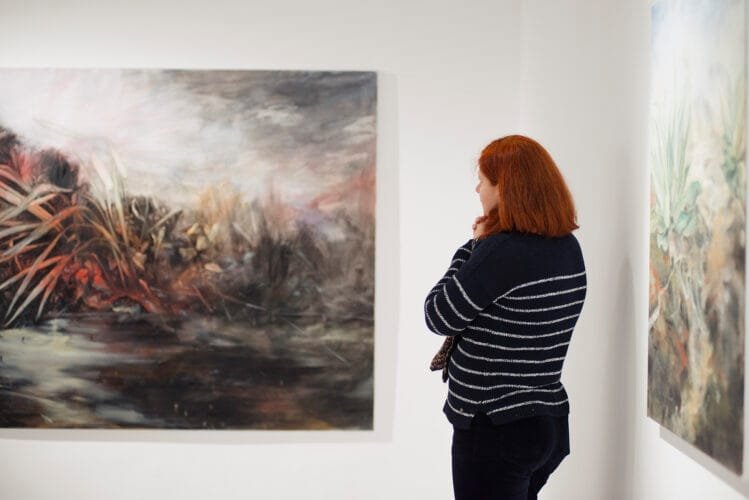
How do we relate to the environment in the 21st century? What is our view of nature? To what extent does ecological anxiety influence our daily decisions and lifestyle? Are we willing to reevaluate our relationship with other beings on the planet? Can we pay attention to other species and learn from them? Is it possible to shift our perspective so that we replace the hierarchical relationship between humans and other living beings with cooperation based on respect, for a healthier and safer shared future? These are the questions posed by Uliana Gujuman’s solo exhibition, “Random acts of disappearance”, which, through a dialogue between temporal planes and modes of representation, creates a sensual and hypnotic visual language of plants, drawing on personal memories and a utopian vision of the future. The exhibition can be visited until February 15, 2026, at the META Spațiu Contemporary Art Gallery.
Uliana Gujuman was born in Chișinău (Republic of Moldova) and moved to Timișoara in 2009 on a scholarship; since 2014, she has lived in Zetea (Harghita County). The diverse flora and fauna of the quiet and picturesque rural environment, as well as the attentive and caring attitude of the locals toward the environment, have been one of the fundamental sources of inspiration for the artist’s depictions of nature. Her observation and in-depth study of plants also intrigue her, as her doctoral thesis, Nature and the Imaginary in Painting (West University of Timișoara, Faculty of Arts and Design, advisor: Assoc. Prof. Dr. Daniela Catona), focuses on this theme.
The artist captivatingly experiments with various techniques for depicting plants, approaching and recreating their appearance from multiple perspectives. Some of her compositions bear the mark of the Impressionist style. Examples include her paintings Strawberries (2025), The Nameless Place (2025), and Armoracia Rusticana (2025), whose elegant brushstrokes, dreamlike atmosphere, and delicate textures capture the grace, fragility, and sensual beauty of nature.
These works contrast with the artist’s creations that deconstruct and then abstractly reconstruct the layered structures of roots, leaves, and petals, creating an infinity effect (Nocturne, 2025; Scorching Heat, 2025). The exuberant plants symbolize nature’s power and perseverance, as well as its intelligent mechanisms of adaptation and survival. All of this also conveys a powerful ecological message. Instead of depicting the potential consequences of harmful human activities by portraying a post-apocalyptic, desertifying environment, Gujuman shows what Earth would look like without our species. Rich, lush, and vibrant vegetation would eventually reclaim the areas occupied by society, reborn from the abandoned ruins of a civilization destroyed by its own hand. Ultimately, we would be the ones to lose the most due to the exploitation and complete depletion of our environment, as nature is far more capable of regeneration than the human species.
However, the act of disappearance and elimination does not refer to an aggressive invasion seeking to dominate humanity. On the contrary, it symbolizes the gentle and creative power of our planet’s flora, which, like the works in the exhibition, invites us on an immersive journey, drawing us into its mystical and serene world. The works thus offer visitors the soothing catharsis of reconnecting with nature and invite them to engage in a meaningful dialogue about the current situation. The search for a respectful and symbiotic coexistence is the common interest of both human and non-human beings. “In Gujuman’s view, disappearance is neither a loss nor a defeat; it is a form of integration, humility, and, at times, protection. It reflects a way of living in the world that does not impose itself, but participates in it, allowing other forms of life to express themselves, grow, and flourish.” (Stoeac-Vlăduți 2025)[1] This symbolism can also be seen in the “coexistence” of native and exotic plants within the exhibition space, which, by creating a harmonious hybrid environment, underscores the importance of natural diversity.
Heterogeneity is also evident in the color palette used in the compositions. On the one hand, the monochromatic appearance of the pale white hues in his paintings symbolizes the delicate charm of flowers. On the other hand, it refers to their ability to hide, to blend into the surrounding environment, and to assimilate. Next to these creations is the work Scorching Heat (2025), which, on the contrary, draws attention with its bold tones. The bright turquoise, mysterious violet, fiery orange, and lush green counterbalance and complement the message of the previously mentioned images, emphasizing that behind the fragile and ephemeral beauty of flowers lies a power that should not be underestimated.
The exhibition also features works (Il Giardino, The First Humans, Raw Green; 2025) that surrealistically amplify the appearance of certain species, introducing viewers to the mysterious microcosm of plants as insect-sized beings. On the one hand, this may refer to the evolutionary phenomenon known as Foster’s law, which states that small animals on islands tend to evolve into giant versions, while large animals tend to evolve into dwarf versions of their mainland relatives. On the other hand, the reversal of sizes and roles highlights the vulnerability of non-human entities to human tendencies toward exploitation. “The artist frames disappearance as a profoundly ecological gesture: a way to reconsider our size, importance, and impact. It is an act of stepping back so that other presences may come to the fore.” (Stoeac-Vlăduți 2025)
Some of her works examine the structural composition of flowers with botanical rigor and meticulousness. “By amplifying botanical detail until it dissolves into a dense structure of forms, Uliana Gujuman constructs a perceptual space that demands active engagement of the gaze.” (Stoeac-Vlăduți 2025)
The artist creates spaces that lie on the threshold between imagination and reality, between the artificial, urban and natural environments, which she calls “impossible landscapes.” In this context, the title and theme of the exhibition may also refer to the blurring and disappearance of boundaries, where places imbued with nostalgia and brought back to life from the artist’s memories merge with fictional landscapes drawn from her imagination. Consequently, in her works Steps (2025) and Desert Flowers (2025), the objective precision of scientific observation intertwines with the visual poetry of admiration for the power and beauty of nature. In her artistic universe, we can admire “[…] staircases covered in vines, the accidental greenery of abandoned buildings, patches of vegetation sprouting through the concrete in crowded public squares.” (Stoeac-Vlăduți 2025)
The representational strategies of 19th-century Romantic landscape painting degraded and reduced nature to the role of scenery and a background element, whose sole “function” was to be discovered and conquered by patriarchal society. Similar representational techniques were used in the portrayal of women and the female body, largely mystifying them as muses or dehumanizing them as decorative objects. Gujuman’s works invert this perspective, in which plants become equal partners of the viewer. “The plant is no longer a passive backdrop, but a protagonist, architecture, and myth.” (Stoeac-Vlăduți 2025) All of this can be approached from an ecofeminist perspective, as femininity, the gentle yet determined feminine force, is often associated with nature’s independent and self-organizing system.
The curatorial text also reveals that the artist’s choice of theme was inspired by a deeply personal and intimate experience, one that dates back to her childhood. When she revisited her family home, abandoned for years, she was shocked by the terrifying yet utopian sight of overgrown plants. She was fascinated by the gentle yet determined way in which nature had reclaimed and recreated its own spaces. Furthermore, the structure of the sprawling, rhizome-like roots and the layers of plants “written” one over the other like a palimpsest can symbolize the connections and associations within memory. All of this reminds me of the nostalgic, impressionistic atmosphere in Marcel Proust’s novel In Search of Lost Time [À la recherche du temps perdu], in which nature can be interpreted as a mirror of human experience and the passage of time.
It is also interesting to observe how the artist captures other elements of nature and their impact on our ecosystem. In some of her compositions (Roads, Landmark; 2025), the delicate, rosy hues of the sunset create the atmosphere and mood of an idyllic setting. In other paintings (Sunset, Acui; 2025), however, the bright red light filtering through the background creates a much more oppressive and unsettling effect. All of this may refer to the dual nature of sunlight, which can be soothing and nourishing, yet also threatens us with global warming and desertification as a result of harmful human activity. In this way, the works also remind us of our decisions and responsibilities that affect the future of humanity.
The exhibition “Random Acts of Disappearance” does not offer a romantic, escapist refuge to avoid reality, but rather highlights the astonishing richness and diversity of an independent entity, a “parallel universe,” which we still often regard as merely a biological backdrop. At the same time, Gujuman’s intelligent and sophisticated communication strategies are not based on spreading fear, nor do they illustrate the consequences of harmful human activities. Rather, they draw our attention to the world in which we could live if we focused more on inclusion, respect for other beings, and reducing our ecological footprint.
„Uliana Gujuman: Random acts of disappearance” curated by Mirela Stoeac-Vlăduți, took place at META Spațiu, Timișoara, during 11.12.2025−15.02.2026.
[1] Fragment from the curatorial text
Translated by Marina Oprea


POSTED BY

Yvett Toth
Yvett Toth was born in Arad in 1999. She earned her bachelor’s and master’s degrees in Hungarian and English language and literature from the Faculty of Humanities at Babeș–Bolyai University in...