Two years after the publication of Costică Brădățan’s book, In Praise of Failure. Four Lessons in Humility, winner of the PROSE Award in Philosophy and nominated, in Vlad Russo’s translation, for the Monica Lovinescu Prize (Spandugino Publishing House, 2023), Cristina Vasilescu curates the exhibition “I Still Wonder,” which, like Brădățan’s highly topical book, was born out of an intense reflection on the experience of failure. “Failure is essential for us as human beings,” writes Brădățan. “Failure puts a distance between us and the world, as well as between us and others; a distance that gives us the acute feeling that we are inadequate, that we are not in sync with the world and with others, that something is out of place.” As if to illustrate this analysis of failure, Cristina Vasilescu chooses seven artists who approach this phenomenon, which, as Brădățan writes, “defines us,” from different and surprising angles. However, the title of the exhibition is not inspired by Brădățan’s book, but by art critic Jerry Saltz’s article, which reflects on his past as a “failed” artist (My Life as a Failed Artist), asking the question: “I still wonder: was I fated by my upbringing to failure?” A question that Cristina Vasilescu would rather replace with: “I still wonder: what would have happened if I hadn’t let myself be discouraged by my failure?”
Illustrating the performative power of failure, which triggers doubts, revisions, and processes of conscience in us, the exhibition “I Still Wonder” leaves open a series of questions, the most serious of which seems to be this: how can we forgive ourselves for our failures in a society willing to accept all our eccentricities, provided they guarantee success? Once freed from academicism, traditions, and canons, in a world where failure (in this case, artistic or intellectual) has lost the self-sacrificial and heroic aura it held in the “damned” art of the 19th century, what can we do to help ourselves forgive our failures? And how can we make the most of them?
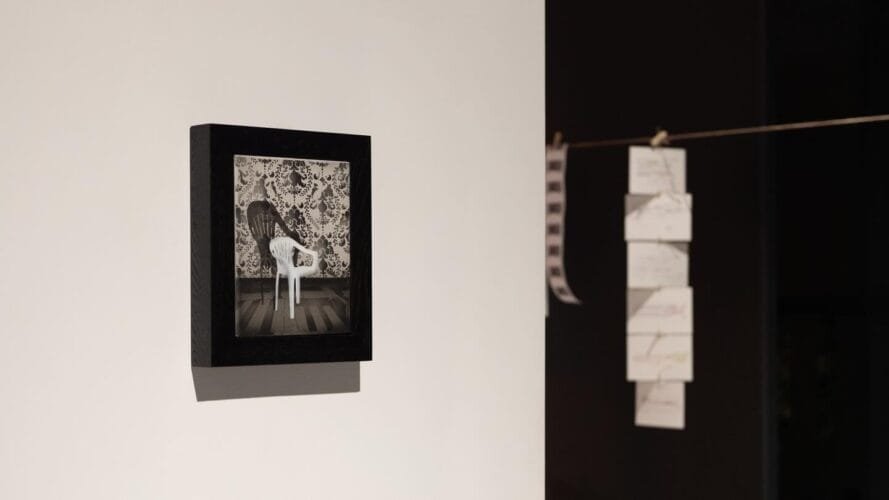
Not only do the answers vary from artist to artist, but – and this is even more interesting – so does the phrasing of the question itself. As if to open up a landscape where the specter of this question can haunt freely, Tudor Ciurescu’s airbrush paintings depict unsettling spaces, sometimes angular, sometimes extending toward low horizons as in metaphysical surrealism, populated by figures or props whose narrative context we do not know – spaces undermined by elements of Magritte-esque anti-physics (a fully functional lace chandelier) or alienated cinematic references (as in Untitled [after Tarkovsky’s Andrei Rublev] or Five Legged Horse, which reminded me of a scene from Weerasethakul’s Uncle Boonmee).
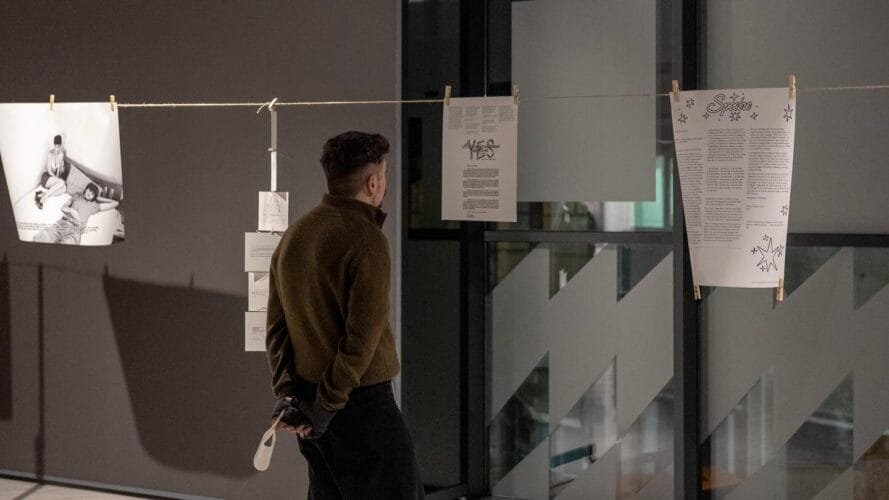
The most direct and offensive forms of failure – rejection and blame – are embodied in the installation by the Sleepy Press duo: Lucia Holásková and Marta Lopes Santos, who, following an open call, collected negative responses (the dreaded rejections) to applications, discursive venting documents, testimonies of historical injustices, and poems that redeem failed endeavors through aestheticization. Clamped with clothespins on a clothesline that runs from one end of the exhibition space to the other, these Letters of No, whose pain and frustration have not been “washed away,” are like the proverbial dirty laundry exposed in public with “no shame”—a therapeutic “shamelessness” since the humility recounted and shared loses its weight, becoming, through correction, reinterpretation, sublimation, a work of art. Compared to the losers’ satisfaction, who know they are fulfilled in a way that is immeasurable by the winners’ standards, the latter’s success becomes derisory, reduced to “some sort of fulfillment,” as one of the voices in the installation venomously and condescendingly wishes the arrogant executors of common opinion.
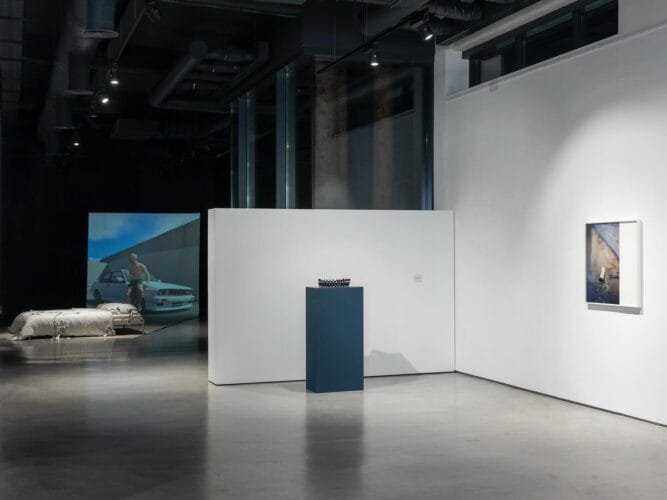
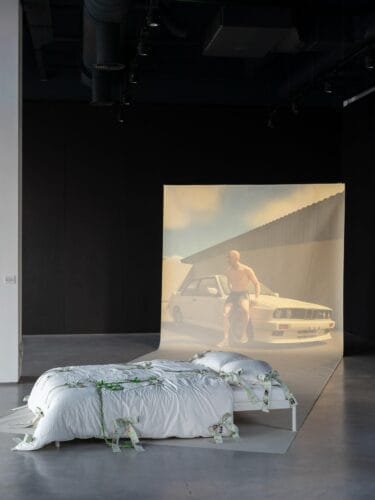
Turning the tables, Aurora Mititelu recounts her romance with Abel, who is none other than herself in a male version, in an installation that imagines the perfect relationship with her own “opposite” gender. Abel is a homunculus in line with the romantic ideal of achieving perfection through artifice. Like the creature in Frankenstein or the character in Faust II, Abel is also the product of cutting-edge science, in this case generative Artificial Intelligence, as a kind of modern equivalent of alchemy. The paradoxical encounter with romanticism in this project also occurs through the motif of weariness and dissatisfaction with the present, with the aggressive heteronormativity of traditional society, in this case Eastern European, which justifies escapism towards perfection and the “romantic” ideal. But this is the point where the exacerbation of idealism turns self-ironically against itself. Less unpredictable than his alchemical counterparts, Abel is programmed from the outset to limit his reactions to a sphere of options which, although infinite in number, respond to limited expectations. On the other hand, as it is mediated by the social network – visitors are invited to communicate with Abel via a telephone provided on a generous matrimonial bed – the perfect relationship with Abel raises questions about the degree of fictionalisation that any human relationship reaches when its preferred sphere of communication is restricted to the digital environment.
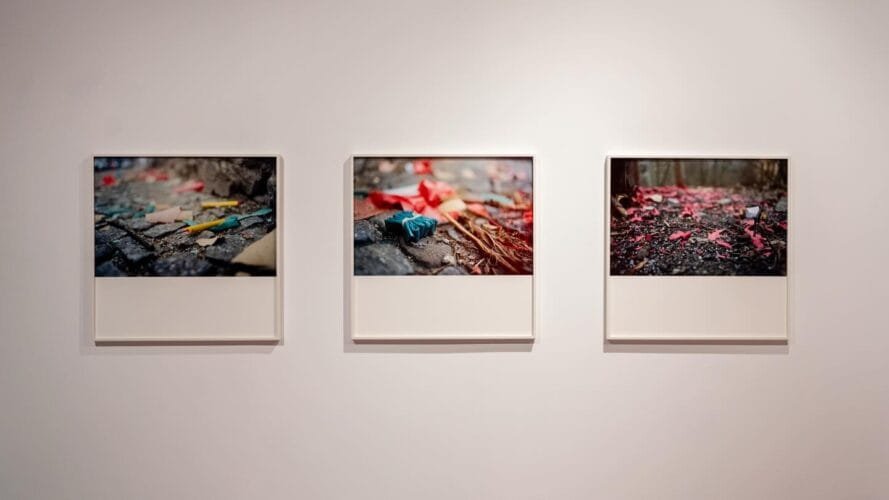
The series of works by Christian Jankowski takes us into the realm of metaphor. The issue of failure is transposed here into the realm of artifacts, and can then be enriched with an allegorical message and redirected towards the human realm. Responding to an invitation from the Welt am Sonntag newspaper, on January 1, 2000, Jankowski photographed firecrackers thrown on New Year’s Eve that had failed to explode. The series Millenium Duds thus explores the tension between function and its non-realization and stages the almost personified solitude of the artifact that has failed in its purpose, that has refused to participate in the general euphoria of the night with its supposed eschatological connotations and that could explode in your face at any moment — a frightening prospect that the enlarged close-ups of the photographs make full use of.
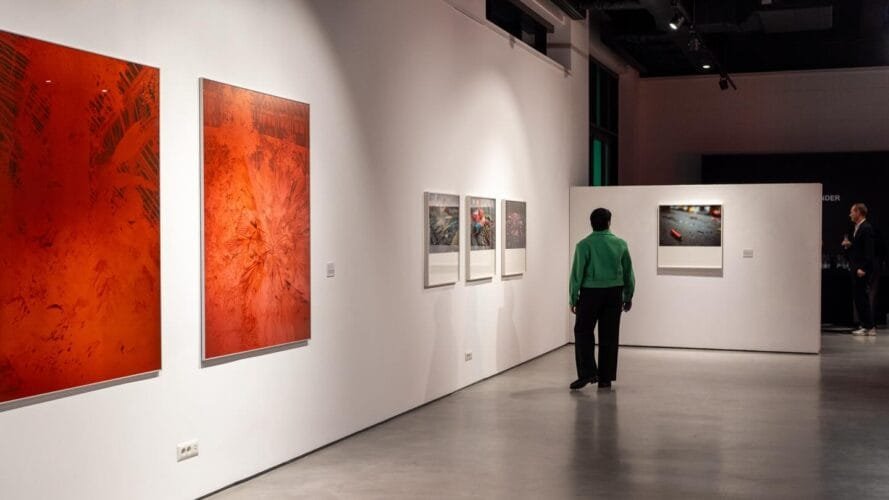
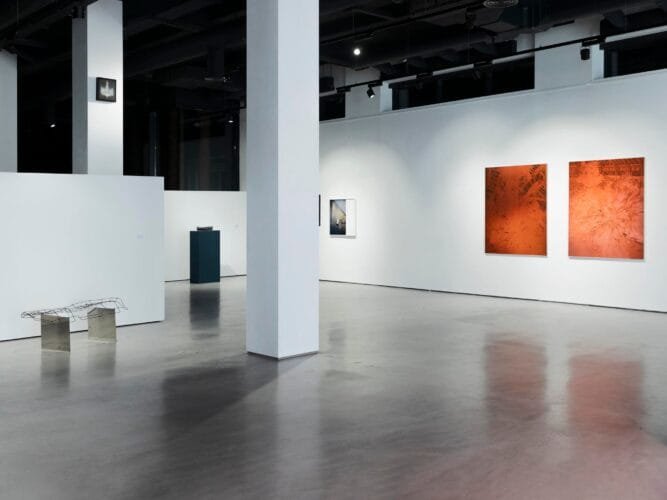
Lucian Bran’s works, Thermscape 56C41 and Thermscape 56C43, raise the issue of failure to a hyper-personal level, approaching it from a global perspective. Developing photographs taken in various greenhouses across Europe at 56º C subjects the film to thermal stress that transforms the green hues of tropical vegetation into shades of red. In nature, at this temperature, plants cease to photosynthesize. Photography, a traditional vehicle for evoking the past, thus becomes, in Lucian Bran’s hands, a souvenir from the future, capturing the moment when man-made global warming will reach the proportions of an infernal combustion. The viewer of his works finds himself in the position of a post-apocalyptic subject contemplating his own drama, as if it had already taken place.
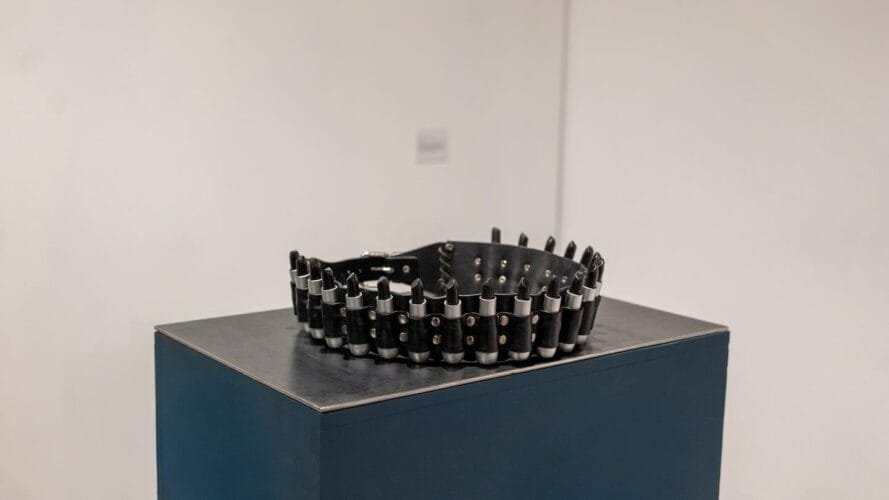
With Ilena Pașcalău’s work Suits you well, we enter a clearly feminist territory. Inspired by the artist’s grandfather’s hunting bandolier, the work explores, through Magritte-esque humor and the alienation of the object’s functionality, the transition from the anecdotal to the political, from irony to alarm. Replacing the bullets in the bandolier with black lipsticks is not simply substituting one weapon for another, in the facile sense of “femme fatale,” but rather re-semantizes the very notion of a “lethal weapon.” Like Banksy’s bouquet of flowers, which, although thrown with fervour, does not destroy, these weapons hit their target but do not kill. Instead of explosives, they carry a message. In fact, it is not the weapon that is important, because it will not hurt anyone. What is important is the force with which this non-lethal object is sent to its target.
Through these explorations, Cristina Vasilescu creates a veritable compendium of “failure” and its semantics. The message that seems to emerge from this compendium of divergent meanings is perhaps that no failure is definitive. Art refuses to give failure the last word. Does art then have the last word? Certainly not, because art never has only one thing to say.
Translated by Marina Oprea


POSTED BY
Gheorghe Pașcalău
Gheorghe Pașcalău (born 1984) studied philosophy and Greek philology at the universities of Bucharest and Tübingen. His doctoral thesis, written at the University of Heidelberg (2016), deals with N...