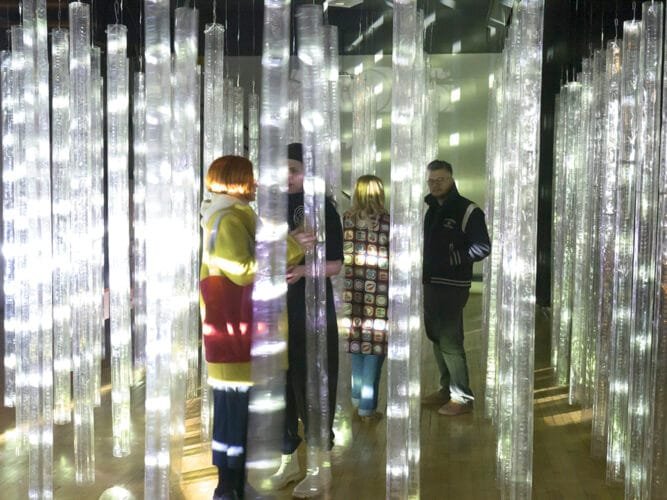
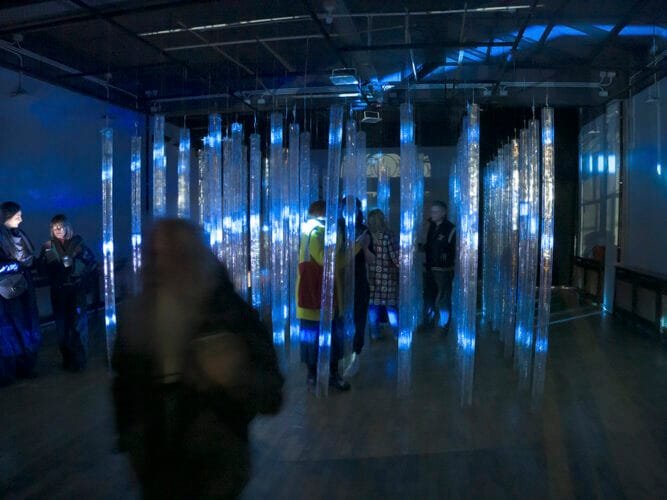
In the midst of an ecological crisis and within a socio-political context hardly favorable to nature, where real estate interests mutilate parks and eradicate the last patches of greenery in a captive city like Bucharest, artist Sergiu Chihaia and curator Mihai Zgondoiu propose an authentic eco art project at Atelier 030202, Grow your own forest, an endeavor that blends a critical dimension with a poetically expressive one.
While this approach proves exemplary of the current paradigm, marked by interdisciplinarity and the blurring of boundaries between mediums, genres, and artistic species, these two renowned actors of the local scene embody, in their own right, the traits of the dynamic contemporary artist. Such an artist simultaneously assumes the roles of curator, professor, agent of informal education, and social commentator.
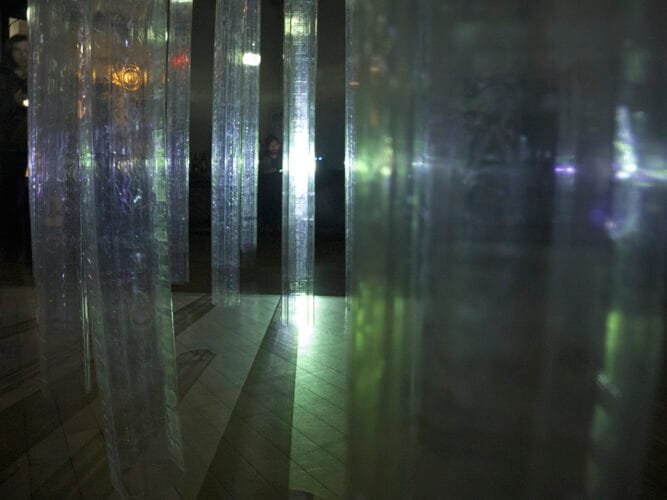
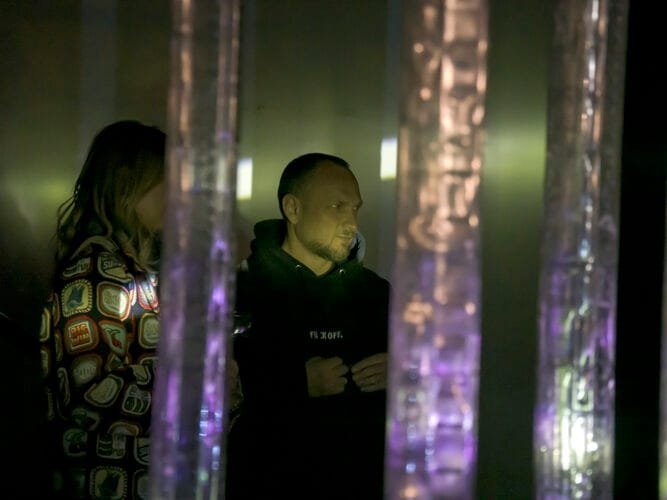
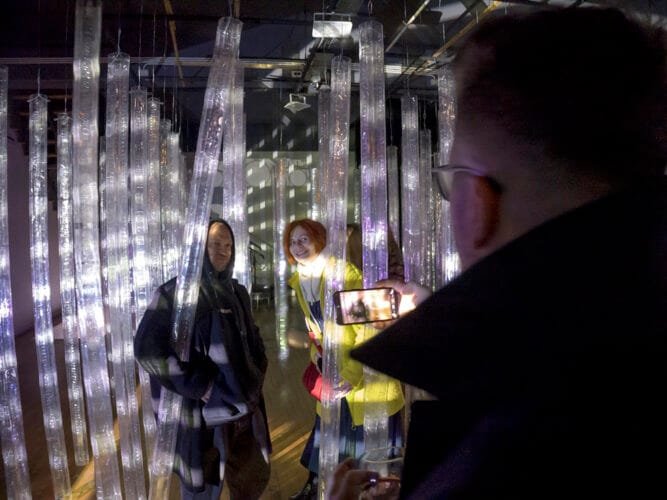
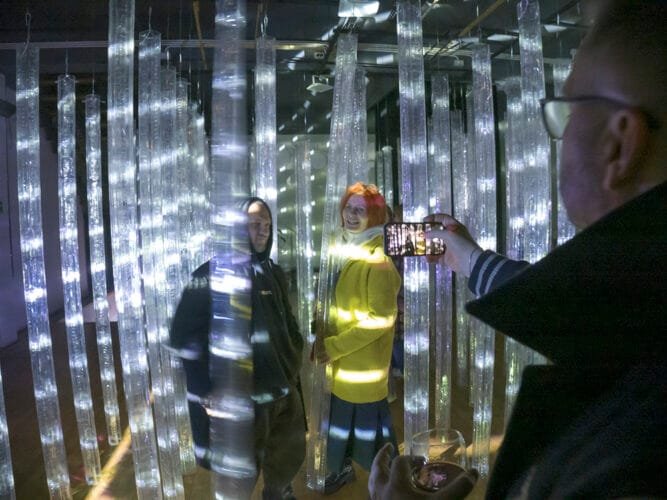
Sergiu Chihaia, one of the most highly regarded fashion design professors at the National University of Arts in Bucharest, who proposes to his students, from their very first year, not only lessons on form but also research themes related to the recycling of fashion and waste, transposes this consistent and lasting interest into a personal contemporary art project: an artificial forest, whose uprooted trees, built from plastic bottles, hang from the ceiling. The audience can wander among them, touching their cold, somewhat repulsive plastic flesh, and can contemplate their transparency, weightlessness, and sheer lack of core and materiality. This very lack, however, facilitates the interplay of projection mapping across their bark, created by Răzvan Pascu. It features green iridescences that reclaim the nonexistent sap within, shining fascinatingly in the dark to electronic rhythms that flawlessly capture the intense, yet at times melancholically resigned, trepidation of our current times.
As the artist recounts, plastic is by no means an appealing material for the eye or the hand. Even though its lifespan is virtually infinite, its initial period of brilliance fades quickly, wrinkles and a dull, dusty appearance set in early. Its touch is hollow and indifferent. Unlike wood, stone, and other natural materials, working with it is rather tense, disagreeable, and disappointing.
These impressions converge with the thought of Timothy Morton, for whom plastic represents the paradigmatic example of a hyperobject: an entity distributed on a planetary scale, whose microparticles already penetrate seas and oceans, birds and fish, influencing the metabolism of all living organisms. It is an entity for which the idea of death loses its meaning, thus establishing its own regime of time: a long, geological time in the face of which lived time, the subjective duration of a life, becomes completely insignificant.
We are confronted with the new ontologies of objects and with a materialism that celebrates the enchanting yet terrifying power of things, the vibrant force of matter (Bennett), and the establishment of an ultimate era of strangeness, of that uncanny theorized by Freud at the beginning of the 20th century, which has been brought back into discussion not only by the cyborg revolution and artificial intelligence, but also by the strangeness of nature altered by the ecological crisis. Initially associated by Freud with mechanical dolls or amputated limbs that move on their own, with that dose of unfamiliar weirdness slipping right into the heart of the familiar, the aesthetic category of the uncanny perfectly captures the ambivalence of a plastic infiltrated not only in our most intimate proximity, encompassing clothes, household items, the banal transparent bottle of still or mineral water, rubbing alcohol or cheap vodka, but also, more recently, within the consistency of tissues, in blood and breath, in breast milk and sperm.
In this context, the artist’s statement that the material does not attract him as a material becomes entirely pertinent, as he can hardly wait to get rid of it and work with wood or stone. What stops him, however, is the fact that he feels the project is not yet finished, that he has a duty to continue it.
The question regarding the power of fascination of hyperobjects such as plastic, but also of the installation itself, remains open. How can a discourse of ecological critique become aesthetically appealing? One possible explanation would point to the aesthetics of ugliness, to that tradition which legitimizes the agreeable representation of repulsive things – death, disease, disasters, or monsters – accepted ever since Kant’s era. And yet, what happens here surpasses simple individual contemplation, as it cannot be associated with calm and aesthetic detachment.
In the case of the Grow your own forest installation, fascination is built rather as a bodily experience, which combines the act of seeing with movement and participation. It is linked, first and foremost, to the immersion of the space in darkness and to the rhythm of the mapped projection onto the transparent, artificial trees, which are alternately illuminated and “X-rayed”. Added to this is the immersiveness and the careful manner in which the artist and curator have worked with the space, occupying the entire hall of Atelier 030202, at the entrance of the Comedy Theatre, with suspended trunks that are impossible to avoid. An essential role is also played by the mixture of playfulness and interactivity, the possibility for the audience to stroll, in groups, through this forest, touching and swaying the almost weightless trees with a minimal impulse.
Therefore, the power of attraction does not derive solely from the choice of a highly topical subject, but also from the adaptation of the means to a participatory, playful, and simultaneously critical artistic program, capable of bringing socio-political themes into discussion through poetic means. The structure of the work, as well as the profile of the actors involved, including the curator’s openness towards the realm of theater and literature, places the endeavor in the proximity of those practices that fruitfully explore interdisciplinarity and intermediality. In this sense, the installation does not merely represent the ecological crisis, but renders it sensible on a perceptual and bodily level, transforming it from an abstract discourse into a direct experience that is difficult to ignore.
Translated by Dragoș Dogioiu


POSTED BY
Raluca Oancea
Raluca Oancea (Nestor), member of International Association of Art Critics (AICA) and European Network for Cinema and Media Studies (NECS), is a lecturer at The National University of Arts in Buchares...
www.Dplatform.ro