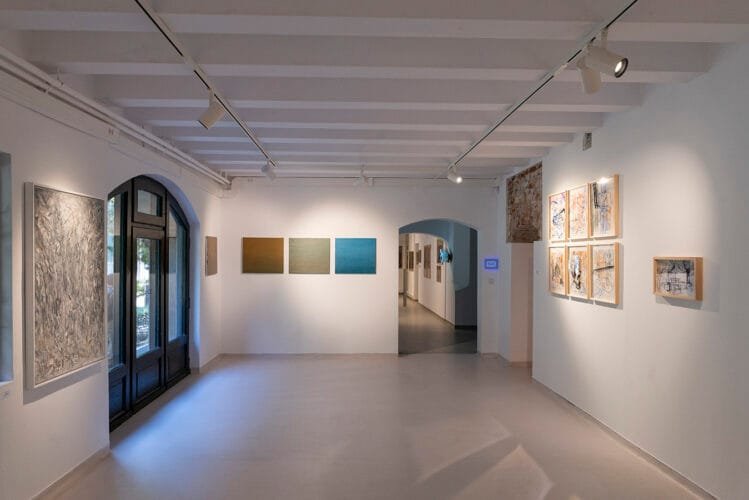
By what means can absence be represented in art? How does this aspect influence the interpretation of presence? How can an image be captured using only the language of textures? What artistic techniques can be used to create a connection between the dimensions of the spatiotemporal continuum? These are the questions posed by the NOIMA group (Ciprian Bodea, Dan Gherman, Cosmin Frunteș, Andrei Rosetti, Sorin Scurtulescu) exhibition, titled “Index of Absence,” which, drawing on the pair of semiotic concepts “sign” and “signified,” combines painting, installation, and performance to initiate a dialogue between the traces left by a past presence and the subsequent ways of interpreting them. The works also explore the possibilities of visually representing absence and the procedures for framing it. The exhibition can be visited through August 1, 2026, at the META Spațiu Contemporary Art Gallery.
Ciprian Bodea’s series of paintings, named ORGANIC GEOMETRIC, Organic Geometric, No title (2017–2025), draws attention to the plurality of possible interpretations, showing how absence destabilizes the elements of presence within their traditional interpretive frameworks. The works in this series are based on a dual dynamic of deconstruction and reconstruction of the image, offering the viewer the opportunity to explore them in a random order. One of the works’ components is a floral structure, broken down into geometric shapes—pentagons—after which the layers are gradually built upon the surrounding elements, progressing from abstract to figurative representation. However, what makes the composition particularly captivating is the fact that the beginning and the end are interchangeable. Thus, when viewed from a reversed perspective and chronological order, the work can also be interpreted through the lens of the aesthetics of death, withering, disintegration, and decadence. For me, all of this evokes the poetry collection Les Fleurs du mal (The Flowers of Evil, 1857) by Charles Baudelaire, one of the leading figures of 19th-century French Symbolism, in which the poet addresses, in a bold, grotesque, and bizarre style, the taboo themes of spiritual emptiness, loneliness, and decline.
However, the series of works can also be approached from a much more positive perspective, as the infinite variability of the mosaic-like fragments can symbolize the cycle of nature and rebirth. Furthermore, the paintings, which engage in a captivating dialogue with the canvases—which themselves take the form of a pentagram—are reminiscent of the inkblots in the Rorschach test used in psychological methodology. Through the process of playful association, all of this also reveals the plurality of different layers of visual meaning: beyond the obvious image of flower petals, the silhouette of a group of people also emerges. On the one hand, this aspect may refer to the NOIMA creative community, and on the other hand, viewed from a more cosmic perspective, it may illustrate how everything in the world is interconnected and forms a network-like structure.
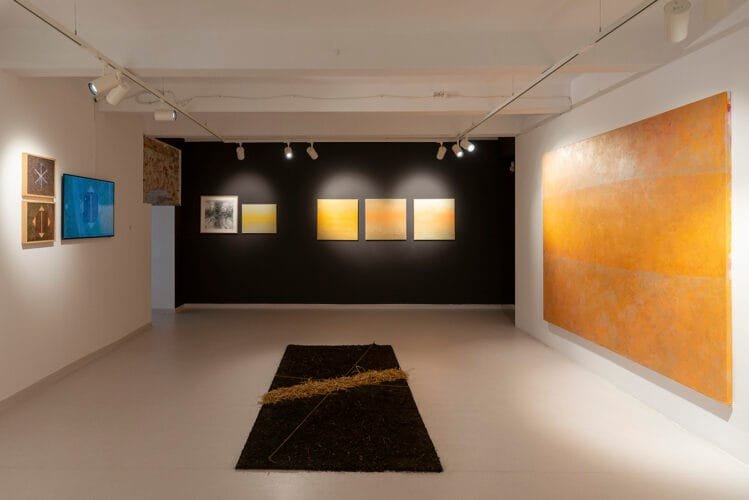
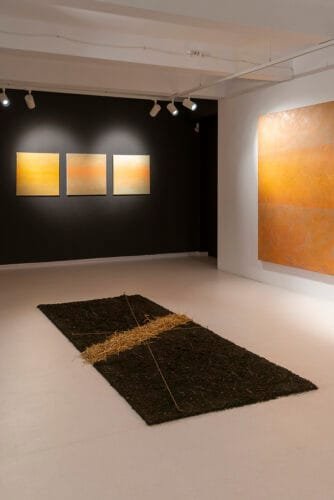
The images of Andrei Rosetti’s compositions[1] are accompanied by Robert Nedelcu’s spiritual musical backdrop, called Moog Matriarch (2026), so that the colors of the sunset become audible. A captivating synesthetic and multisensory experience emerges from this dialogue between the two media. The sunset phenomenon can stimulate philosophical reflection because, paradoxically, it brings together the unrepeatable uniqueness of a fleeting moment and the soothing stability of nature’s cycle. The ever-renewed yet familiar layering of colors and textures serves as a point of reference that offers a sense of security at any stage of life, creating a bridge between memories and the present, between our former selves and who we are today.
Sorin Scurtulescu’s series of works, IT Light I, II, III, IV (2016), mysteriously breaks down the natural landscape into its primary elements, encoded in the texture of the compositions. At the same time, beyond the deep earthy hues, the neutral and gray tones, and the layers of vivid blue, the atmosphere of entire ecosystems is revealed, bringing to life the harshness of the steppes, the illusory softness of the deserts, and the unpredictable waves of the seas. Furthermore, the title may suggest a much more scientific approach, as the works likely explore the metaphysics of light, which is not only responsible for the diversity of colors but has also played an important role in the development of various forms of life and habitats on our planet.
The artist’s other creation, Screen Ion Andreescu Winter (2021), can be interpreted as an imprint of the transitional state between the beginning and the end of the creative process, which, through its overlapping layers resembling a palimpsest, roughly presents the stages of the entire process and the compositional variations that blend together. Furthermore, the work pays homage to the oeuvre of Ion Andreescu, while simultaneously reinterpreting the creative vision and techniques of the 19th-century Romanian Impressionist painter.
Cosmin Fruntes’ compositions experiment with the spatial and temporal multidimensionality of visual perception, often evoking the sensation of an optical illusion. His monumental work, Shelter (2018–2024), appears to be a two-dimensional composition when viewed from a distance; in reality, however, the work straddles the boundary between painting and installation. This is because Frunteș has integrated a three-dimensional metallic element into his composition. In this way, the work encodes numerous captivating layers of meaning. On the one hand, it challenges the viewer’s perception of reality, illustrating in a meta-reflexive manner the contextualizing nature of art and its capacity for continuous reinterpretation. On the other hand, his integration of inorganic materials and various metals into his creations also conveys an eco-critical message. This is how the artist emphasizes the importance of recycling and an environmentally responsible lifestyle.
His work Constellation (2018–2024) is based on a similar process, where the silhouettes of star clusters take shape along thin strands of wire suspended from nails. The perceived boundaries between proximity and distance, space and time, are thus completely blurred, and an inaccessible cosmic phenomenon is transformed into a tactile experience within the exhibition space.
His composition titled Unghiere (2018–2024), which represents a transition between sketch and painting, approaches the sensory illusion created by his previously mentioned works from a reversed perspective. Although it has a flat surface, the work produces a three-dimensional effect. The title also alludes to this aspect, playfully combining the meanings of the words unghi and unghere (corner, nook).
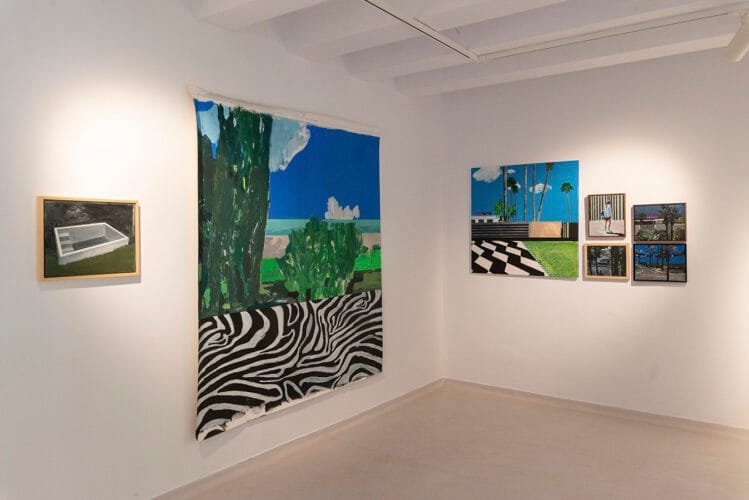
Dan Gherman, the only artist in the NOIMA group who uses a figurative style, captivatingly nuances and complements the abstract perspective of his colleagues. The work of the recently deceased English painter, graphic artist, and set designer David Hockney may have exerted a significant influence on Gherman’s artistic vision. As with one of the leading figures of British Pop Art, indoor swimming pools are a recurring theme in Gherman’s paintings as well.[2] Other parallels can be noted regarding the use of vivid colors, as well as bold, psychedelic forms and checkered patterns. Furthermore, like Hockney, he draws inspiration from his own experiences, capturing moments from his time in Texas in some of his works (Rayford Rd, 2020–2026).
His series of works, Highway billboard (2020–2026), featuring the billboard for the Mexican restaurant Gringo’s, is not limited to simply experimenting with the possibilities offered by various media. His works move between the immanent and the transcendent, between tangible and virtual reality, calling into question the legitimacy of figurative art in the 21st century. Gherman does not merely imitate or reproduce the surrounding environment; rather, he critically analyzes our habits of visual consumption in the age of modern technology. The elements of his series thus cover the stages of image reproduction, starting with the traditional processes of sketching and painting, moving through the digital medium of photography, and culminating in the installation medium that mimics the screen of smart devices, where the image that unfolds appears simultaneously immersive and inaccessible in its remoteness.
The fusion of scientific and spiritual perspectives, as well as the perception of material and ethereal reality, is characteristic of each artist’s creative vision. Their works illustrate how the energies, materials, operating mechanisms, and dynamics of the universe are reflected in the structures of nature.
All of this is excellently illustrated by the artists’ video installations titled Small Representative of the Universe (A Miniature of the Universe, 2021) and Letter from Home – Logos (2021). The recordings feature the group’s collaborative, site-specific land art performances, where the rhythm of harmonized, repetitive movements, combined with a deep and respectful interaction with organic materials and nature, creates a ritualistic and hypnotic effect.
Small Representative of the Universe, produced in the mountainous area of the Șirnea commune in Brașov, pays homage to their mentor, Constantin Flondor, through its predominantly white color palette and distinctive geometric forms. NOIMA’s mentor stated the following regarding the geometry of the snowflake: “My fascination with the snowflake stems from revisiting older ideas in analogy with the symbol of Heaven and Judgment. I found the following wonderful observation in Eminescu’s Fragmentarium: ‘The Byzantine cross is like a snowflake, a small representative of the universe.’”
Meanwhile, Letter from Home – Logos, created in the area of the Mureș River terraces, gives the impression that the artists have sent a message to the universe in the form of a time capsule, through the system of semiotic codes governing the interaction between humans and nature. The miniature model of the artwork that forms the basis of the performance can also be admired in the exhibition space.
Another joint series of works by the NOIMA group (You, Layers!; 2024) represents a captivating transition between the realms of performance and painting. The artists captured the image that emerged before them while standing with their backs to one another, then switched places. The abstract—almost surreal—works resulting from this initiative establish a dialogue between the creators’ individual and collective perceptions and visions of reality. Through the interplay of different viewpoints, the compositions draw attention to the diversity of ways in which an image is perceived, while the perspectives, harmoniously complementing one another, also reflect the team’s cohesion.
At the “Index of Absence” exhibition, one could admire well-defined and original artistic visions, works inspired by various stylistic trends and artistic techniques, as well as abstract and figurative representations. However, the works did not appear in the exhibition space as independent entities hermetically isolated from one another, but rather as compositions brought to life by a shared dialogue, collectively creating the unique visual language of a harmonious group of artists. In this way, the members of the group continue and complement the narratives of each other’s creations through the interplay of textures, perspectives, and carefully layered elements.
“NOIMA Group: Index of Absence,” curated by Mirela Stoeac-Vlăduți, took place at META Spațiu, Timișoara, from June 4, 2026, to August 1, 2026.
[1] Studio + Nursery, Nothing/ Horizon III, Nothing/ Bone of Fire III, Nothing/ Horizon I, Nothing/ Horizon II, Coast of Fire, 2020-2026
[2] Lovely pool, Afternoon at the pool; 2020–2026.
Translated by Marina Oprea


POSTED BY

Yvett Toth
Yvett Toth was born in Arad in 1999. She earned her bachelor’s and master’s degrees in Hungarian and English language and literature from the Faculty of Humanities at Babeș–Bolyai University in...
Comments are closed here.