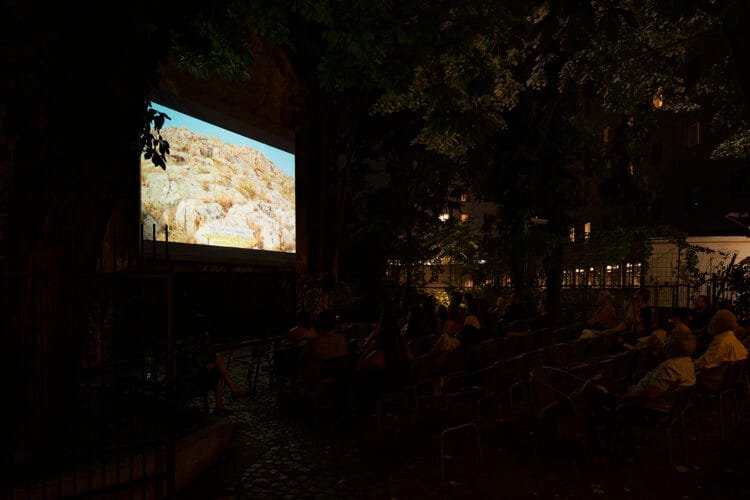
Human nature craves absolute truths, or at least that is what Stanisław Lem’s characters speculate in the novel Fiasco. Yet, absolute truth entails an absence of mystery, where questions are no longer needed because all the answers have been given. Do we view archives in the same way, whether personal or institutional, or thematically cataloged documents and photographs that methodically file away the past or the present, from a singular, absolute perspective? FIASCO. Video Art Evenings took place in July in the garden of the National Museum of Romanian Literature, where the concept of the archive shed its rigid contours, making way for alternative approaches constructed through frames, montages, essays, and commentaries.
For three editions now, Larisa Crunțeanu and Cristina Stoenescu have been developing FIASCO, a screening program for video art and experimental film that functions as an open platform for the encounter of images, ideas, and sensibilities in a state of constant negotiation. Framed by the theme Archives in Motion, this year’s edition explores the archive as a space of memory, imagination, and the reinterpretation of the present. Over the three screening evenings, we sifted through political histories, natural fictions, and layered languages to speculative approaches and personal narratives, through films and video art by artists such as Anton Vidokle, Dominique Gonzalez-Foerster, Radu Jude, Filipa César, Ursula Biemann, and kinema ikon, among others. The screenings were preceded by two events exploring analog technologies and post-Soviet identity constructs: an audiovisual performance, Umbráfono, by artist Enrique del Castillo, and a lecture-performance by artist Anastasia Kolas titled The “Soviet Girl Boss” Theory (SGBT): A Makeup Tutorial.
The selection for this edition has enriched the way I view archives. I found myself wondering what holds the fragments of an archive together, or who recovers and retraces the gestures missed by an official perspective? I have seen how tools other than the conventional ones are employed when engaging with documentary materials, and that it is not always necessary to maintain a critical or reflective stance when working with personal ones; or, most importantly, that the archive becomes a space for negotiating between different versions of the past, calling into question the possibility of an absolute truth.
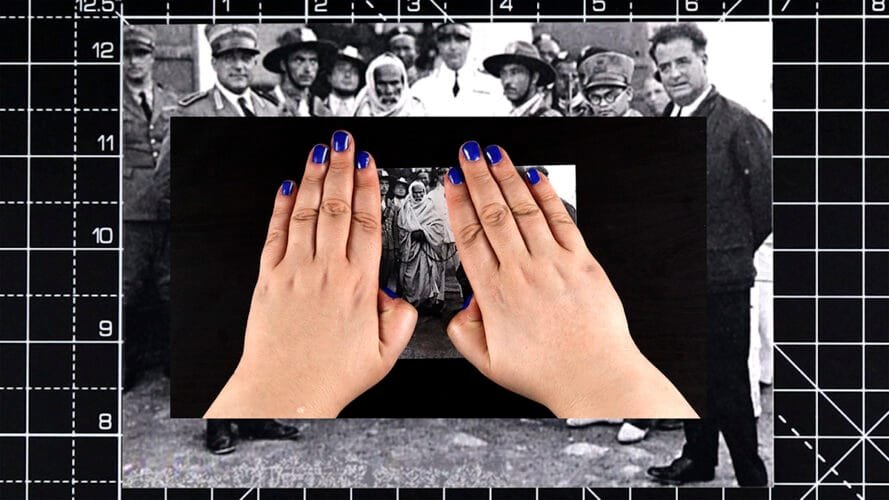
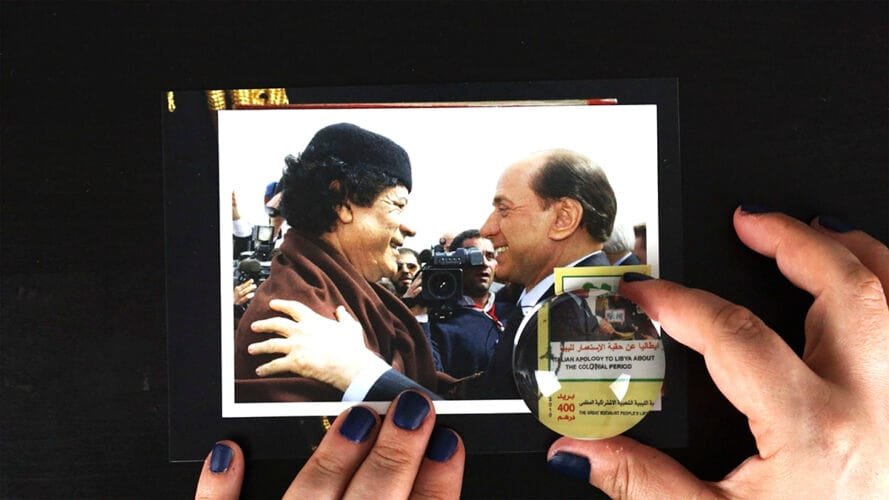
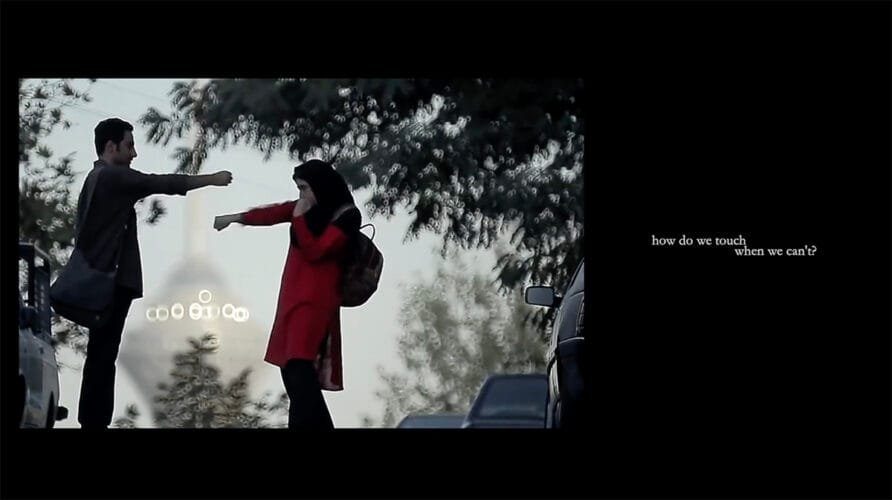
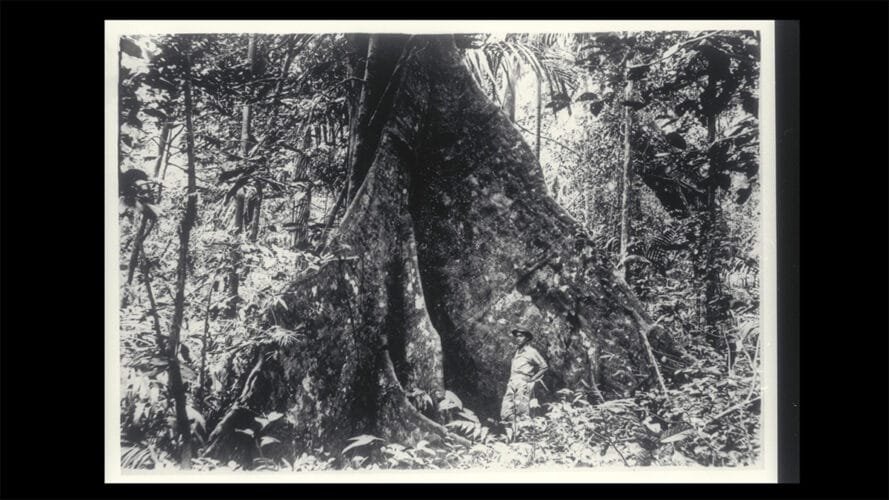
What stayed with me after the screening evenings were films and video artworks that engage with historical material through subjective and affective lenses, ultimately questioning political regimes and colonial legacies. The program opened with Gaddafi in Rome: Anatomy of a Friendship by director Alessandra Ferrini, a work that exposes the links between Italy’s colonial past in Libya and its contemporary politics. By examining photographs of Gaddafi and Berlusconi, the film unpacks and analyses events that reveal the state’s contradictory positioning regarding colonialism and modern migration. Director Shireen Seno’s video essay To Pick a Flower follows a similar approach; starting with the rainforests of the Philippines and layering archival photographs from the American colonial era, it explores the complex relationship between humans and nature, as well as the ways in which capitalism has transformed it. However, my personal favorite remains Irani Bag by director Maryam Tafakory, a video essay that compiles scenes from 1990 to 2018 in which prop bags serve as mediators of touch within Iranian cinema. Poetic and sensitive, the essay carries a strong critical undercurrent, analysing how the visual language of Iranian cinema adapts to and negotiates the boundaries imposed by censorship.
FIASCO continues into the autumn with a special screening dedicated to a new artistic production by director Laura Săvuțiu, bearing the working title The Study of Movement through Image: Gheorghe Marinescu, Étienne-Jules Marey, and Eadweard Muybridge. Her work draws upon a rare archival collection: footage shot by Romanian neurologist Gheorghe Marinescu between 1898 and 1901, some of the earliest scientific recordings in the history of cinema. Laura, winner of the FIASCO award for fostering video art production in Romania, presented the project’s research and development process, as well as the conceptual context shaping her artistic approach, on the program’s final evening.
In his novel, Lem wrote about a missed opportunity to make contact with an extraterrestrial species, a mission that ends with catastrophic consequences. Inspired by the book, the FIASCO festival reflects on the possibilities and limits of communication, bringing together works that nuance, contradict, or offer an ironic take on the narrative’s pessimistic perspectives. While Lem explores the possibility that profound cultural differences render full understanding impossible, the three editions of FIASCO bring together works that attempt to break away from the established models of successful communication; or, in this instance, of archiving.
—
FIASCO. Video Art Evenings / Archives in Motion, curated by Larisa Crunțeanu and Cristina Stoenescu [The Garden of the National Museum of Romanian Literature, Bucharest, 02–04.07.2026]
Artists: Enrique del Castillo, Ben Brix & Kiri Dalena, Tara Najd Ahmadi, Alessandra Ferrini, Radu Jude, kinema ikon, Dominique Gonzalez-Foerster, Josef Dabernig, Anna Vasof, Anastasia Kolas, Anima Goyal, Gohar Martyrosian, Giulia Zabarella & Sol Archer, Maria Thereza Alves, Cosmin Nicolae, Maryam Tafakory, Adéla Babanová, Dafna Maimon, Anton Vidokle, Razan AlSalah, Ana Gurdiș, Filipa César, Karla Crnčević, Ursula Biemann, Kareem Nofal, Gernot Wieland, Shireen Seno, Vanessa Ferreira & André P. Barata & Reine Pires Muzzi, Evelyn Pakinewatik.


POSTED BY

Monica Dănilă
Monica Dănilă is a curator and editor based in Bucharest. In line with the projects she is involved in, she writes about collective and collaborative initiatives at the intersection of research and ...
Comments are closed here.