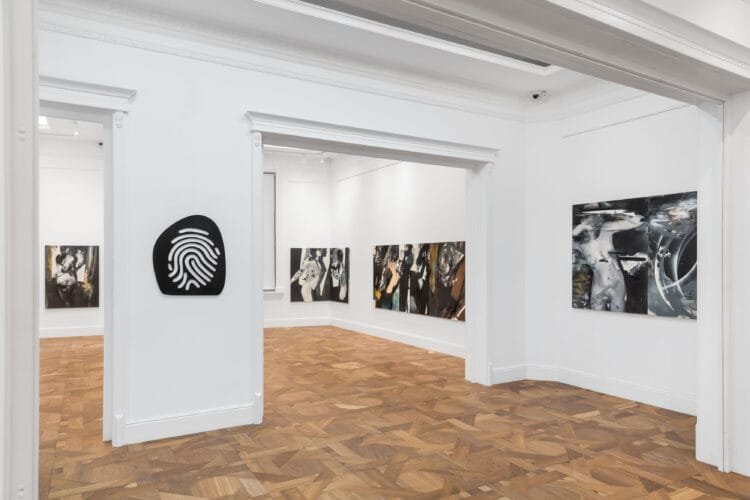
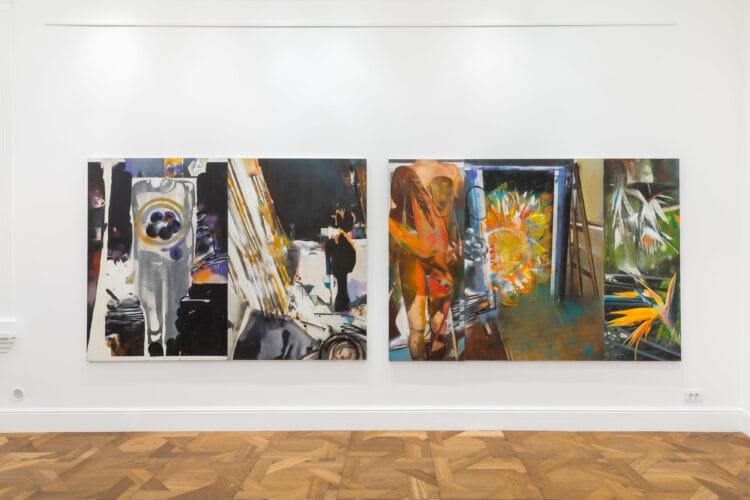
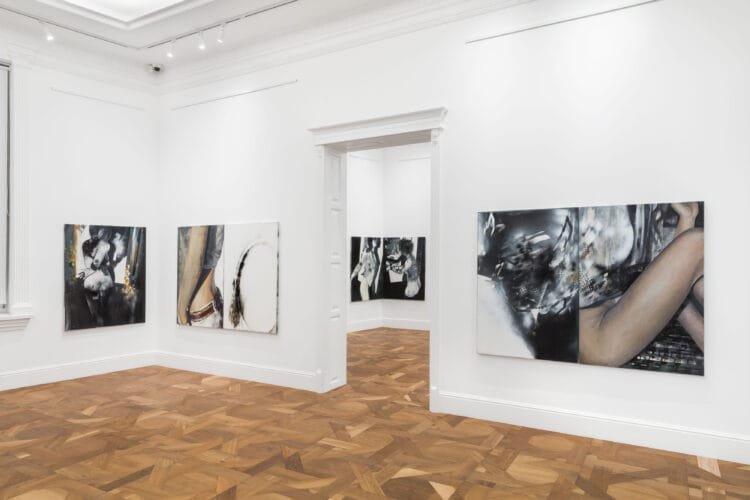
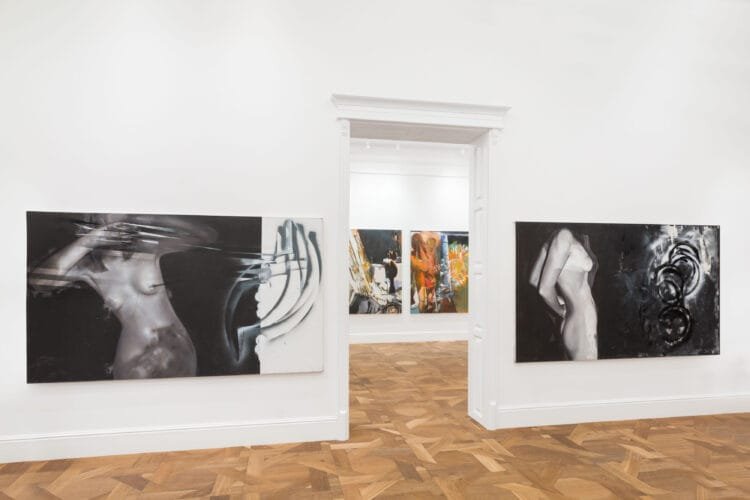
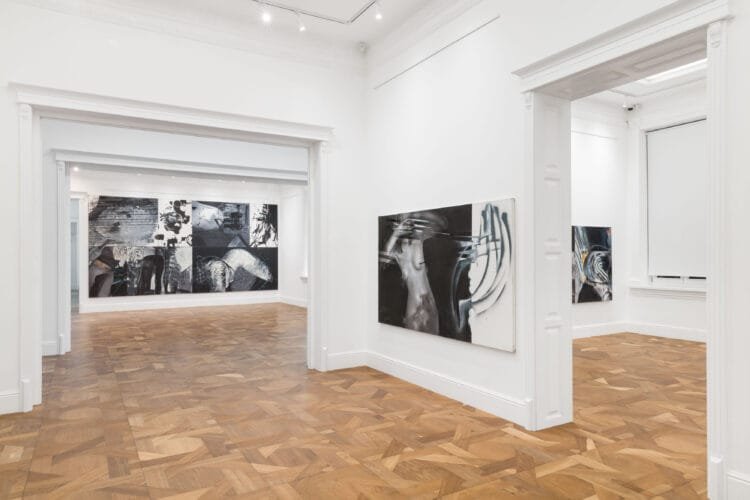
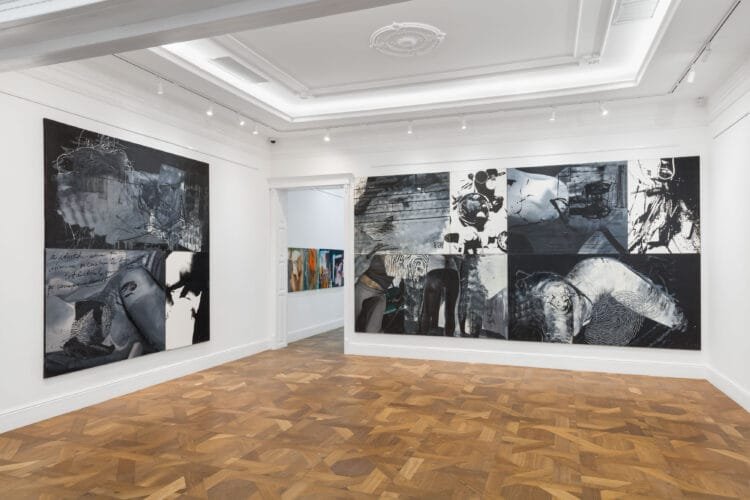
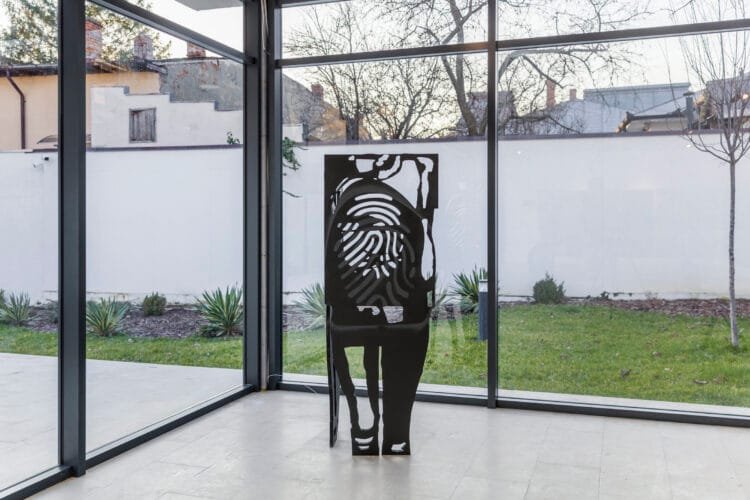
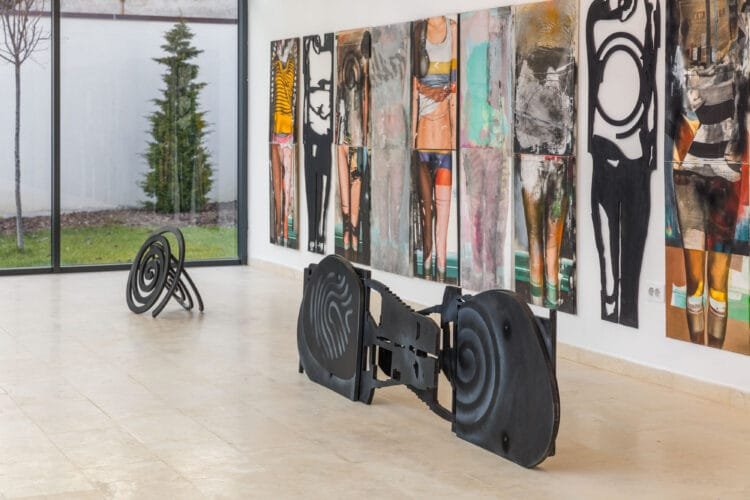
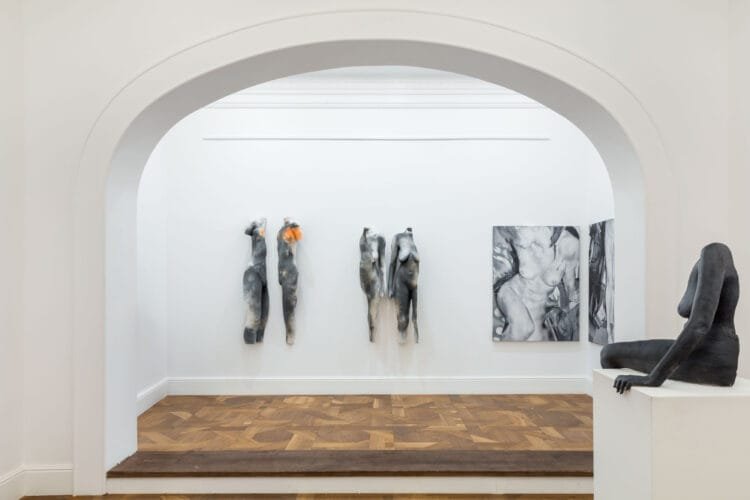
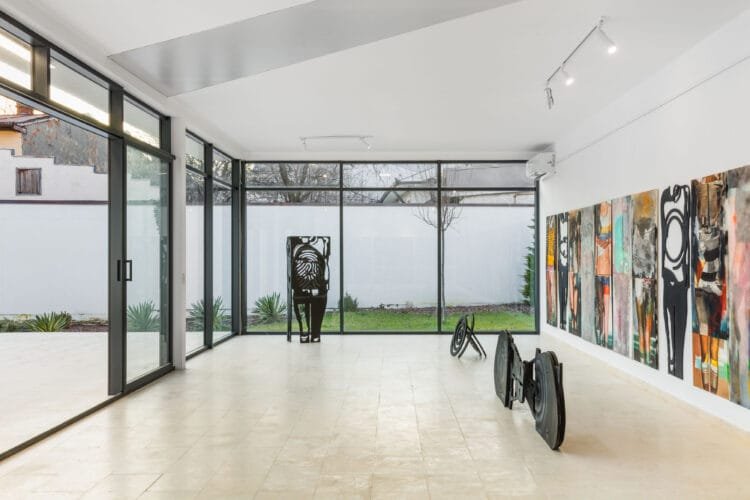
Inspired by the title of a book written by Georges Didi-Huberman, Sortir du noir, Ruxandra Demetrescu curates Petru Lucaci’s solo exhibition of the same name at GLORIAE ART GALLERY, tracing a journey from his earlier themes, where black was the only option, to the recent explosion of color in his latest works. Focusing primarily on experiments with the elements of painting through the use of different materials and random assemblages, the artist pushes beyond known limits in favor of high-impact visual effects. The exhibition route is conceived as a narrative, with welcoming works (introduction), a gradual progression from black to color (main body), and culminating in a chromatic display linked together like an emotionally triumphant frieze (conclusion).
But, at the same time, the “action” that connects the works can be glimpsed. What caught my attention is that a single character appears in all the works: a beautiful girl. She is a modern urban goddess captured in colorful leggings and a T-shirt or nude, with the fragile bone structure of youth, moving from one work to another, partially visible, fragmented, against a two-dimensional, ambiguous architectural background, amidst layers of black with gaps of light, until the sudden burst of natural color, at once three-dimensional, real, dominated by the strelitzia, a flower also known as the Bird of Paradise. A modern Persephone who spends half her time, in winter, in the world of shadows alongside Hades, and the other half, in summer, on earth, as a goddess of fertility and the renewal of nature. From chiaroscuro to color.
Lucaci, as a keen yet distant observer, approaches femininity by excluding any trace of established feminist symbolism. The woman is neither idealized, nor monumental, nor a heroine, nor even a mother, but rather a natural apparition glimpsed within the existential/chromatic-compositional amalgam. She is a constant presence, alongside us in everyday life, a presence in every frame depicting various settings of daily life. The paintings in the exhibition are the same size so they can be placed side by side to form interchangeable, seemingly random arrangements, enhancing the mystery of feminine versatility.
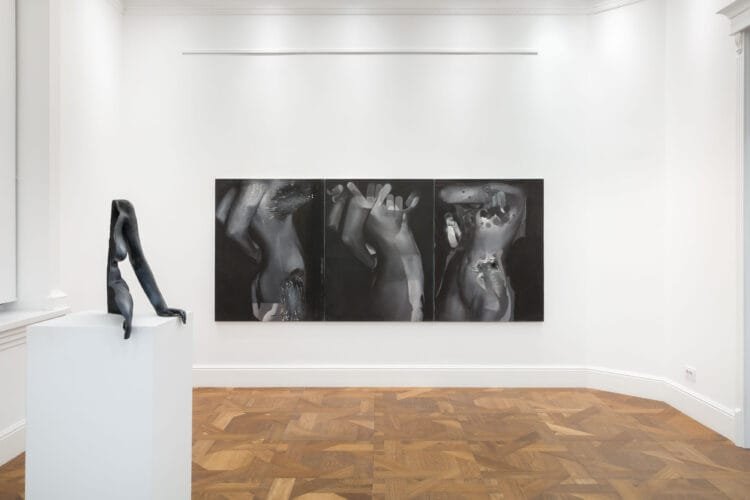
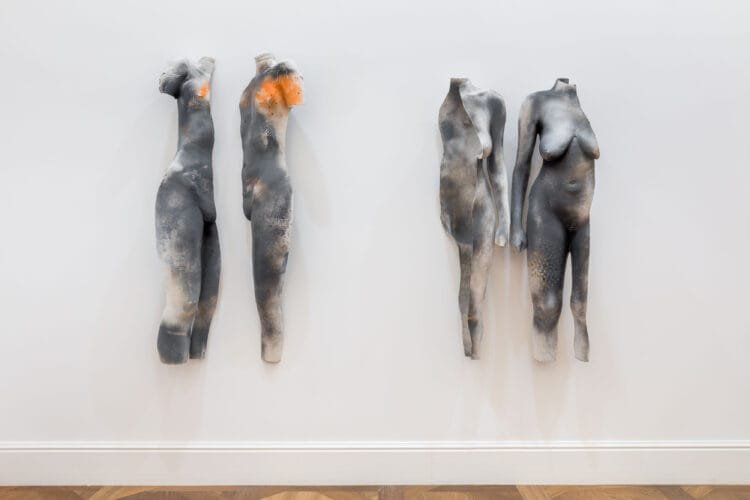
The decapitated woman, as Ruxandra Demetrescu calls her, given that she is depicted primarily as a torso, is subtly identified by the sometimes visible imprint within the body of the painting but also separately as a perforated spatial form. In another interpretive key, the imprint placed on the woman’s body carries the connotation of taking possession, revealing her possible vulnerability.
Unlike the works in earlier series, where the woman is framed within a landscape and captured in a pose, in the recent large-scale pieces – arranged side by side to form a frieze displayed at the end of the exhibition route in the pavilion – she is depicted monumentally, standing, statuesque, in a cropped view from the shoulders down to mid-calf, dressed only in leggings and a T-shirt. The woman, appearing among the shadows, ultimately gains self-awareness and emerges into the light radiating from the flowers of paradise, for “one is not born a woman, but becomes one,” to quote Simone de Beauvoir. The precious, structured black is present in the exhibition through several meaningful objects – imprints, decoupages, relics of the emaciated body, meant to mark the journey toward becoming in absolute solitude.
Petru Lucaci, who is also interested in body art and feminism, set out to trace the path of feminine innocence and vulnerability all the way to the verticality of triumphant superiority. Petru Lucaci, in his conception and vision, is essentially contemporary, inspired by the modern woman who needs no pedestal to make herself visible.
The exhibition is overwhelming, featuring large-scale works assembled into panels that furnish the space like a succession of cinematic sequences with a single character (the woman or the artist) in constant, subtly suggested evolution, on the path of escape toward color and light.


POSTED BY

Ruxandra Dreptu
Ruxandra Dreptu is an art critic and historian specializing in modern and contemporary art, curator, and author of artist monographs, catalog essays, and articles published in art journals. She curren...
Comments are closed here.