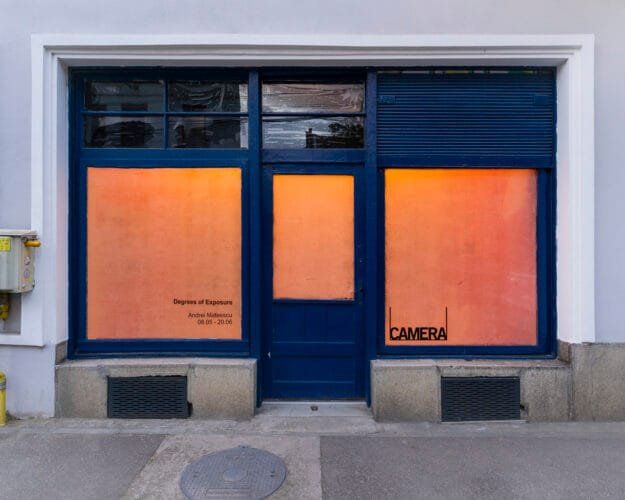
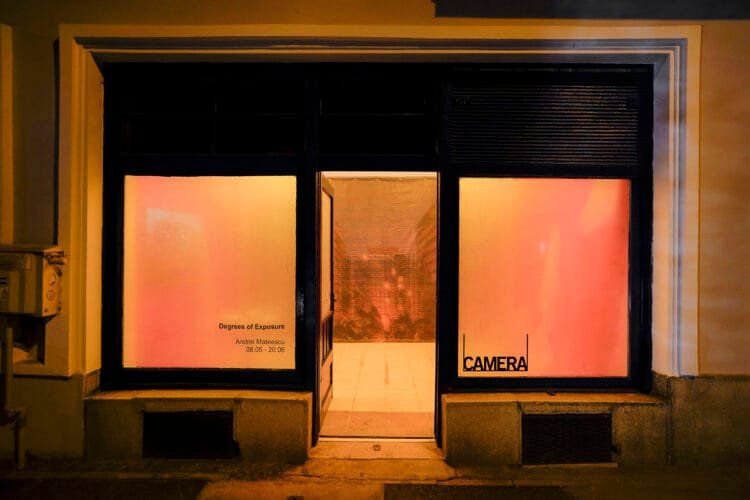
The space focused on contemporary photography in Cluj, dedicatedly curated by artist Irina Dumitrescu Măgurean, is small, cramped, almost packed. It seems no coincidence it bears the name “Camera”. Walking down an old street, among a row of single-story houses, you are greeted by the small storefront of a building transformed into a “white cube.” Here, the technological meaning associated with the photographic device (photographic camera) overlaps with that derived from the technological process of producing an analog photographic image (camera obscura/darkroom) and with the setting in which the photograph, in its final form, is viewed (a room transformed into an exhibition space). From the street, the space could easily be mistaken for a former photography studio. However, for Andrei Mateescu’s exhibition, titled “Degrees of Exposure”, the large windows of the façade – which should provide a clear view of the entire interior at a glance, making the exhibition accessible even to the hurried passerby or the flâneur, capable of transforming the stroll into a snapshot imprinted on the retina and stored in personal memory – are, on this occasion, covered with white paste. After dark, it appears to cast a diffuse, reddish light onto the street, generated by the color-filtered light from inside. To see the exhibition, therefore, you must enter – accepting the curatorial invitation to explore rather than merely observe, an invitation paradoxically embodied by an initial occlusion device.
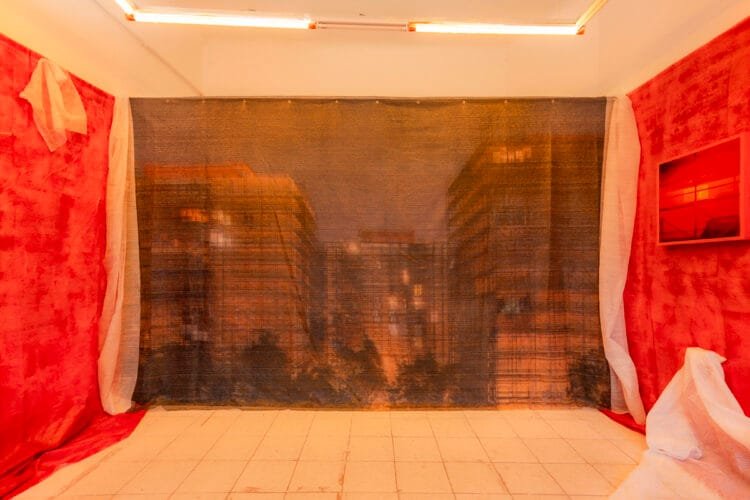
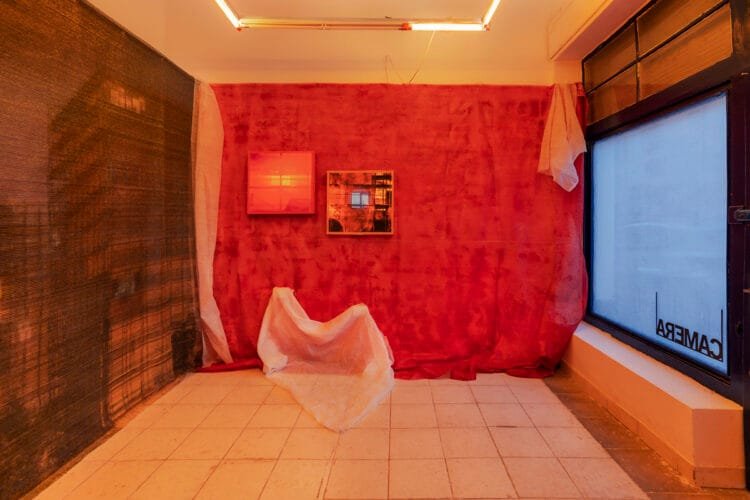
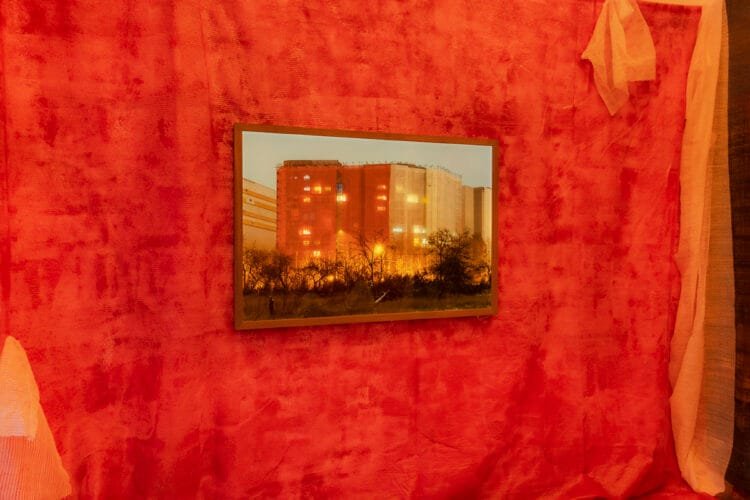
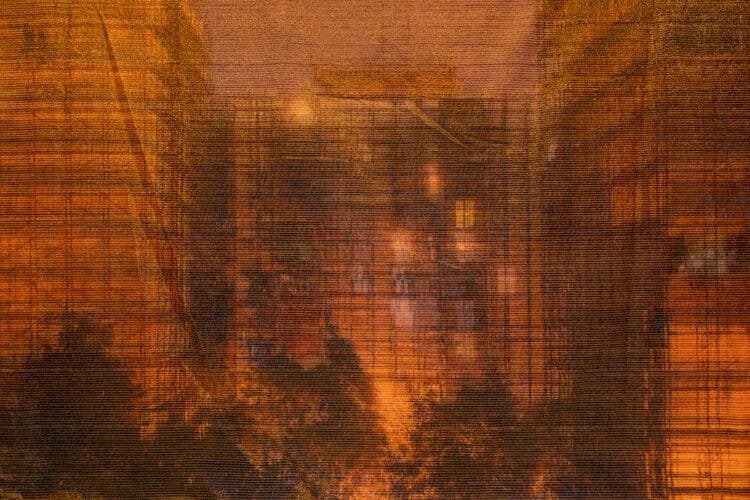
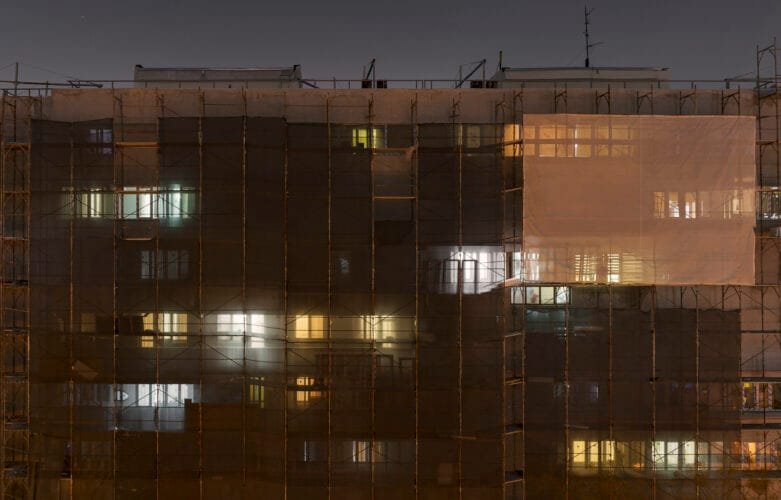
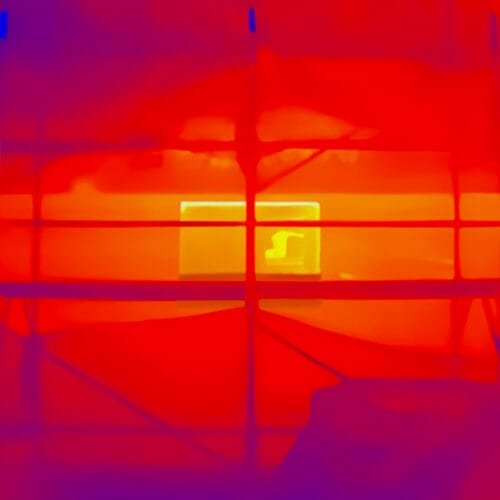
The interior is disorienting. Andrei Mateescu reverses the relationship between interior and exterior, between urban and private space, as well as between distance and proximity, between the panoramic view that sweeps across the surfaces of public space and the detail-oriented gaze characteristic of domestic space. Inside, you are greeted by tarpaulins typically used on scaffolding for dust protection, but also for displaying advertisements often covering the facades of the brutalist architecture found in residential neighborhoods across most post-socialist cities. These conceal two of the walls, serving as a backdrop for two interactive light boxes; at the same time, the mesh becomes an optical device that, once again, filters and conceals the oversized central image displayed head-on. Like a pointillist painting, or an oversized fragment of a low-resolution digital image, the displayed image becomes legible and clear only when you try to document it – viewed, therefore, through another photographic device. In turn, the light boxes, equipped with motion sensors, activate when the viewer approaches, requiring their physical presence in front of the image and thus highlighting a phenomenological experience. The resulting photographic installation transforms the distracted experience of gazing at urban space into a condensed experience, more akin to an optical experiment, in which our physical presence in a given space and the way we perceive external reality become inseparable. The sensation that the exhibition’s audience is unwittingly transformed into the subject of an optical experiment, in which the exhibition space becomes not only a fragmentary reconstruction of urban space but also an allegory of a darkroom, is reinforced by the fact that the light used in the space is chromatically filtered, just like the reddish light used to illuminate one of the light boxes on display.
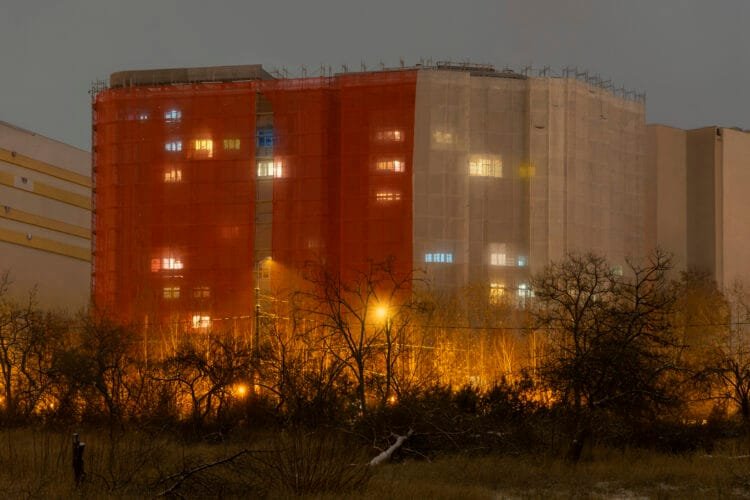
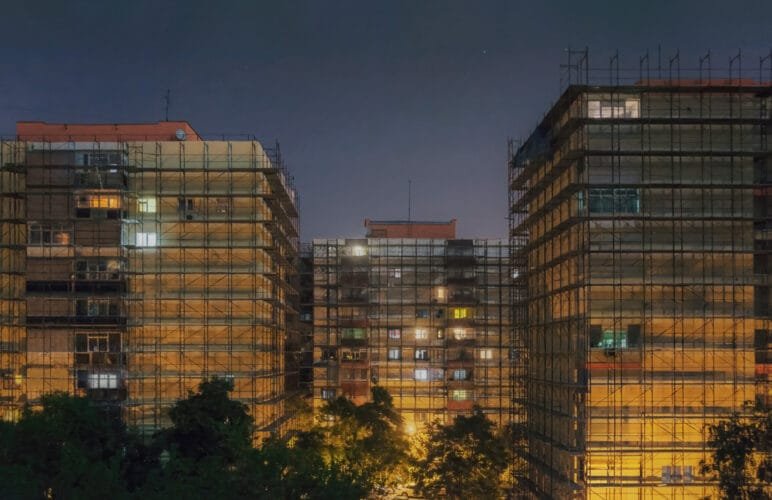
This presentation strategy, in which the image appears to have been reconstructed for the photographic gaze (documentary, photojournalistic) rather than for the disoriented gaze of the viewer on site, clearly highlights Andrei Mateescu’s analytical interest in the vocabulary and process of photography, rather than in the use of the photographic image as an uncodified imprint of reality. The documentary dimension of the captured images is evident, marking – from a sociological or anthropological perspective – a specific moment in the history of Romanian society, in which the process of thermal rehabilitated building facades not only alters the urban landscape, but also the experience of living there. However, this documentary dimension refuses to remain a mere representation, to be associated with a simple (urban) landscape, and thus to be passively exposed to the curious gaze of a passerby in search of exotic subjects. It, in turn, becomes raw material for a conceptual analysis of the situated gaze, carried out using tools specific to the environment and the camera.
More specifically, “Degrees of Exposure” not only spatially expands the vocabulary of analog photography in relation to digital photography, but also materializes, through transposition, technical processes involved in image production. This materialization of elements extracted from the image-making process through techniques reminiscent of sampling allows the viewer to reflect on the types of gazes that photography as an artistic medium provokes and actualizes. The reversal of the relationship between background and foreground, between interior and exterior, as well as the use of filters – various means of partially obscuring the field of view – are recurring artistic techniques in his recent photographic practice. Whether it involves thin sheets of semi-transparent plastic covering the image partially lifted by breeze, strands of fabric, colored paper filters applied to light fixtures, or simply lights that turn on inside light boxes only in the presence of the viewer, they depict a universe of the obstructed gaze. And this particular gaze becomes a central focus of the photographic investigation in this exhibition. On a theoretical level, the filters used by Mateescu embody the metaphor of the veil (and veiling) – an ambivalent concept that, in the tradition of Jacques Derrida’s deconstruction, both conceals and reveals. Thus, the project raises fundamental questions about how we see – that is, interpret and understand – what is presented to our gaze.
Through these artistic devices, Andrei Mateescu’s photographs tend to elude the paradigm of representation. Indeed, even in terms of the subject matter of the exhibited photographs, the post-socialist urban space serves more as a pretext for analyzing the experience of the gaze in relation to that of inhabiting a space. In the exhibited images, the reversal of the relationship between interior and exterior continues through the destabilization of the relationship between inhabited and uninhabited space, as well as between the virtual and the real. From the outside, the illuminated windows, bright squares silhouetted against the scaffolding covered in tarpaulins, are the only signs of life in these otherwise cold spaces, completely dominated by concrete. From the sidewalk, they in turn become pixels in an artificial, dormant universe, where the boundaries between the virtual experience – filtered through digital screens – and the real experience lived in the urban universe blur. The resulting nocturnal images, rendered artificial through chromatic shifts and characterized by solitude, are at the same time deeply atmospheric.
Beyond these filters, the entire project revolves around the window, which both allows a view outside the domestic space and blocks the prying, intrusive gaze of passersby. One cannot analyze the window in Mateescu’s images without evoking its intimate relationship with the notions of frame, border, and framing – fundamental both compositionally and semantically. Within the framework of Albertian theory, for instance, the window in paintings appears as a plunge into the abyss, a reflection of the painting itself, viewed as an open window onto the world. In the vocabulary of digital culture, the window is a screen-mediated portal. Between these two, Andrei Mateescu’s photography plays an intermediary role: the windows of anonymous apartments, obscured by shutters and re-illuminated by light boxes, become representations into the abyss of the frame produced by the camera’s viewfinder.
Using relatively simple means, “Degrees of Exposure” thus cleverly creates not only an intimate and immersive space – typical of a photographic installation – but also a conceptual, analytical space examining not only the post-socialist urban landscape but also the ontological levels of reality. The exhibition thus marks a milestone in the career of an already mature artist who has mastered the tools of the photographic craft and uses them convincingly to generate subtle existential reflections, imbued with a keen, atmospheric sensitivity that ultimately shines through the density of conceptual frameworks and a highly intellectual discourse.
Translated by Andrei Mateescu


POSTED BY
Cristian Nae
Cristian Nae lectures in history and theory of art and the Arts University in Iași. He works between visual studies, aesthetics, exhibition studies and geohistory of art....
Comments are closed here.