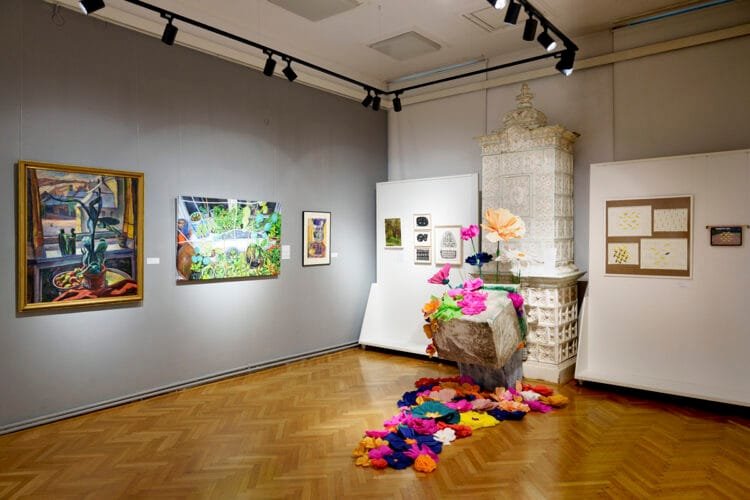
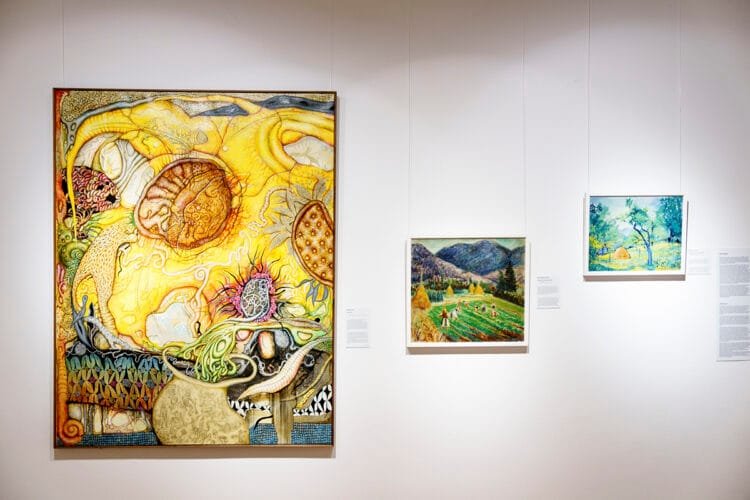
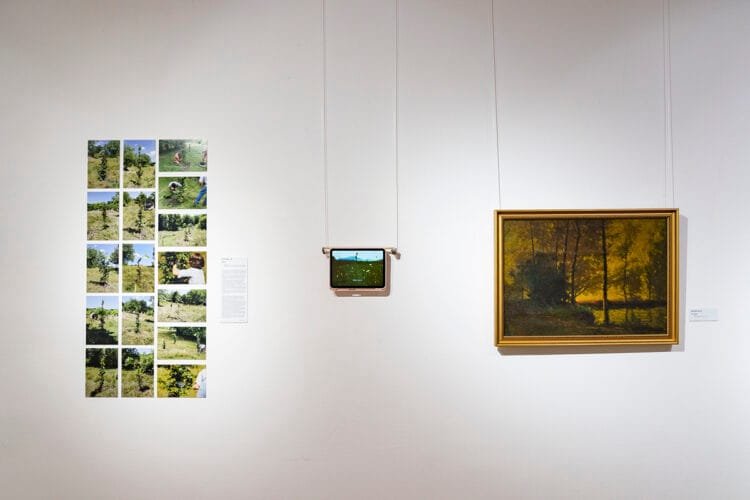
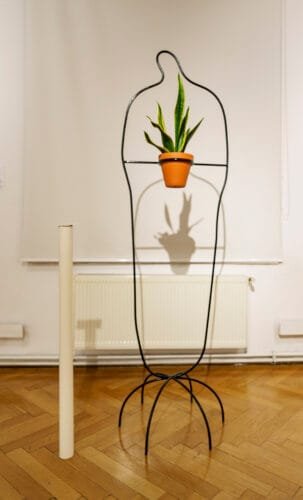
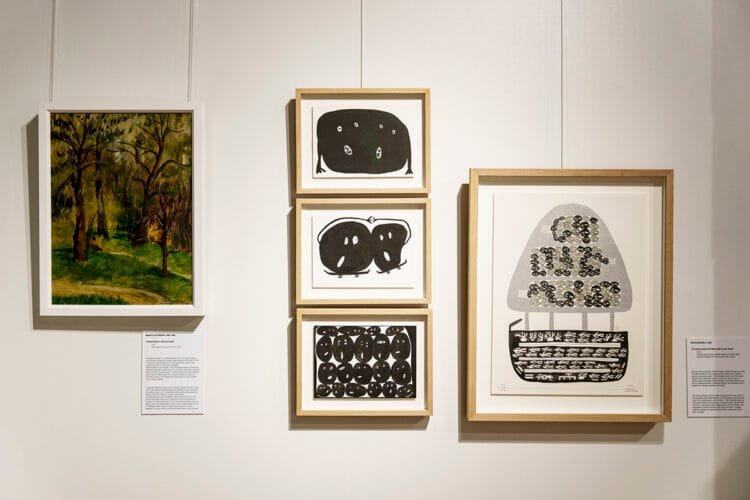
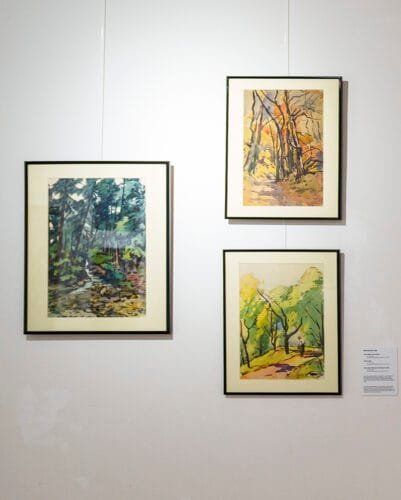
“Nature is vision,” proclaimed an ancient philosopher. As if to bring this ancient manifesto up to date, the exhibition “In Search of Nature”, curated by Valentina Iancu at the Brașov Art Museum, aims to move beyond the substantialist discourse on nature—that centuries-old rhetoric that has led to the personification of nature either as a Muse or as an object of experimental observation. In a monologue that the philosopher just cited attributes to Nature, she says: “Whatsoever comes into being is my vision.”[1] Understood in this way, in contrast to the reifying attitude of the mainstream currents of Western thought, nature is more appropriately interpreted as being itself contemplation, and not merely the object of contemplation. In this more faithful hermeneutics, nature transcends the distinction between object and subject, acquires a spontaneity of its own, becomes active, with an activity equivalent to the intellectual and contemplative; in short: it looks, and is not merely looked at. This attitude, which grants nature autonomy and the right to express itself in its own name, has recently been theorized by philosophers Timothy Morton and Michael Marder, who inspired Valentina Iancu’s curatorial project. By proposing a “plant-thinking” (Marder) and a de-anthropologization of the relationship with nature (Morton), this new philosophy of nature guarantees every single thing a voice—or, rather, its own silence—in accordance, moreover, with an ancient precept of metaphysics: “Nature also designates the essence of each thing.”[2] Reinterpreted, this precept is likely to provoke a reversal of perspective, insofar as it is not the visitor who views the exhibited work, but the work that views the visitor. In this sense, the heritage works selected by Valentina Iancu from the permanent exhibition of the Brașov Art Museum are re-staged from an inverted perspective, supported by works by contemporary artists who parody, reformulate, and update the message of the canonical works. Thus, the two spaces into which the exhibition is divided—Wild Nature and Domesticated Nature—refer through their titles to an already obsolete relationship with nature, which the tension between the exhibited works and the gravity of the overall message aims to bring to implosion. In turn, the two spaces are subdivided into constellations, into which heritage works and recent works “enter,” the latter being tasked with eroding the meaning and aesthetics of the canonized works, extending their message toward the contemporary, and drawing, sometimes against the grain, conclusions from their implicit premises. Unlike astronomical constellations, however, they do not necessarily “move” together. The eye can coordinate or group them with other works in the room.
Nothing better illustrates the effort to de-objectify nature than the works of the Expressionist painter Hans Mattis-Teutsch, who lived and worked in Brașov. Here, nature appears reduced to a sign. The lines that define or could define a tree merge with the lines that define or could define a hill or the clouds in the sky. Objects become indistinguishable from one another, and as such cease to be objects. This artist’s works represent, in a way, the zero point toward which efforts converge to abolish the supposed otherness of nature, to reintegrate it into the system of signs that constitutes reality as non-duality, undivided by the opposition between artifice and nature.
At the antipode of this abstract pantheism lies Hortensia Mi Kafchin’s work, A Little Bug Minding Its Own Business. Coexisting with the classics Grigorescu and Andreescu, Kafchin’s work contradicts the Impressionist aesthetic of the two “masters” through its graphic style reminiscent of Japanese prints. Like Japanese prints, it creates a close-up view of the lives of small animals and humble vegetation, over which she seems to lean with a kind of affectionate attachment. The object thus gains the right to express itself through a clear outline, to show itself “as it is,” seemingly uninterpreted—which corresponds to the Object-Oriented Ontology propagated by Timothy Morton, one of the inspirations behind the exhibition project.
The antagonism between the works is fully exploited in the grouping that juxtaposes the academic works of Friedrich Miess and Henri Trenk with the photographs of Adrian Oncu. Between an idyllic landscape and a sublime one, Oncu’s two photographs, From Dusk Till Dawn #1, 2, cite the favorite motif of idealizing Romanticism (the sunset) in combination with its antithesis (the garbage heap), which brings us back to a context of ecological alarm, with an anti-nationalist jab at genre painting and its regional patriotism.
The constellations imagined by Valentina Iancu, however, do not rely solely on contrast and paradox. By a remarkable coincidence, the works of Elena Popea (the second artist with a university education, after Elena Mureșianu, in 19th-century Transylvania) are in perfect chromatic harmony with Uliana Gujuman’s work, Disintegrating Landscape, which depicts a corner of nature “down to the blade of grass,” in the manner of Dürer’s famous watercolor Das große Rasenstück from the Albertina, but oversized, which induces in the viewer an intense sense of immersion.
The Renaissance reference is also present in the first room, that of Wild Nature, through the sketchbooks of Irina Neacșu (Sketchbook) and Sorin Oncu (Nut), which allude to the devoted and erudite study of nature during the Renaissance, in the vein of Leonardo’s Notebooks.
The relationship between nature and sign is also explored in the works of Gabriela Mateescu (Hygeia, as in heaven so on earth). Jugendstil-like plant motifs are associated here with fantasy imagery, forming the backdrop for a reflection on vulnerable, suffering, exposed femininity. Within the sterile decorativism of Art Nouveau patterns, the female genitalia float like an anthroposophically charged hieroglyph, like a frozen, semantically alienated arborescence, rendered through graphic elements that bring it close to technical drawing.
“Wild nature,” to which the first room of the exhibition refers, is at the same time the realm of myths. In Ciprian Mureșan’s work Apollo and Daphne, the relationship between man and his non-human otherness is analyzed as a traumatic experience. The nymph’s transformation into a tree, to escape rape, elevated to the status of a poetic spectacle by mythological erudition and justified in the name of higher aesthetic interests, becomes, in Mureșan’s work, an opportunity to study the anatomy of horror—which, in Daphne’s case, is simultaneously a “botany” of horror. The transformation into a tree is an escape through dehumanization. The opacity of the plant, its inaccessibility to “love,” represents a liberation for the victim, but a liberation that is also a curse, which aggravates the crime. Drawing inspiration from Bernini’s famous sculpture, Mureșan creates a series of sketches that explore Daphne’s transition into the plant kingdom, the points of juncture where the human limb becomes a plant component, thereby reenacting post factum Bernini’s creative process in the form of studies dedicated to reshaping human anatomy as botanical morphology.
The second room of the exhibition, dedicated to “Domestic Nature,” does not treat the theme as a thesis but problematizes it. In the room’s program, domestication is understood as a relationship of power. Instrumentalization and exploitation are merely the most obvious aspects of the power dynamic between humans and the nature they control. Idealization and aestheticization are the other two, less obvious, forms of this domination. The most striking manifestation of this one-sided relationship is the “killing” of nature with the aim of transforming it into “dead nature,” according to the technical term in Romanian artistic vocabulary, borrowed from the French nature morte. (English and German prefer here the terms “still life” and “Stillleben”.) In this sense, the two Polaroid photographs by Alexandra Sand, Enduring, Not Burning, inserted between a peony still life by Rodica Maniu and a “Dutch” still life by Mișu Popp, function as mug shots of captive, precarious beings, adding a touch of derision to the self-celebration of the artificial construction in the two “classic” still lifes that flank them.
In the context of heightened awareness, even the simple act of photographing nature becomes synonymous with its transformation into a “nature morte”, by “killing” it. This is what Ana Maria Micu shares with us about working on The importance of sun … life’s challenges, an acrylic painting on linen depicting the artist’s balcony garden, created on the basis of a photograph: “In order to photograph these seedlings […], the artist’s body had to physically position itself between the plants and their source of nourishment, the sunlight. […] The artistic gesture of one living being is paid for by a moment of deprivation endured by another.” Thus, even above the pots of living plants hovers the specter of “Nature Morte,” in the guise of the “noble” violence of the aesthete who adjusts nature at will as an object of contemplation and productive exercise.
The theme of guilt is explored in depth in Katja Lee Eliad’s works. Based on a study of colonial history, they allude to the fact that the first chrysanthemum seeds were brought to Europe aboard a ship involved in the slave trade. The direct address in the title: How Many Souls For Your Garden? reminds us that European horticulture, even the humble private garden, is rooted in the violent history of the “Old Continent” and that involvement in this history extends tentacularly to the “innocent” flower beds in the yards of common people. Katja Lee Eliad’s works use Japanese ink—a parodic homage to the “Land of Chrysanthemums”—for complex, albeit small-scale, compositions that draw equally on the imagery of children’s books (big, head-like seeds with eyes and mouths), African art, and the plates of historical folios depicting cross-sections of slave ships.
Through its two “wings,” “Wild Nature” and “Domestic Nature,” the exhibition curated by Valentina Iancu resembles a diptych. And just like a diptych, the exhibition revolves around a unifying theme: the goal of preserving nature’s autonomy and of immersing the viewer in a contemplation that is not that of the perceiving subject, but which, paradoxically, is emitted by the object itself. Nature thus ceases to be, strictly speaking, an object. In line with the scholastic quotation at the beginning—“Nature also designates the essence of each thing”—this attitude gives a voice not only to “external” nature, but also to that nature which constitutes the essence—always social, yet always resistant to domestication—of each of us.
Translated by Gheorghe Pașcalău
[1] Plotinus, On Nature, Contemplation, and Unity (Enneads III.8), ch. 4. Translation Stephen MacKenna.
[2] Thomas Aquinas, On Being and Essence, ch. 1. My own free translation.


POSTED BY
Gheorghe Pașcalău
Gheorghe Pașcalău (born 1984) studied philosophy and Greek philology at the universities of Bucharest and Tübingen. His doctoral thesis, written at the University of Heidelberg (2016), deals with N...
Comments are closed here.