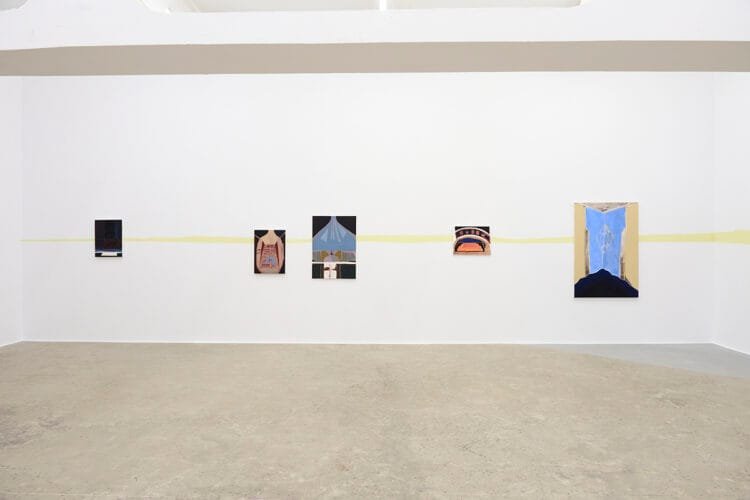
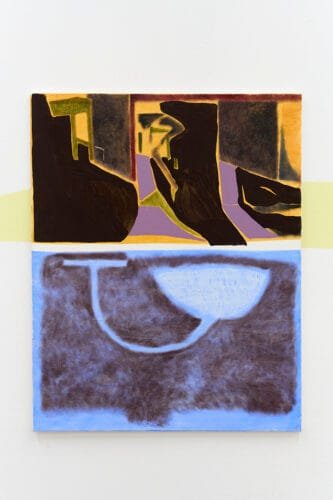
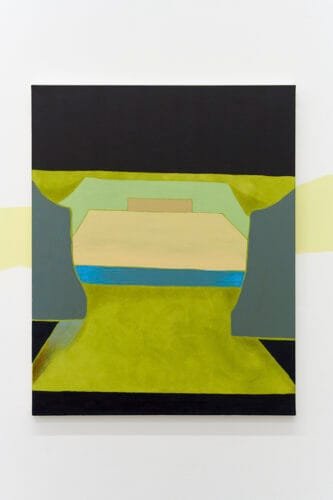
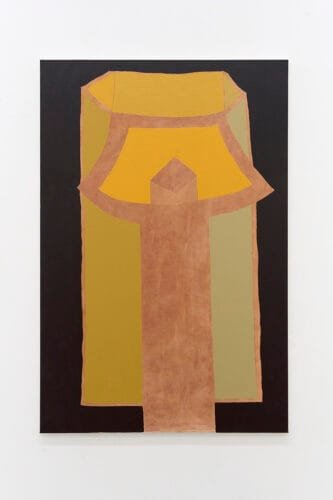
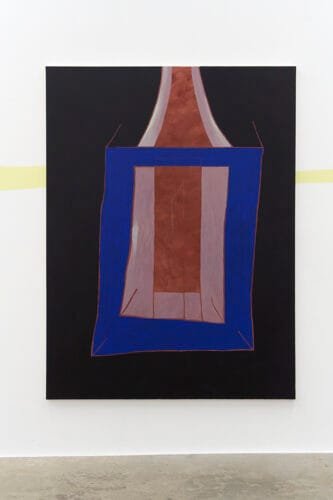
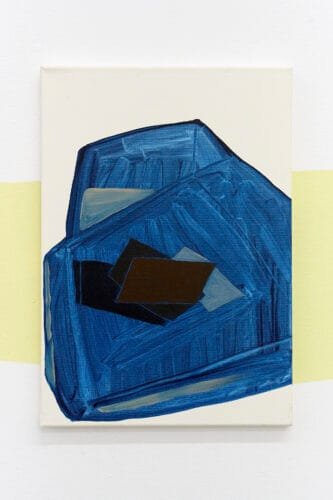
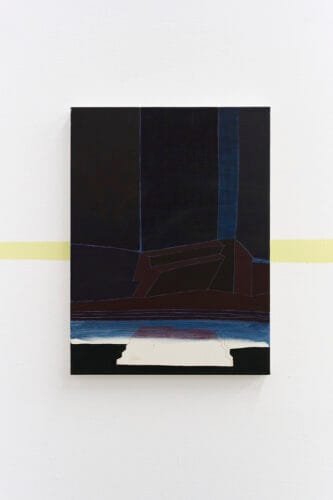
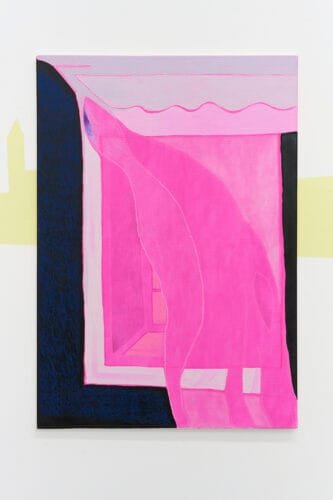
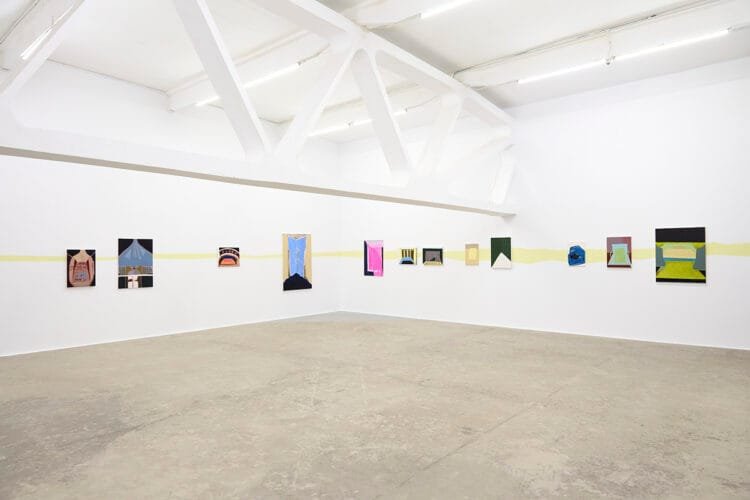
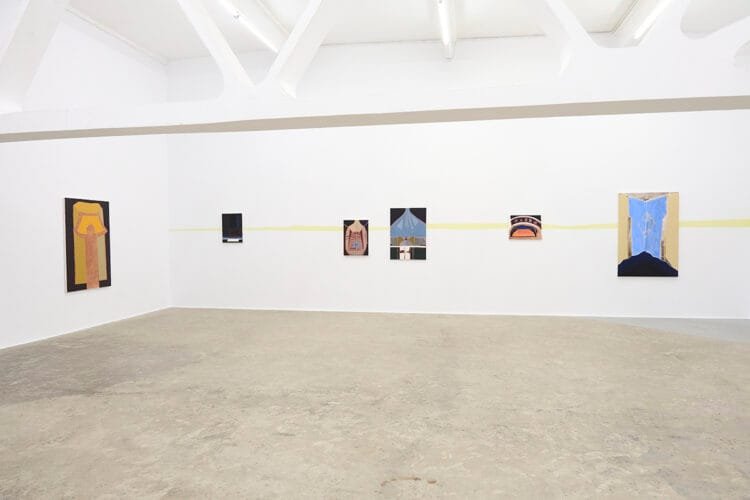
If you speak with Ana about her work, she will tell you simply: “I paint interiors.” She speaks as if this were merely one of the well-established genres of painting. More precisely, these are architectural interiors or, as we shall see, mnemonic chambers. Within the historical context of this theme, one cannot help but recall the “melancholic interiors” painted by Ioana Bătrânu, particularly in the 1990s and 2000s. While adjacent to that (dark) romantic typology, Szőllősi’s works are better described as nostalgic. If melancholy is a general predisposition that filters the world through a general sepia filter, nostalgia is triggered by a real referent. It stems from tangible objects and the subject’s interactions with the exterior.
Stylistically, Ana Maria Szőllősi’s approach is diametrically opposed to that of Bătrânu. While melancholic interiors are often vast, absorbing the viewer like a lit stage, these nostalgic pieces are immersive in a different way. They are typically small, resembling the personal mirror one keeps on a nightstand. Through their scale, the thinness of the chassis, and the technique of diluted oils applied like a watery wash, they possess a portable quality. They are memories to be carried away, akin to prehistoric mano-portable artifacts, or one’s personal micro-fictions. Created within a restricted palette, they possess the illusory materiality of a “false watercolor” rather than the heavy, almost earthy texture of an oriental rug of the former.
Metatextually, these images reveal a presence-absence binomial. They present an interchangeable triad of meaning between similar defined structures as the perimeter, the territory, and the membrane. The works possess a silent monumentality. They evoke the devotional quality of small, irregular, dark spaces that generate movement, yet they also reflect the Cartesian rectangularity of a neutral but regulatory public space. By extension, the window emerges as a recurring motif. It acts as a device for connecting with or dissociating from the world through the same Cartesian technology of subject-object separation in the modern individual.
Local and natural colors lose their autonomy here. They yield to a palette that is simultaneously pastel-waxy and iridescent, like an incandescent source hidden behind rice-paper curtains. This is an enveloping, twilight glow. The warm-cold contrast is achieved through shades like scarlet-burnt sienna and an indigo-bluer-than-a-moonlit-night. By diluting oil paints with turpentine or White Spirit, certain registers are treated as a false watercolor, enhancing the incandescent effect. Light does not seem to fall upon the object; instead, it emanates from behind, from within the canvas itself.
The restricted palette employs pigments representing materials that are both earth like and brittle, such as cinnabar or the rare caput mortuum. These pigments easily turn to dust, originating from the earth, from our immediate proximity. The pictorial membrane oscillates between the mineral and the organic in its materiality. This effect is heightened by delicate lines scratched onto the canvas with pastel or graphite. The diluted oils allow the paint to penetrate the grain of the cloth without creating relief. It soaks in like ink. The rapid drying hardens in a matte surface, stripping the oil of its characteristic precious luster. The result is an opalescence where small pigment granules disperse across a glass-like surface, reminiscent of a window separating rooms from the outside world.
Beyond formal and morphological elements, we must consider these works through the lens of visual studies. What can be said of them iconographically and, more importantly, iconologically? An important aspect, noted in the exhibition text, is that Szőllősi eschews traditional Albertian linear perspective. In visual studies, authors like Martin Jay or William Wees argue that linear perspective is merely one way to describe space, lacking an absolute validity. André Bazin went as far as calling it the “original sin of Western painting.” Researchers generally agree that Renaissance perspective is a particular and limited interpretation of the visual world. Here, we encounter a kind of kaleidoscopic perspective. It may be telescopic in the rooms pictured as viewed from above, or frontal, originating from a central point, spiraling into vertigo or detail.
Almost every work in the exhibition allows a glimpse of white space through the ink-pigment. This intuition of the bare canvas acts as an acknowledgment of the conscious deception involved in constructing an illusion on a bidimensional space. It is a recognition of, but also and a fear of, the erosion of memory, which can alter or hide anything in an instant. The rectilinear contours, never perfectly straight, resemble the edges of a moving, undefined image. They possess the quality of a hesitation felt in the motor pauses of the hand that traced them. Indeed, the entire compositional approach mimics a controlled hesitation. Symbolically, the quadrilateral perimeter found in every work suggests the anatomical skeleton of every room in the world.
In the image-text relationship, the titles are overtly subjective. They stem from small daily invasions, referring to an interstitial, unnamable biographical element, much like diary entries. Typologically, they frame the domestic space as a site of recovery and protection, a cell and a membrane. Titles like Window, Archway, Personal Room, The Bed Fortress, or Stable Table serve as examples. The spontaneous brushwork and speed of execution also recall confessional journals, suggesting a truth that must be confessed quickly before it is lost.
Despite these strategies, the works do not feel methodical; they exude spontaneity. A tension exists between architecture and objects. Geometric forms appear as individuated portraits of interior spaces or furniture, stage-beds or window frames through which someone has just entered, exited, or peered. The artist possesses the rare ability to distill an interior, a club scene, or a street into a single form and a single blot of color.
The reference to Prosper Ménière adds a critical layer: the ear as the organ of balance. In this context, horizontal lines, such as the yellow stripe connecting the works within Kunsthalle space, function as more than decoration. They act as a fulcrum or a line of equilibrium. This likely emerged from conversations between the artist and curator Bogdan Rața, whose interest in how sensorially incongruent spaces produce disorientation is well-known. This mechanism involves a conflict between the visual system and the inner ear (the vestibular system). It is a cognitive error that causes vertigo or nausea in spaces with atypical coordinates. Here, Rața has constructed a serpentine, moving horizon line. Its cuts mimic the graphic contour of a city on a road sign, providing a stable reference that links these mnemonic chambers into a cohesive system.
“In the evening, when you go to bed” is the title of one of the seventeen works presented. I chose it because it perfectly captures the emotional typology of Szőllősi’s creations. It evokes the atmosphere of returning home, laden with thoughts of the heterotopic and transitive places you visited. You suddenly arrive in your room, just the safest place in the world, and collapse into bed like the quiet drowned beneath dark water. And yet, flickering images persist, transmitted like an SOS signal. Gestures, club floors washed with petrol, dirty hands, and consumed objects appear kaleidoscopically in the mind’s rectangular perimeter. They seem to demand to be cataloged, journaled, and remembered. You sleep “after” the lights of others, after the outside world, and after the monotonous hum of the television.
In conclusion, we should also not forget that rooms, membranes, and informational black boxes are also panoptic spaces. Within these perimeters, where the second law of thermodynamics operates optimally, surveillance is always possible. This is a boundary-space where one can only control a part; that which stays warm inside can always be observed coldly from without.


POSTED BY
Horațiu Lipot
Horațiu Lipot (b. 1989, Alba Iulia) is a curator and cultural journalist. As of 2021, he works as an independent curator, collaborating with venues either from the ON or OFF art- scene in Bucharest, ...
Comments are closed here.