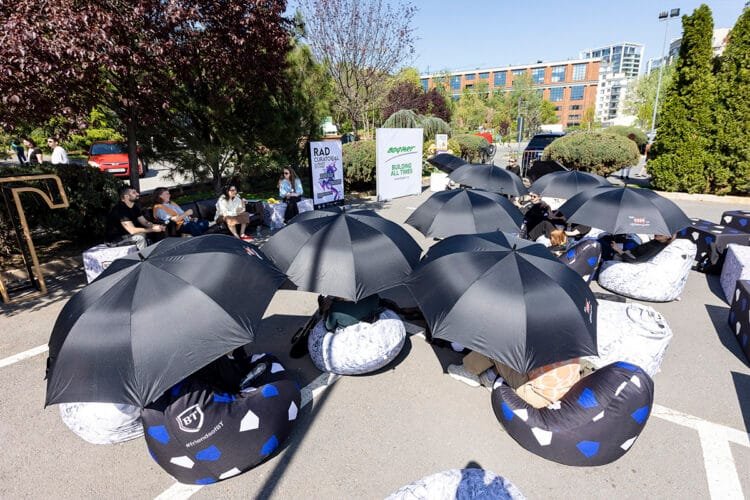
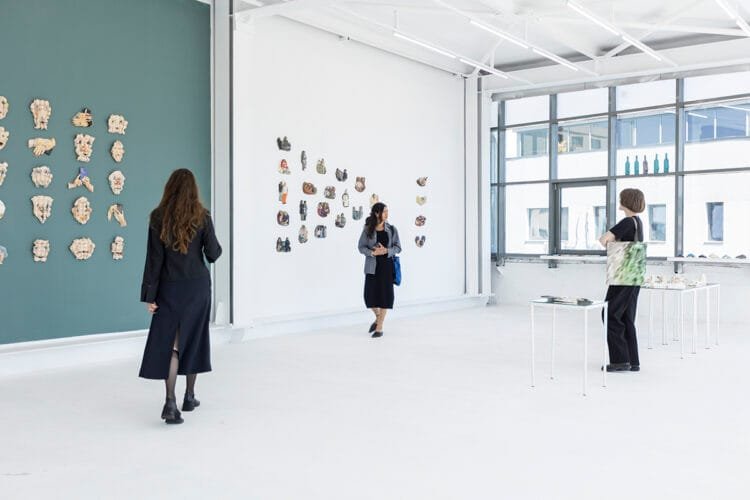
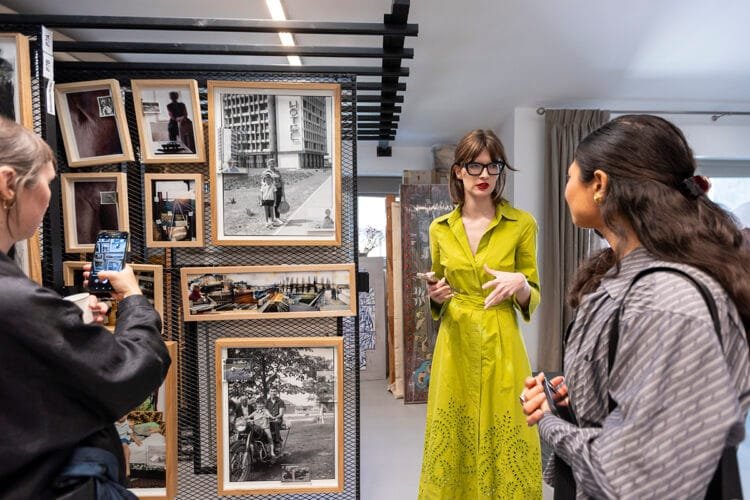
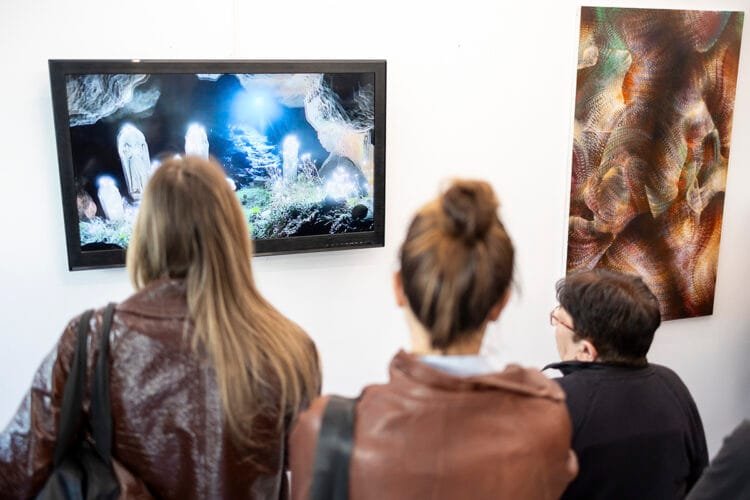
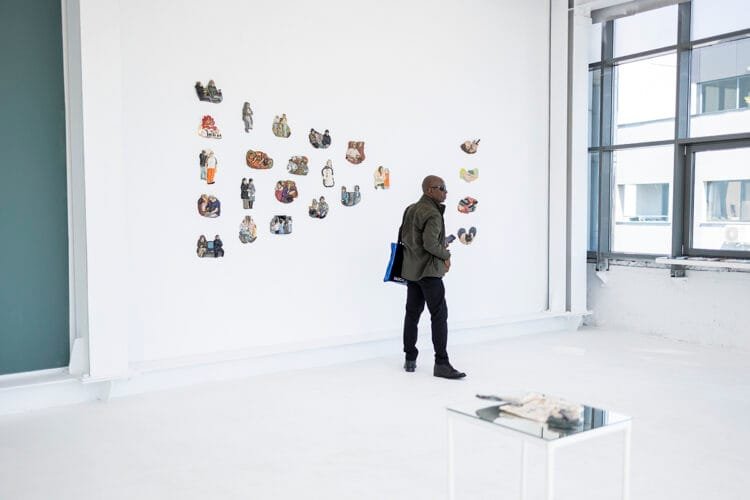
Every spring, the RAD art fair takes place at the Caro Hotel in Bucharest, bringing together a significant number of galleries from Romania and beyond. Part of the fair’s program is RAD Curatorial, a summit where curators from around the world are selected to take the pulse of Bucharest’s art scene and share their insights. The fair’s accompanying program took place April 21–26.
At RAD Curatorial, there are many intelligent people and discussions on every topic—some persistent, others brief—ranging from the serious to the frivolous. Here, useful information and business cards are exchanged in the comfort of V-Class rides between galleries. Through the tinted windows, the city flows by with its apartment blocks, villas, and trees, all while discussions revolve around taxation, collectors, budget cuts, management styles, the art just viewed, opportunities on other continents, what kind of institutions they’d like to see, the usuals. An exchange takes place between multiple participants, from morning to night, to the point of depersonalization, an intensified effort for greater presence of mind, which involuntarily draws yet another business card as a counterpoint in the waltz between status inconsistency and real-life brain rot. We were all bound by a fragmentation of time that occurs in cultural work and probably in other jobs today as well.
Every year, the caliber of the invited curators rises, and applicants come from all corners of every continent, from South Africa to the Philippines. “It seems to me that interest in the program has grown, and at the same time, interest in scenes like Bucharest’s—which we might call semi-peripheral,” confides young curator Ana-Maria Ștefan, the project’s initiator. Ana-Maria felt from the very first edition of the fair that it needed an educational component. That was around 2023. It was a time when one could say that Romania and Bucharest finally had an art market, but one that was not yet accompanied by the educational aspect that the gallery system can provide. “At that time, while working at the gallery, I was in dialogue with people who were interested in the Romanian context but who hadn’t had much contact with it, or, if they had had any contact, it had happened more than 10 years earlier.”
This year’s theme was “support.” In an environment as complex as that of a curatorial summit, connections are forged that will undoubtedly lead to mutual aid, as we will see this year. The support among those who make things happen—and who may come from an oppressed position—is the element that disrupts the replication of existing hegemonic forms in the rest of society, forms that are camouflaged within contemporary art. This mutual aid allows those in the art world to continue being who they are: discordant notes in relation to the rest of reality. In one of the conferences, Simon Njami was asked about reparations, to which he replied that it is pointless to talk about them, as something broken cannot truly be repaired. After all, the term “decolonial” contains “colonial” within it. The only remedy is to start over with something new. To conceive of an entirely different system.
An underlying theme of this edition, reflecting a dynamic that grows proportionally and cyclically in the cultural sphere, is the fragmentation of time—especially in work that never ends, that branches out into diverse activities, that requires extensive interaction with so many other people, and that involves working on multiple fronts simultaneously. The curators in the program made time, not long before the opening of the Venice Biennale—when they probably should have been in several places at once—to come and be as present as possible in the experiences offered by RAD Curatorial.
“It had been a discussion about death, the body, and illness. Just as the contemporary art system often seems to crumble like the bodies of the people who make things happen. Koyo Kouoh was an institution, for example. Institutions are people. What stayed with me was time, humanity, and the body. For me, that resonated the most—the scattering of attention and how to make things more settled, more consistent, and more respectful of everyone’s time,” Ana-Maria confides to me. During the conference where Philippe van Cauteren, curator of S.M.A.K. Ghent and the upcoming edition of Art Encounters, spoke, he said that institutions are people and for people. The museum building where he works even takes into account the birds’ nests in the surrounding area. Reflecting on discussions like this, Italian curator Giulia Menegale summarizes: “The institution itself and the institutional building process that the curator undertakes within their own work should not be seen as something separate, but rather as part of our curation of the present and the future, especially in a climate that is moving toward the demolition or at least the vulnerability of institutions.”
What many of the curators note is a spirit of cooperation—at least from the outside—that is very evident between gallery owners and the other players in the scene. At least against the backdrop of the fair, from our perspective, one can sense how they collaborate, how a group of gallery owners set aside their egos and coordinate to organize a fair and related activities. German curator Julika Bosch notes how she encounters people and their names, from one context to another: artists featured in the fair are also present in the storage spaces of some galleries; a Romanian curator participating in the program is signing texts in catalogs opened at random and is set to curate future exhibitions prepared by a gallery owner featured in the fair; members of the organizing team are collaborating visibly on this occasion and with other organizations. Julika tells me: ”I’ve been to very different curatorial summits. The last one I went to was in Tunis, and I was also at another one in Amsterdam. I really enjoyed the hospitality. Like every place we went to, an effort was made. I love people preparing for different types of roles. In other places I’ve been, sometimes you see people again but not in different roles, that felt unique to me. I really liked that people kept appearing, appearing, appearing. I felt I could get a sense of the scene. And for me as an outsider, I’m not familiar with the Romanian names, I am not familiar with the pronunciation. In a curatorial summit you get to know someone very quickly and you don’t get to see their name and it is difficult to remember it. But because you got to see the same name in an exhibition, in a catalogue, it really felt like being part of a community.”
What emerges from all these visits is a picture that’s a bit broader than you might have imagined. It’s often repetitive, even over the course of days packed with visits: practices and styles, artists’ names. However, such repetition, in the grand scheme of things, may be more sustainable, even if it might not serve individual needs as well: a greater sense of community, more substantial relationships between people that cannot be achieved in a place where people are constantly coming and going, focused artists, more specificity, perhaps even a greater concern for the common good or for quality art, as it can be made. However, there is less cosmopolitanism, less direct contact with a variety of practices—or even no contact at all—and a slower circulation of ideas, possibilities, and the knowledge of what can be done and how far one can go. For many in the scene, reality, with all its struggles, is a place driven by a major comfort factor: the familiar. And the familiar can be frustrating, but it’s a safe bet. But, as one of the guest curators, Raphael Chikukwa, director of the National Gallery of Zimbabwe, put it, “the fair turns the periphery into a center, and there are so many ways in which peripheries can be centers.” As a young gallerist from New York tells one of the curators: “It’s cheaper to have my New York gallery in Bucharest.”
Speaking about the RAD Curatorial Summit, one of the participants, Adina Drinceanu, says: “The way this curatorial summit was conceived managed to shift the focus from the fair experience—from looking to thinking. In doing so, it created a space where conversations about art became just as important as the works themselves… so there is a certain blurring of the line between the viewing of art and conversations from different perspectives, which revealed the invisible structures that underpin the contemporary art ecosystem. For me, that was much more interesting than the fair itself.” As a result of the program, Adina concludes: “The Romanian art scene is increasingly confident in defining its own languages than it has been over the past fifteen years, and there is less anxiety surrounding external validation and more attention paid to methodology and how institutions are built, such as access and how long-term cultural relationships are sustained.”
Italian curator Giulia Colletti notes: ”Coming from Italy, which is a fairly older country in all senses you can imagine, I found it extremely positive the fact that very young, or fairly young, people, like people under thirty, were exposed and were very included in these processes, which is something that in Italy I wish could have happened for my generation, but it doesn’t necessarily currently happen. While you are still a student or you are still into a MA program, so in the process of shaping your own research, you are already exposed and challenged by the so-called system. This is something that in Italy is extremely rare, because in your forties you are considered a young curator or a young practitioner, and you’re going to be an established professional in your sixties, so for me this was exceptional in that sense. But I was like, what if they get burned by the system so early, at an early stage of their career? Which quite often happens in systems that are just extracting from you because of the label youth or young generation. They smoothen the process of entering the system by selecting a few artists right after finishing their university and way before they become established, so they offer them a platform where they can further develop in a sort of temporary secure state. That is something that, again, for me was like they truly think that they are a resource in the positive sense of the term. Not a resource to extract from, but a resource to brew, a resource to nurture, and a resource to think with”.
Two encounters were a perfect fit for American curator Job Piston: the works by a young Brâncuși at the National Museum of Art, those last steps before the avant-garde, and first steps into the avant-garde, and then with Paul Neagu at artwill—a bridge that “spans” the history of the avant-garde, a before and after, the latter of which is truly a “history hidden in plain sight.” “Really looking at Paul Neagu’s work as a whole across decades. And then I could trace the 60s, the exploration with material and performance. I could move through all of these different 20th-century avant-garde conceptual approaches through his work. I have a special mention for Magda Radu, the curator. She was talking about the video work and she was talking about the collages on the walls. It suddenly made me look twice, to look at it again. That was really important when she explained the obsession with the Hyphen.”
Another important visit was the tour of Ștefan Bertalan’s exhibition at the Museum of Recent Art. Nayaa Krugman, curator at SAVVY Contemporary, would see him engaging in a dialogue with an artist from the Amazon, concerned with cosmology, both in opposition and in tandem.
There was also a brief performative-participatory moment during the summit. In the conversation featuring Atabay, a Colombian-born choreographer and performance curator at HKW, he spoke about the institution’s principles of conviviality, emphasizing the importance of creating a space where “people feel comfortable being open to one another, where their bodies are not left outside the door. And by bodies, I mean their cultural background, identity, the memories stored in their experiences, their dreams, desires, and processes.”
In this context, participants were invited to engage in a short practice inspired by bullerengue, an Afro-Colombian musical style characterized by lamentation with anti-oppressive undertones. During the exercise, on the song Déjala Dí by Etelvina Maldonaldo, Atabay invited participants to stand and repeatedly shift their weight onto one foot while allowing the rest of the body to follow, then letting the hips begin to move, followed by an invitation to massage the pelvic area. Participants were then encouraged to close their eyes and touch their entire body, immersing themselves in their sensations before reopening their eyes and continuing the conference. This episode functioned as a shift from logocentric reflection toward a multisensory mode of understanding.
Following the interviews with the curators between studio visits, the visit to Larisa Crunțeanu’s studio at Malmaison was mentioned most frequently; it stood out for its variety of practices, media, and concepts, as well as for the artist’s generosity in explaining them. Among these, the newly explored extractivist theme in the video Hélène F. A (post)mining allegory was appreciated by several of the distinguished visitors.
Among the favorite works at RAD, the vast majority of curators chose Donate a Word by Victoria Zidaru. The work dominated the central area of the exhibition pavilion: textile tentacles filled with hay and inscribed with biblical verses hung from the glass ceiling. The natural lighting of the work gave “a certain type of gravity to the fair at the same time,” according to Adina Drinceanu. At the base of Victoria Zidaru’s work lies a pile of “pine cones, sticks, and dried leaves, all glazed in beeswax and knotted with a strip of cloth,” inscribed with words of blessing. To Nayaa Krugman, Victoria Zidaru’s work reminds her of Cecilia Vicuña’s Disappearing Quipu: in both, inscribed textile “tentacles” flow down from above, except that in the latter case, the Andean mnemonic system is used. Victoria Zidaru’s work would easily fit into a dialogue with works from any other part of the world that establish a connection between the earth and cosmic forces.
After RAD, Job Piston’s reaction was to quote his former governor: “I’ll be back.”


POSTED BY
Bogdan Bălan
Bogdan Bălan is a cultural journalist, art critic and cultural worker. He has collaborated with Goethe-Institut, Savvy Contemporary, Scena9, among others....
Comments are closed here.