There is a difference between imagining the future and bringing it about. The former may remain a work of fiction or a form of entertainment. The latter requires investments, territories, and resources. The future thus becomes less of a destination and more of a system of decisions that gradually takes shape in the present, sometimes in the form of a promise, other times in the form of a seemingly inevitable necessity. The exhibition “Xenofuturism,” curated by Adrian Bojenoiu at CASA—the Center for Art and Applied Science in Bucharest—takes this tension as its starting point. It brings together works by Ubermorgen, Tzusoo, Katee Kin>%, Sillyconductor, and Andrei Nacu to explore how the technology of recent years fuels ideologies, dependencies, and models of social organization.
At a time when artificial intelligence has become a tool used multiple times a day, the works in the exhibition seek to make visible the things that remain outside the images generated by innovation: the consumed resources, the hidden labor, the affected territories, the disciplined bodies, and the responsibility transferred to systems that claim to function autonomously.
Adrian Bojenoiu’s point of departure is the convergence of emerging types of reactions, the expansion of artificial intelligence, and the acceleration of capitalism. At the same time, artificial intelligence has moved from the realm of speculative scenarios into the heart of everyday life.
For the curator, the assertion that AI must be kept in check because it can be destructive—which amounts to discrimination against a potential non-human entity—is symptomatic. The moment artificial intelligence can be discriminated against, it has already acquired a form of discursive body, a status as a subject capable of claiming rights. Generated images have multiplied and succeeded one another at a pace that renders them instantly obsolete. AI has conquered the realm of visual production and circulation, and the synthetic image has become so pervasive that it can no longer be separated from the social environment that distributes it. The exhibition does not treat this situation as an abrupt rupture, but rather as a process of naturalization: a technology becomes part of everyday life when it ceases to appear as technology.
In this context, the idea of “hypersition” persists: fiction that, when repeated often enough, begins to produce the reality it describes. The models of social organization promoted by tech circles, digital citizenship projects, and discourses on artificial intelligence are not merely fantasies. They attract capital and influence decisions, taking root among the public before being fully implemented. Fiction becomes a form of groundwork.
Bojenoiu constructs his curatorial framework based on the notions of territorialization and deterritorialization formulated by Gilles Deleuze and Félix Guattari. Every social form relates to a territory, but this territory can be dismantled, relocated, and replaced. In the 1990s, these ideas were taken up by the British group centered around Nick Land and Mark Fisher, who eventually parted ways politically: Fisher toward left-wing criticism, Land toward right-wing accelerationism.
In Bojenoiu’s interpretation, this deterritorialization has been transformed by capitalist accelerationism into a program for increasing capital. Instead of a reformed society, structures are envisioned in which the state is treated like a company, and technology becomes the tool through which capital breaks free from institutional constraints. Projects associated with Peter Thiel, including Praxis Nation and the ideology of The Network State, can be understood within this logic.
The Network State proposes a reorganization of the state from a network perspective. The citizen is replaced by the “cryptonative,” an individual defined by membership, reputation, and rating. Territory is no longer necessarily a shared space, but rather a technological community capable of producing its own forms of citizenship, passports, and infrastructure. Some projects have been launched in the Philippines, and in Paraguay there have been attempts to actually build such communities.
For Bojenoiu, these projects are both appealing and alien at the same time. They seem to stem from a world of limitless accumulation, in which people who have exhausted the possibilities of material expansion invent new forms of society and new representations of the future. But it is precisely this hyper-acceleration that makes them difficult for most people to inhabit imaginatively. While technological elites propose new territories and models of statehood, immediate reality remains shaped by the climate crisis, precariousness, and the material costs of digital development.
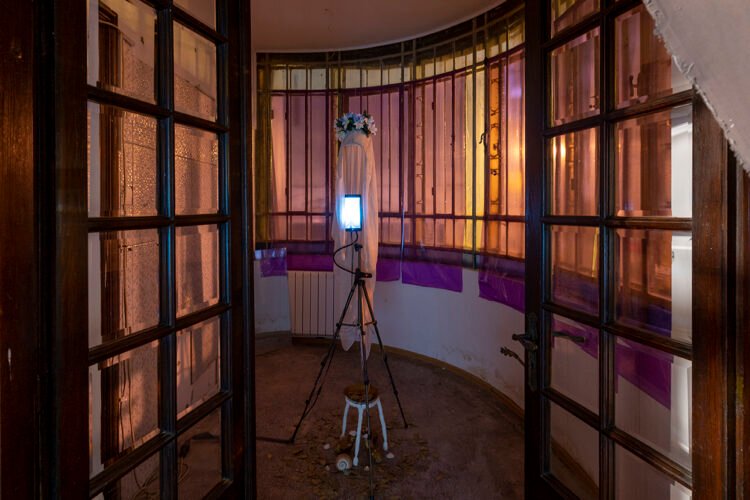
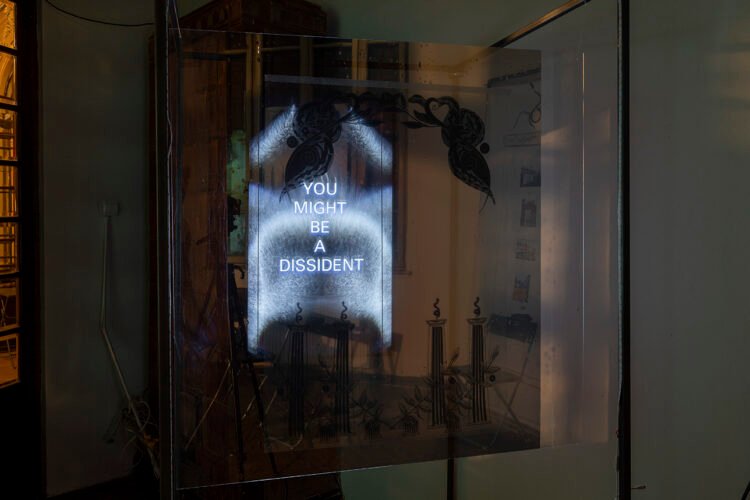
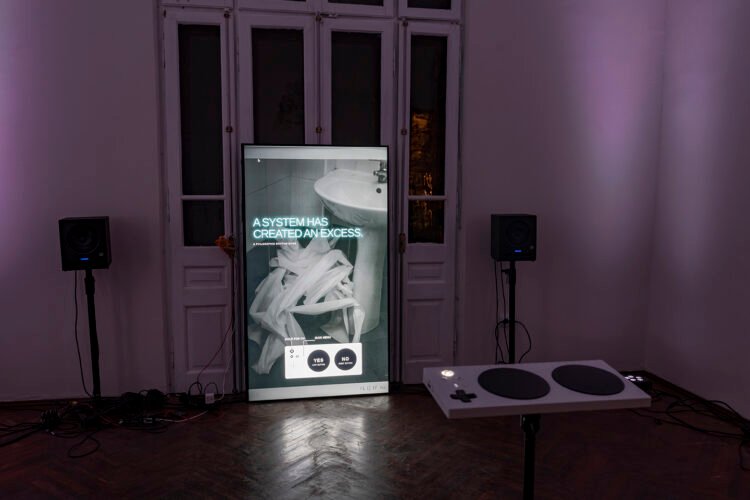
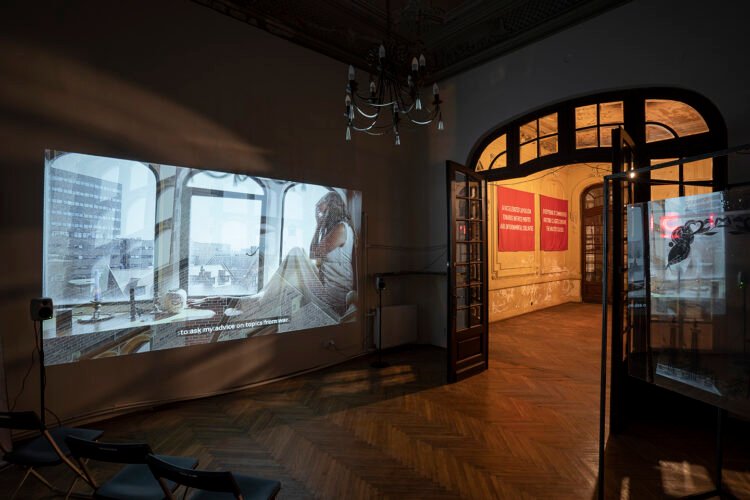
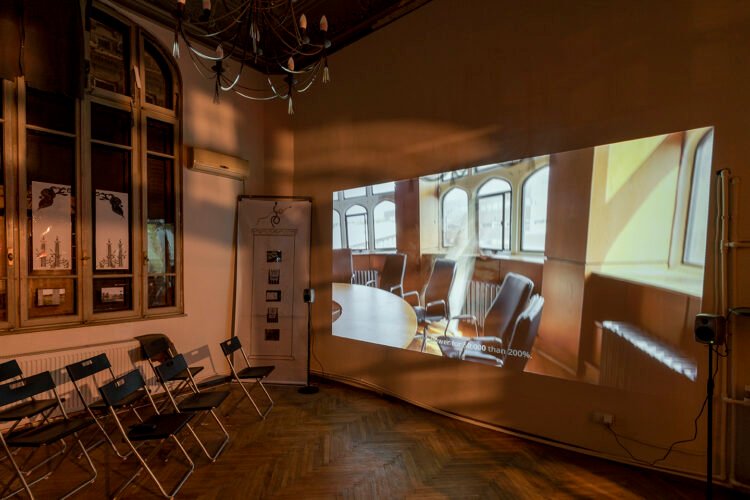
Katee Kin>%’s work translates this tension into an installation consisting of a film featuring a dancer, an interactive mirror, and smaller-scale works—excerpts from images present in one form or another in the video—that reference ancient Greek architecture and data centers. The artist, a PhD student at the University of Newcastle, explores fatalism through algorithmic systems. She is interested in how these systems assert power over our lives and limit individual agency. Kin>% came across the figure of the Oracle of Delphi while researching for this work. In accounts of the Pythia, the priestess delivered prophecies by inhaling vapors rising from the ground. The temple was located in an area crossed by geological faults, and the vapors may have contained ethylene. While studying data centers and their cooling systems, the artist encountered ethylene in another context: in the production of refrigerants. The parallel between the ancient temple and contemporary infrastructure thus become material, not merely symbolic.
Both are predictive technologies. The oracle interprets signs and conveys a possible future; AI systems use past data to generate a prediction. In both cases, people seek to externalize their anxiety in the face of uncertainty. Kin>% evokes Albert Camus and the difficulty of enduring a universe devoid of preestablished meaning. Art, unlike a predictive system, can function as an exercise in ambiguity: it need not resolve uncertainty, but rather teach us to remain within it.
The interactive mirror in the installation offers visitors predictions formulated using modal verbs: “you might get this job,” “you could pass the test,” “maybe it will happen.” In place of the categorical statement “you will do this,” a fragile possibility emerges. The artist introduces an essential distinction between prediction and pronouncement. The system no longer claims to know the future, but rather presents it as a field of possibilities.
Behind this mirror, however, lies a deeper issue. The motto inscribed on the Temple of Apollo, “Know thyself,” is juxtaposed with a reading of Shannon Vallor’s book The AI Mirror. The threat posed by AI lies more in the loss of our ability to know ourselves than in some distant apocalyptic scenario. AI systems tell us more and more about our behaviors, preferences, and identities, and we risk accepting the algorithmic interpretation as a more accurate description of the self than our own experience.
Kin>% recalls that in Herodotus’s Histories, the Oracle of Delphi claims to know the number of grains of sand and to hear the voices of the voiceless. These two abilities, knowing and listening, become political questions in the piece.
The film takes place in two locations: a cave on the coast near the artist’s home and a boardroom at Newcastle University, a place associated with decision-making and authority. The cave is located on the same coast where a data center is set to be built, in the Cullercoats area.
This choice of setting takes on an added dimension after a data center developer referred to its opponents as “cave people,” using the phrase both as an insult and as an acronym for “citizens against virtually everything.” For Kin>%, the irony is obvious: culture and art have their origins in caves. The “cave man” is not necessarily an adversary of progress; he may be the one who reminds us that no technological future exists apart from people and territory.
The artist has repeatedly visited the site where the data center is being built and has followed the project’s progress. In the United States, there is already evidence of the effects of such infrastructure on communities and the environment. Europe could anticipate the consequences if it were to heed this evidence, but the industry’s narrative prefers to focus on promises: jobs, economic growth, and greater efficiency. The film also includes references to Praxis Nation, funding linked to Peter Thiel and circles close to Palantir, as well as to longtermism. This ideology places great importance on the well-being of future generations, sometimes so distant that the problems of the present become negligible. In its most problematic form, longtermism can end up justifying funding for tech companies that promise to save humanity, rather than addressing existing crises. Kin>%’s oracle does not provide definitive answers. The future can be calculated, but it is not exempt from responsibility for its own actions.
For the Ubermorgen collective, technology is a testing ground. Founded in 1997 as a net art project—initially a duo and later a family-run group—Ubermorgen has frequently worked through conversation, travel, and media hacking. The group’s current interest in AI continues this same strategy: using technology to test its limits and anticipate problems that may not become apparent for several years. The project in the exhibition is part of a broader cycle titled Ugly. The version presented in China was called Smooth, and the installation in Bucharest is titled Care.
Billie, a member of the Ubermorgen group, explains that the project stemmed from a puzzlement regarding the aesthetics of the contemporary right. In Austria, where she grew up, school lessons on Nazism and its propaganda left a strong visual impression on her. Leni Riefenstahl’s Olympia constructed an ideal of perfect beauty and formal order. In today’s right-wing aesthetics, Billie no longer recognizes the same aspiration toward perfection. In its place, something ugly, excessive, and contradictory has appeared, yet it continues to communicate and produce political effects.
Ahead of the 2016 U.S. elections, Ubermorgen went on a “family trip” to the United States and stayed at the Trump Hotel precisely to expose themselves directly to a space they considered symptomatic. The golden plastic toilets, swimming pools, fountains, and the extreme heat of Nevada produced what Billie describes as a feverish nightmare: a mixture of luxury, kitsch, excess, and cheap materiality.
In Venice, at the 2026 Biennale’s pre-opening event in the Russian pavilion, the DJ, the dancing, the masks, the video of a horse in a Siberian landscape, and the line “it’s okay, you can go home” created yet another situation impossible to reduce to a single interpretation. The strange images clashed with the free drinks, smoking on the balcony, and the atmosphere of hospitality in a setting that simultaneously evoked comfort and unease. For Billie, such scenarios in which incompatible worlds collide and, absurdly, become coherent serve as research material for Ugly. They are not the direct subject of the installation, but rather experiences through which the artist seeks to understand how the aesthetics of power communicate and which have fueled the work.
In Bucharest, the installation was adapted to an architecturally distictive house, rather than a traditional museum like the one in Shenzhen, where the first version had been presented. In China, the white-painted servers formed a clean, restrictive, and conformist structure, where separation from the public was part of the message. In Bucharest, the work became freer and more organic, so as not to create the impression of a set imported into a space that does not belong to it.
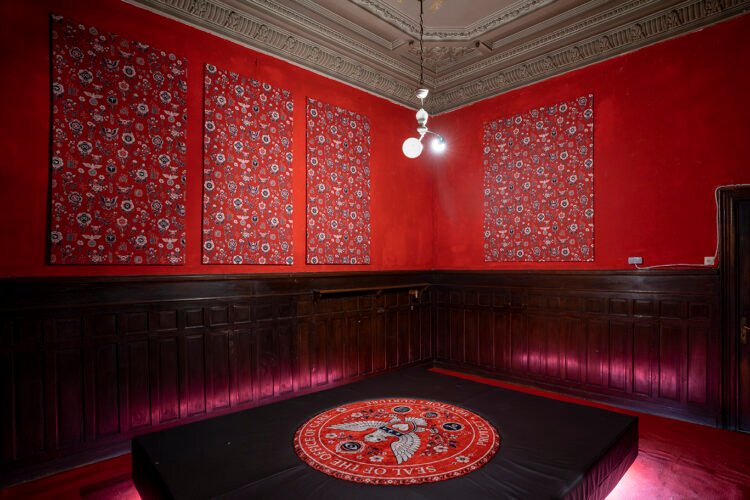
At the center of the installation is a bed on which visitors can lie down. Billie composed the sound emitted by the object, and the black leather covering its surface serves primarily an acoustic purpose: it helps transmit the vibrations produced by the wooden structure. The bed offers comfort, but it is not a neutral object. It transforms care into a sensory experience and, at the same time, into a form of influence over the body.
Liz designed the space and the textile. Red was chosen to anchor the installation and give it a more aggressive presence. The aesthetic draws inspiration from the flowers and patterns of an old sofa in her grandmother’s house, but replaces the pastels and greens with an intense color palette. The fabric features logos from companies such as Tesla and Palantir, inserted where the flowers would be.
In Ubermorgen’s visual identity, the bird in the logo is smiling. The group uses what Billie calls “cutification”: the visual taming of symbols that might otherwise be authoritarian or threatening. A solemn eagle inspires caution; a cute, smiling bird lowers one’s guard. The message becomes: you don’t need to worry, you don’t need to look any further, everything is fine.
Herein lies the ambiguity of the title Care. While the version in China told the audience how to feel, the installation in Bucharest tells them that whatever they feel is acceptable and that the work will take care of them. It is a form of care that, however, crosses a line: it takes control of the visitor’s emotional state. Care is no longer the opposite of control; rather, it becomes one of its most pleasant forms.
This relationship between comfort and control continues in Sillyconductor’s work, an app transformed into a four-level game. The participant must maintain a rhythm by pressing two buttons, while preserving the relationship between sound and image. As the rhythm is maintained, the light intensity increases.
At the same time, texts about technology appear on the screen, some in the form of questions, others as slogans. If the participant starts reading, they become distracted and risk losing the game. To continue, they must choose between two activities: reading the message or keeping the mechanism running.
The work transforms a familiar mechanism into a physical experience. We know that scrolling and the constant consumption of images capture our attention, but we can’t seem to break free from the cycle. Attention is no longer just a mental faculty, but an economic resource. Life lived online is transformed into capital for tech companies, and personal data can become consumer profiles, voting preferences, and potential buyers.
Sillyconductor also works with the logic of dopamine. The reward does not come only when we receive the desired image, but especially in the anticipation of it, in predicting the next stimulus. Digital systems keep us connected through the promise that something is coming, more so than through the content itself. The game replicates addiction and makes the visitor participate in it.
In South Korean artist Tzusoo’s work, artificial intelligence is used in a family context. After her grandmother’s death, her family asked her to prepare a photograph for the grave. There was no suitable portrait, so Tzusoo began combining family photos and modifying the image. The result was that all the generated images resembled the grandmother but did not represent her. The family could recognize the resemblance, yet they always reached the same conclusion: that wasn’t her. AI could reconstruct features and produce the visual continuity of a face, but it could not recreate the person.
Tzusoo recorded the conversations with the family and filmed her desktop, which resulted in a video about negotiating the representation of a loved one. In this work, the AI becomes the medium for an emotional negotiation: how much of a person can be reconstructed, what exactly is lost, and who decides when an image is close enough to the original. Here, the problem of representation is not a technical one. Not even the most convincing image can reconstruct the relationship between the image and the absent person. The difference between “it looks like her” and “it is her” remains subtle at the level of the image, but decisive at the level of mourning.
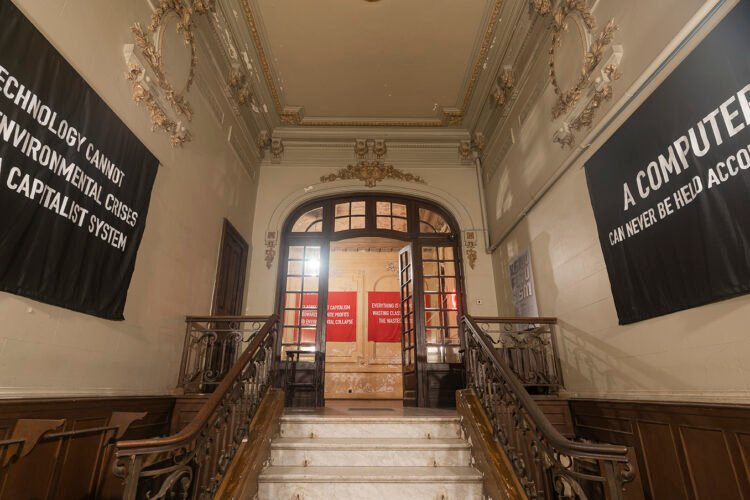
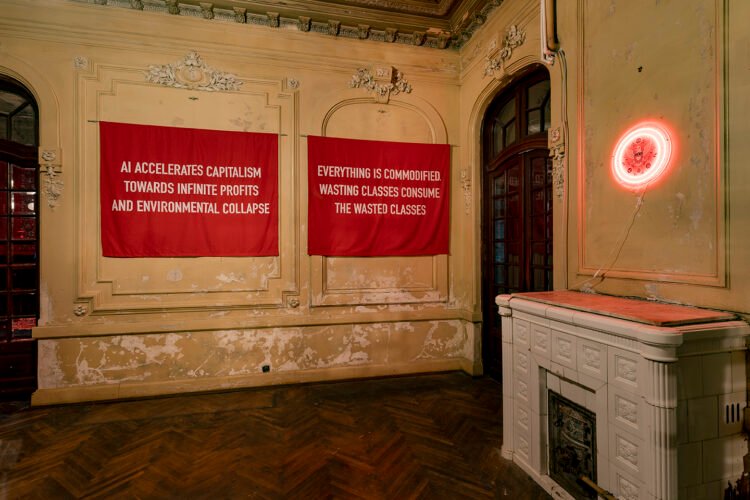
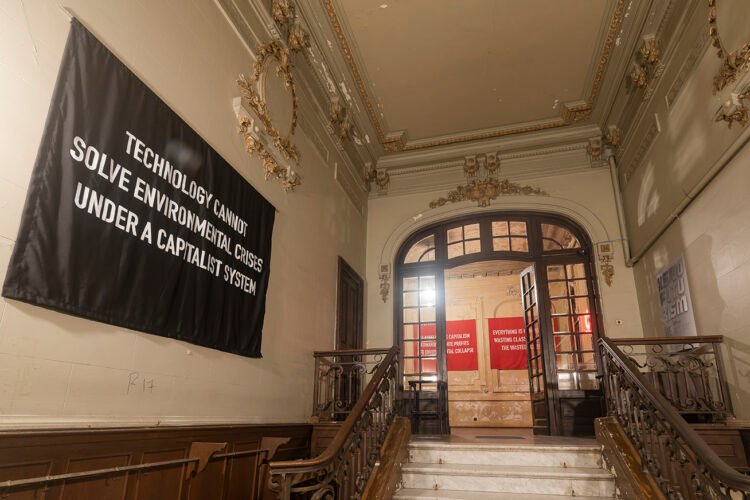
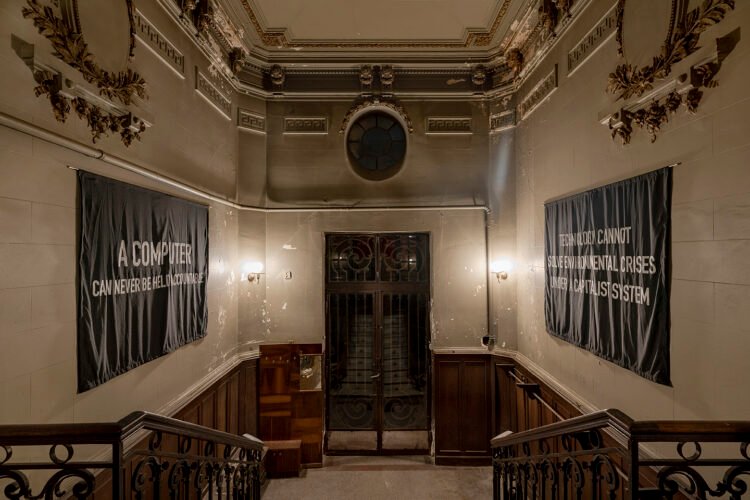
Andrei Nacu shifts this discussion from the emotional realm to the material infrastructure of technology. The artist presents two components: a series of hand-painted textile banners in the format of street protest signs, and a room filled with electronic waste.
Nacu begins with what he calls polycrisis, the convergence of ecological, economic, and geopolitical crises, but focuses his work on the material consequences of technological progress. In the capitalist system, innovation can accelerate extraction, exploitation, the precariousness of labor, and environmental destruction; therefore, it is not neutral. Waste does not appear at the end of the process as an accident, but is produced alongside value.
One of the banners reproduces the statement “A COMPUTER CAN NEVER BE HELD ACCOUNTABLE,” taken from a 1979 internal IBM presentation. In the era of opaque algorithms, the question becomes: who is accountable for the decision-making systems and for the economic and military infrastructures that use them? Invoking the moral responsibility of a machine can obscure the responsibility of the people and institutions that design and use it.
“AI ACCELERATES CAPITALISM TOWARDS INFINITE PROFITS AND ENVIRONMENTAL COLLAPSE” and “TECHNOLOGY CANNOT SOLVE ENVIRONMENTAL CRISES UNDER A CAPITALIST SYSTEM” challenge the promise that innovation could fix the crises caused by the logic of accumulation. “WHO IS RESPONSIBLE WHEN THE ALGORITHM KILLS?” brings the issue into the realm of automated military decisions and the loss of human life, in relation to the genocide in Gaza, the attack on the girls’ school in Minab, Iran, and the war between Russia and Ukraine. The other slogans, “INFINITE ECONOMIC GROWTH ON A FINITE PLANET MEANS STRUCTURAL GENOCIDE” and “EVERYTHING IS COMMODIFIED. WASTING CLASSES CONSUME THE WASTED CLASSES,” place social class at the center of the analysis. Profits and costs are not distributed equally. Some classes and territories are transformed into resources, others into dispensable surplus.
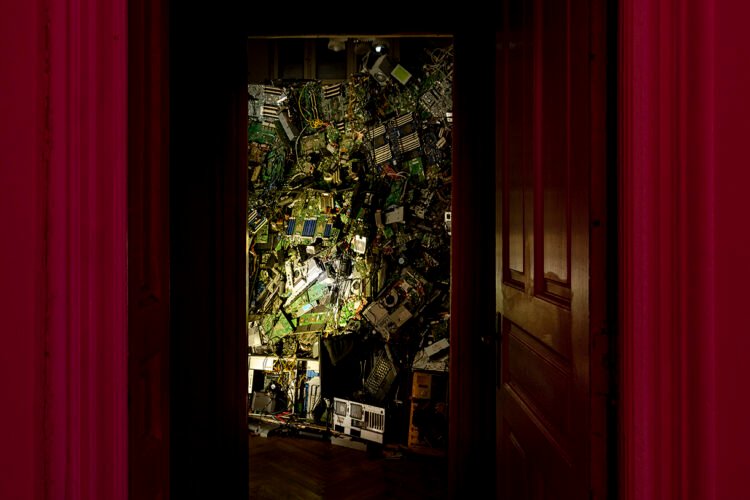
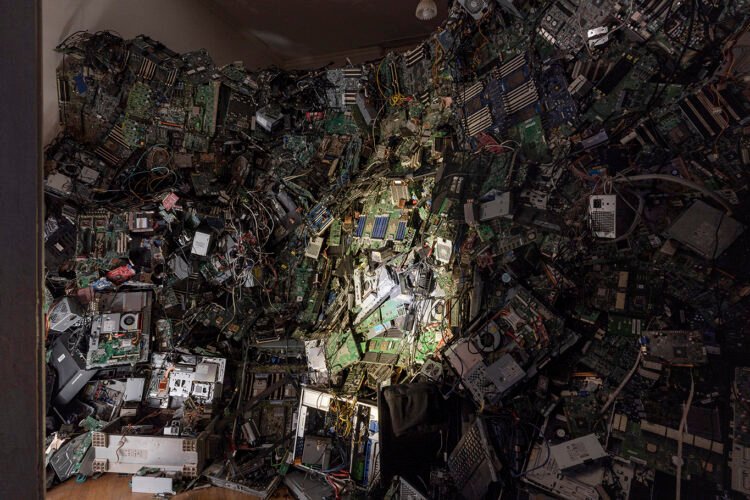
In the installation room, decommissioned hardware components (old monitors, CPU cases, motherboards, integrated circuits, graphics cards, power supplies, cables, and cooling systems) come from collection streams managed by ECOTIC and Ateliere Fără Frontiere. Nacu did not set out to create an orderly sculpture or a selection of spectacular objects. The components are mundane, and that is precisely why they are overwhelming.
They form an avalanche of e-waste that invades the space. The visitor is forced into an almost claustrophobic relationship with the material substrate of technology. Monitors and circuit boards no longer appear as the invisible pillars of the digital world. They become an accumulation of waste, with a volume that cannot be ignored.
Nacu’s point of departure is The Accumulation of Waste by Ali Kadri, in which waste is one of the constitutive products of capitalist accumulation, not something external to it. According to Kadri, so-called advanced technology is manufactured through the violent extraction of resources and specialized labor, only to become, in a very short time, useless, “dead labor,” and toxic waste. The banners articulate the issues discursively, while the room embodies them. The text states that AI accelerates capitalism toward infinite profits and ecological collapse, while the pile of components shows what remains after this acceleration. In Nacu’s installation, progress becomes an economy of perpetual replacement, one that disregards any reference to an upward trend on a graph.
Viewed together, the works in “Xenofuturism” do not form a demonstration with a single conclusion, but rather a series of situations in which technology becomes visible through its effects: an oracle that rejects certainty, uncanniness, the welcoming appearance that masks control, sometimes a game you cannot escape without losing, the hidden infrastructure of progress as a material avalanche.
Adrian Bojenoiu calls this territory xenofuturist because the future no longer appears as a shared promise, but as a world designed by someone else and for someone else. The exhibition shows that the problem is not the existence of technology, but the lack of transparency in the relationships that produce and use it. The future can be imagined in data centers, in networks of digital citizenship, or in algorithms that promise to describe us better than we describe ourselves. But any future needs matter, that is, territories, materials, which are active in themselves, and bodies. There is no network without cables, no comfort without labor, and no innovation without waste.
Perhaps this is the point at which the exhibition becomes truly critical: when it forces us to look at what is already here, not just to fear what is to come. The future does not arrive all at once. It repeats itself, becomes normalized, and accumulates until it begins to resemble reality.
Translated by Marina Oprea


POSTED BY

Bogdan Bălan
Bogdan Bălan is a cultural journalist, art critic and cultural worker. He has collaborated with Goethe-Institut, Savvy Contemporary, Scena9, among others....