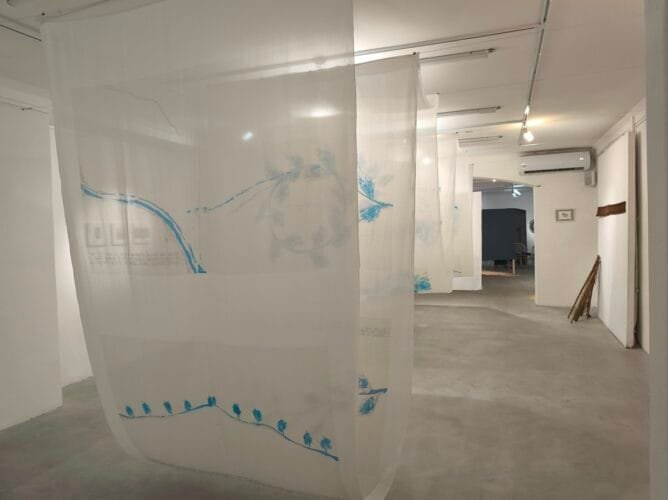
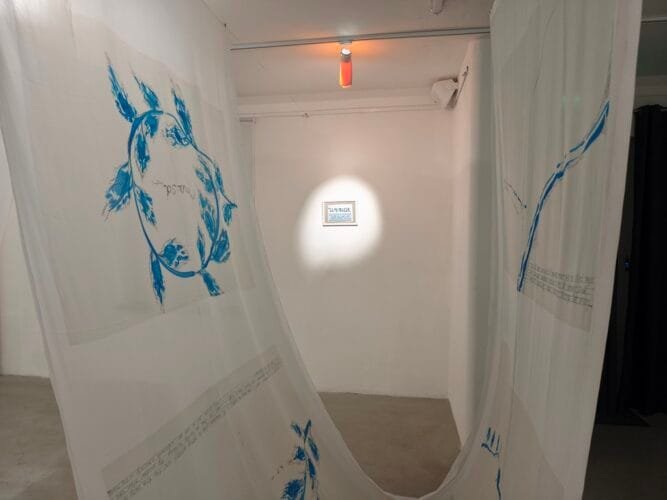
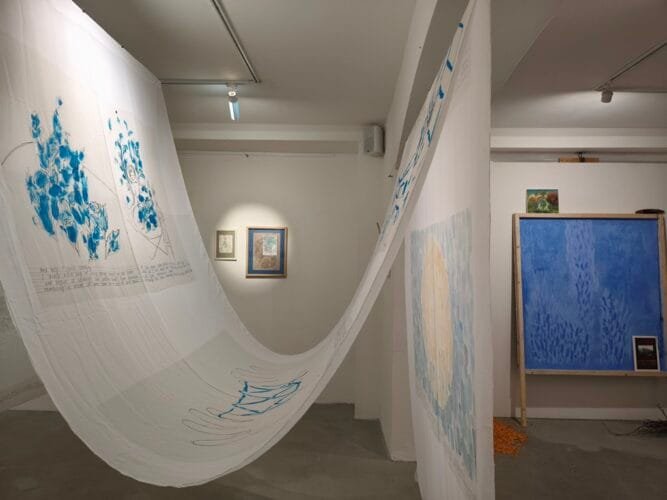
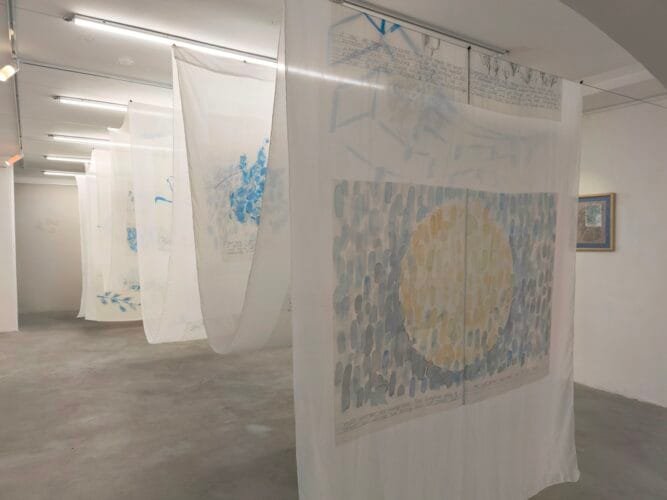
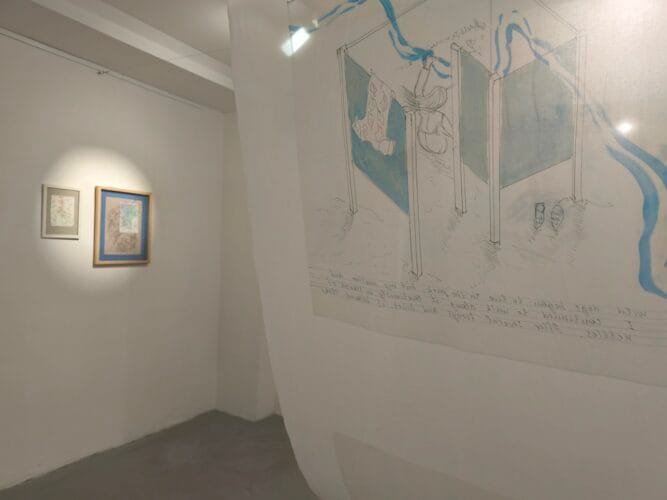
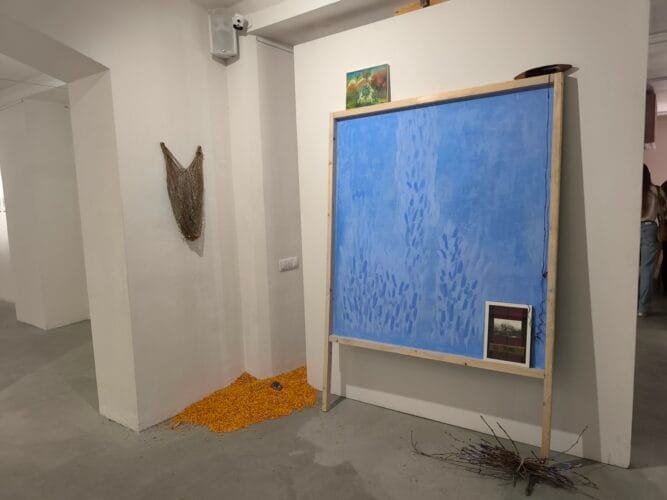
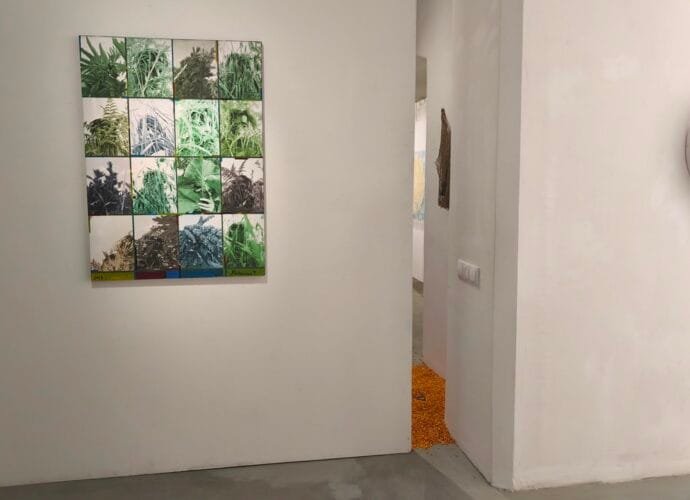
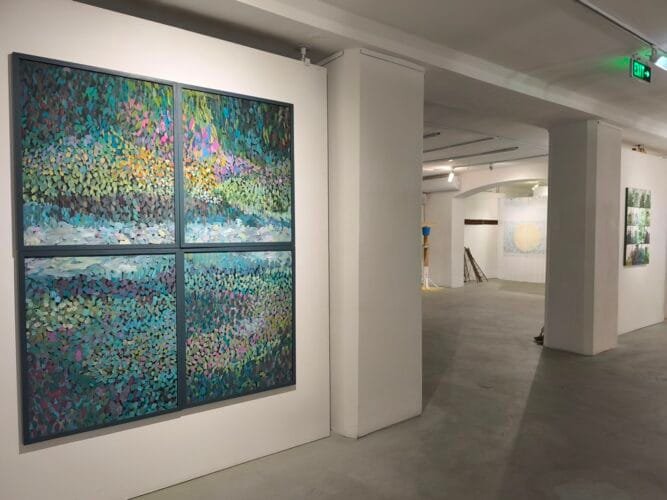
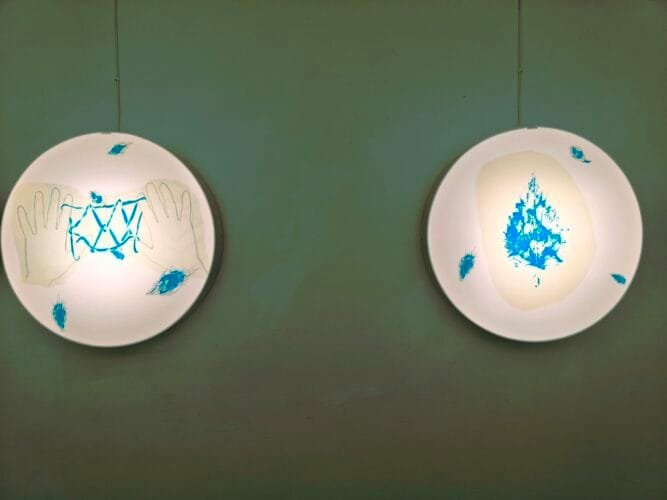
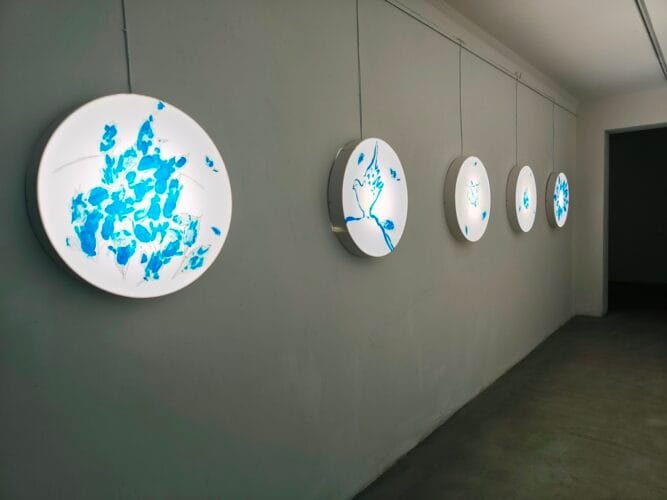
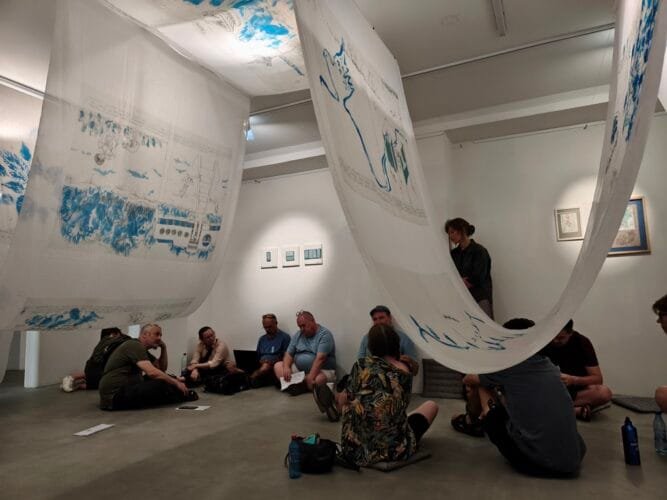
Upon entering the exhibition by artist Tatiana Fiodorova-Lefter, we are preparing to make the journey the artist has made many times as a child, we are outlining the same landmarks the same trails, we are floating through the waves of a memory map. There is in front of us a canvas, with drawn out spaces and texts, it is the centerpiece, it’s both the serpentine wave that engulfs us, and the sails of a ship that will get us through.
We are now on the quest to re-construct the journey of collecting nettles for the porridge made frequently by the artists’ grandmother and mother, we are inheriting this journey through the urban jungle, and walking it in solidarity with the artist. Something deeply personal becomes a connective and collective experience. It is not unusual for the artist to walk the line between personal and collective, and in this project she is questioning the validity of a narrative, opting for a sort of an inter-subjectivity rather than a purported objectivity.
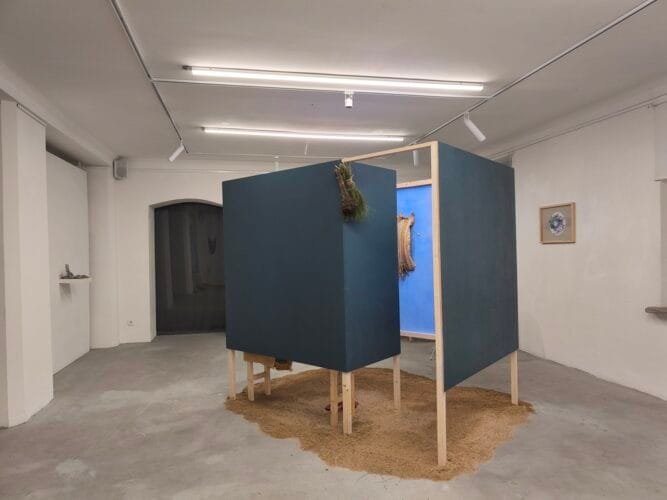
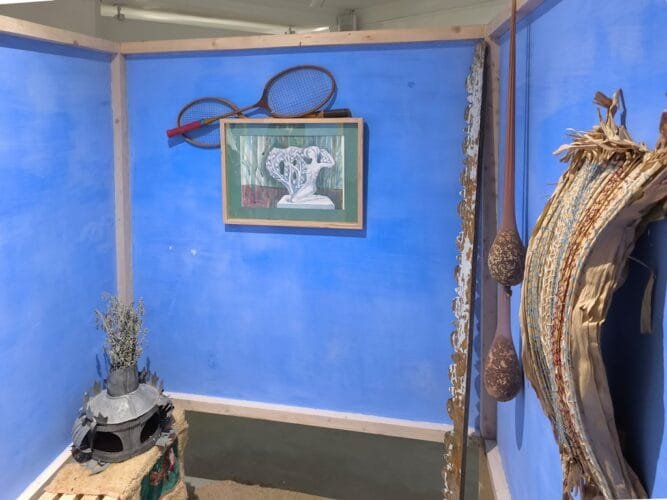
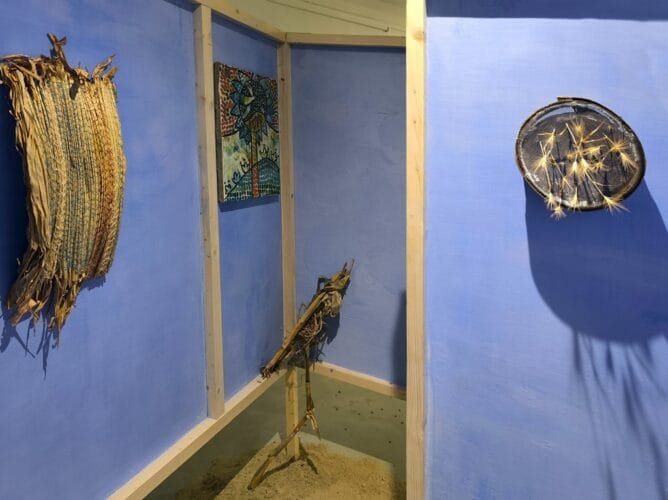
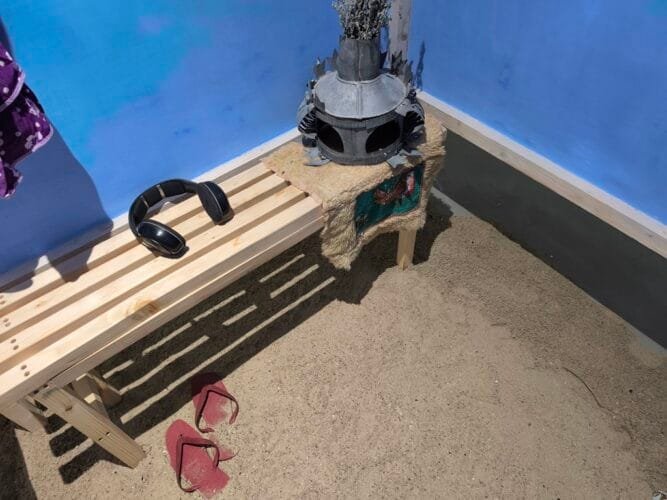
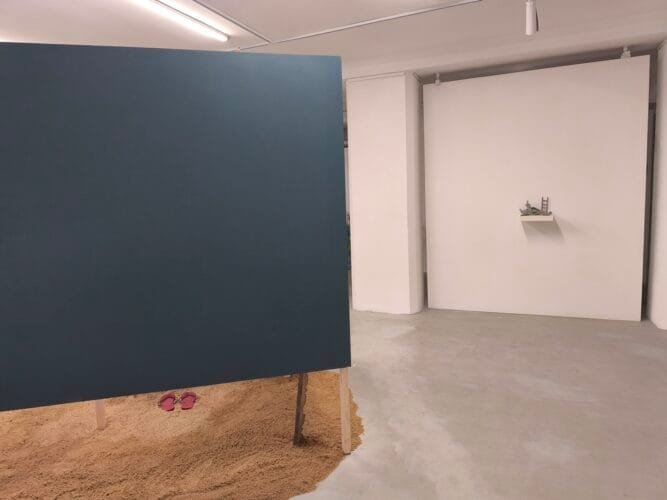
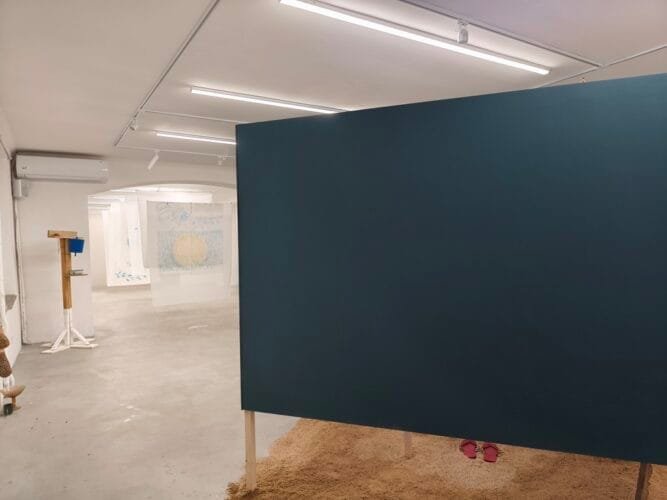
Somewhat further down the line, we have to make a stop, we are entering the changing booth, plopped neatly onto an island of sand, a sort of a sanctuary, a carefully decorated square box as if plucked from an urban lake beach. Upon entering the booth, we lose sight of the rest of the exhibition, and by limiting our view of surroundings we are offered an immersion into the association to the actual place where a booth like this would belong. It is as though we need to isolate ourselves into this small excerpt to be able to have before us its place of reference.
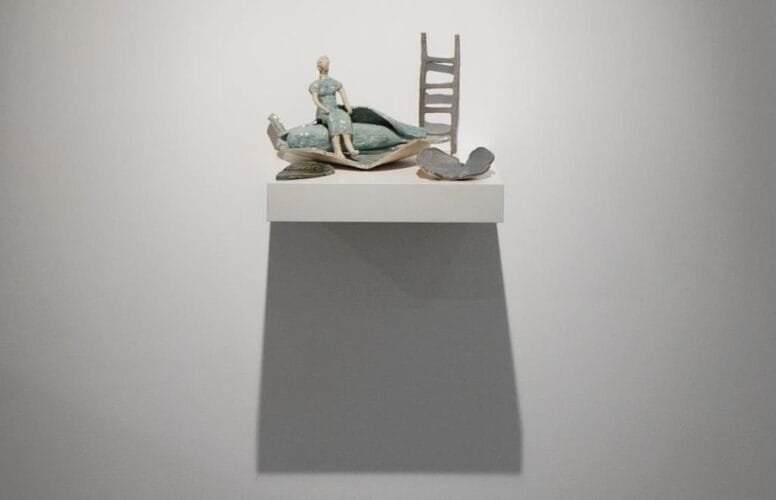
In general, it feels very much, that the exhibition is a patchwork quilt of memories and quoted objects it is as much assembled as it is created, there are these lovely delicate things, be they ceramic sculptures or charming watercolors that are softly sprinkled throughout. The space we navigate feels like a library of memories, where each object or construction serves as an entry point into a specific moment, a specific experience.
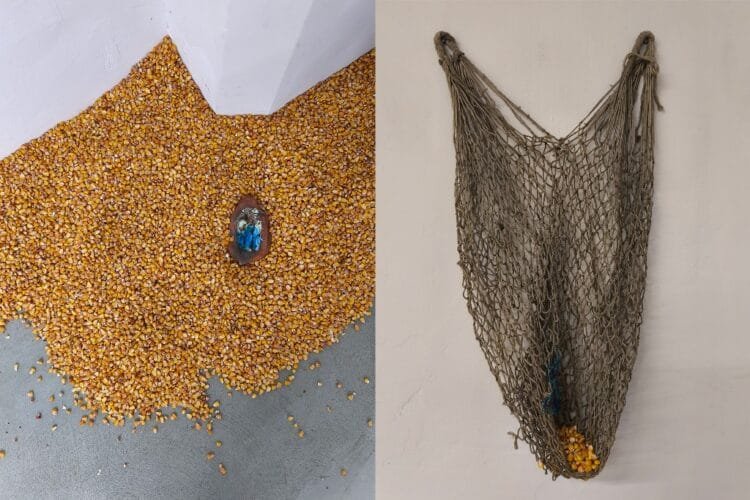
There are leitmotifs, like the very distinct blue of Moldovan houses and wicket gates, the corn, nature gushing through abandoned urban layouts that are present in the broader search of the artist presented here from the perspective of a post-colonial analysis.
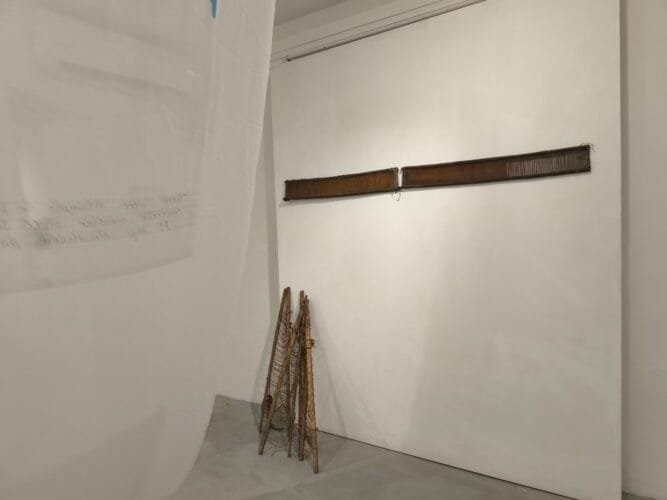
The artist is a collector of objects consolidated or plucked out of their surroundings as they are, objects that accentuate the almost incidental nature of what becomes emblematic and what gets lifted into the rank of “traditional”, or “authentic” and the journey it generally makes to achieve said status. It is both a recollection and an investigation. Is what culturally authentic, naturally autochthonous? Corn travelled across the ocean to become such an indispensable part of our diet and to find its yellow hue, most emblematic for our lands.
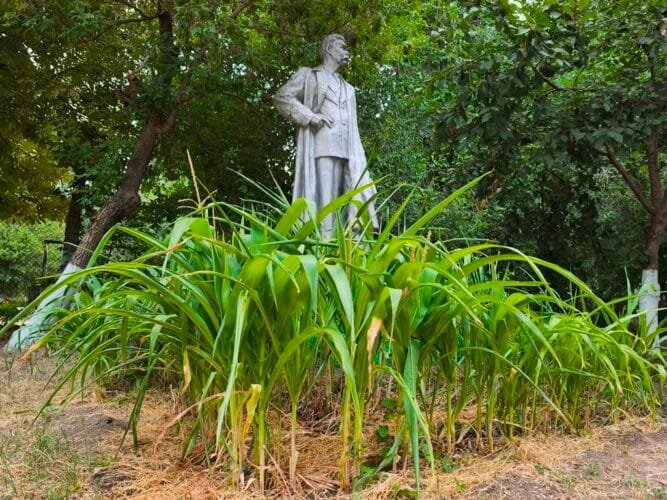
A unique property of this exhibition is that it feels both still and in motion. The corn is growing in the yard next to the lifeless, motionless soviet vestige that is the monument to the poet M. Gorky, the wavelike canvas snaking its way through delicate watercolors and objects. The rug – a never-ending snail house, continuously expanding in circumference via the efforts of ever incoming weavers.
We are walking the road of the nettles. We are searching for a true experience, extrapolated from narratives dictated by “the winner”, we find through the artist’s gaze that nature as a conduit of information is just as powerful as culture and perhaps more impartial. In an essential way this exhibition is a longing for a more embodied, intimate truth, after not quite resonating with all the versions told, and re-told by all the iterations of the state through which the artist lived. She is not looking to align herself with a specific narrative, nor is she attempting to brutally dismantle any of them, instead she is trying to frame the personal as universal. In order to decolonize one’s own history one has to break away from an offered narrative in favor of the reclamation of the personal, subjective experience.
It would be a simple and understandable mistake to confuse the personal with the apolitical, with an escapist fantasy. But in a place like this, with complex colonial and imperial reverberations, the private and the personal, the stories of people and nature, can become a guiding light through histories told by powers that be.
Nettle Garden by Tatiana Fiodorova-Lefter, as part of the broader research project “In the Ruins / In Search of Identity,” was presented in the fellows’ exhibition “The Secret Life of Plants and Trees” (Innsbruck, 2023), at Contemporary Art Week (Plovdiv, 2024), in the group exhibition “Grey is a Cube, Blue is an Ellipse” (Amiens, 2025), at the Green and Just Transition Summit (Chișinău, 2025), at “Nature After Nature” (Timișoara, 2025), at “Affective Ecologies” (Iași, 2025), and the audio work “Urzica,” part of the research, was presented in the project “Borders are nocturnal animals” at the Palais de Tokyo (Paris, 2025), at the Contemporary Art Centre (Vilnius, 2025) and as part of The Listening Biennial (Berlin, 2025), as well as in solo exhibitions at Galeria Plai (Chișinău, 2025) and Galeria Camera K’ARTE (Târgu Mureș, 2025), exploring interdisciplinary themes of identity, memory, and ecology.
Translated by Marina Oprea


POSTED BY

Elena Casiadi
Elena Casiadi is a cultural worker and art critic, with educational background in contemporary philosophy and art management....
Comments are closed here.