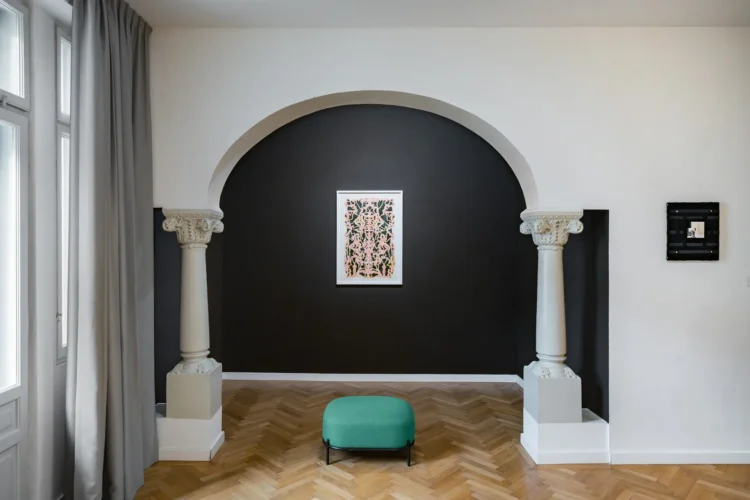
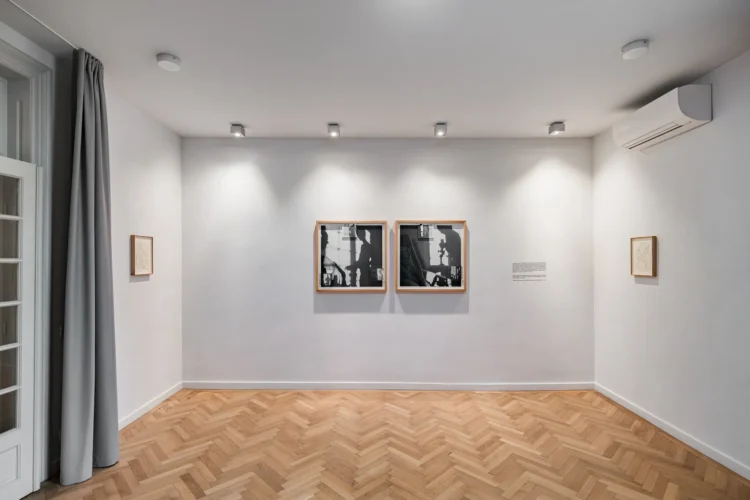
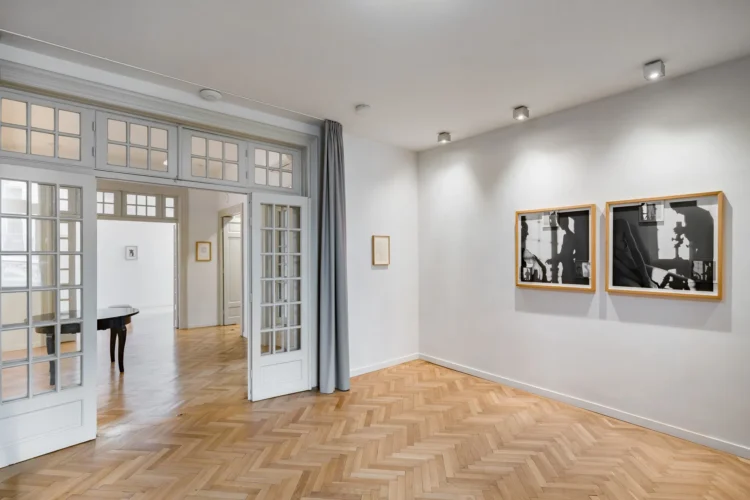
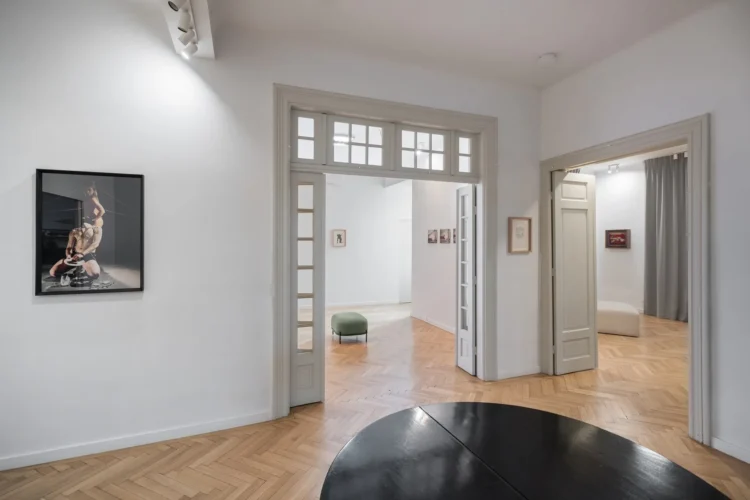
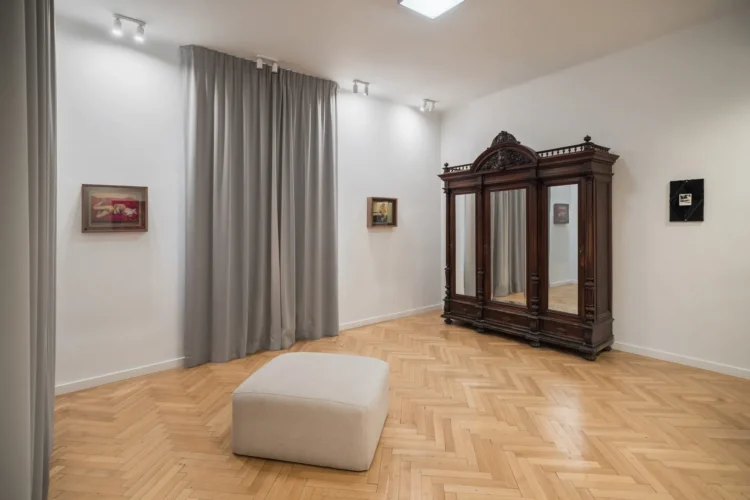
In a contemporary social climate marked by a worrying recurrence of conservative discourse and the digitization of gender-based violence, the female body continues to be treated more as a territory of biopolitical dispute than as a nucleus of subjective autonomy. Against this backdrop of ideological tension, the group exhibition “WANT,” hosted by Salon de Papier in Bucharest, presents a curatorial narrative that is, at first glance, bold and sorely needed. It is directly inspired by the volume edited by Gillian Anderson, which, half a century after writer Nancy Friday’s pioneering work, revisits the documentation of female erotic fantasies.
Hosting the “WANT” project at Salon de Papier—an event marking the recent Romanian translation of the volume edited by Gillian Anderson, published by Editura Trei—fosters a fruitful connection between curatorial discourse and the specific nature of the working environment. Here, paper becomes more than a mere physical medium; it carries a historical significance tied to intimacy, serving as the traditional vehicle for the diary, the quick sketch, or the nuanced letter. In contrast to the often clinical dynamics of the digital visual realm, the texture of paper restores the tactile dimension of experience and fantasy. Thus, a coherent translation takes place from the written word to the visual image, transforming the gallery into a space of intimate resonance, conducive to reflection and self-revelation.
To understand the significance of the exhibition, we must first analyze the internal dynamics of the volume edited by Gillian Anderson. As a political project, this anthology is a triumph of the democratization of the female erotic imagination, completely abandoning “the male gaze” and commercial conventions in favor of a raw mosaic of the female imagination.
This attempt to reclaim visual and narrative autonomy comes as a direct reaction to a profoundly asymmetrical art history. For centuries, the female body has been placed at the absolute center of representations of eroticism, sexuality, and nudity, yet almost exclusively as a passive object of the male gaze and consumption, rather than as a creative subject. This paradoxical “hyper-visibility without representation” was best summarized by the famous 1989 manifesto of the activist group Guerrilla Girls: “Do You Have to Be Naked to Get into the Met?” which highlighted the fact that, while less than 5% of the artists in the modern art section were women, 85% of the nudes on display were female.
This historical disparity has not disappeared in the contemporary era but has become embedded in market and institutional mechanisms. Recent data from the global art system speak for themselves: according to the influential Burns Halperin report, between 2008 and 2020, only 11% of acquisitions by major museums in the United States were works by female artists. The disparity is even more glaring in the secondary market, where works by women account for a minuscule percentage—approximately 2%—of the total volume of sales at global art auctions. In a system where aesthetic and financial value is still monopolized by the male signature, and the female body remains an extremely profitable visual commodity yet deprived of its own voice, the act of reclaiming fantasy and desire becomes an act of radical resistance.
However, upon closer reading, the anthology’s text reveals the limitations and anxieties of contemporary liberal feminism. Compiled in an era of intense moral surveillance, the anthology suffers from a structural caution: the texts are often interspersed with content warnings and disclaimers in which the authors feel the need to justify themselves ethically or apologize for their transgressive fantasies. This phenomenon points to the existence of an internalized panopticon: women have come to monitor and morally censor even their own subconscious.
From this self-surveillance arises what we might call the tragedy of “vanilla” fantasy. The most politically devastating testimonies are not those marked by extreme kink practices, but those in which the ultimate fantasy of liberation consists of a partner taking on a household chore without being asked, or offering basic human respect. These confessions lay bare the deep wounds of patriarchal conditioning, revealing how oppressive systems have distorted and drastically narrowed even the parameters of what women are allowed to dream.
However, precisely at the point where the exhibition takes on this emancipatory mission, a major conceptual fissure emerges. While the eponymous volume edited by Gillian Anderson is a pure archive of female and non-male voices—a radical space where women write their own fantasies—the curatorial selection at Salon de Papier introduces a contradiction right from the outset. The presence of a significant number of male artists in the exhibition (such as Michele Bressan, Roman Tolici, and Iosif Király) made me wonder when I first saw the poster. Instead of an unfiltered self-representation of female desire, we often find ourselves faced with a new form of mediation: the male interpretation of women’s fantasies. There is a risk that, instead of liberation, we are witnessing a repackaging of female fantasy through the lens of the very same patriarchal gaze that the original literary project sought to transcend.
This tension between fantasy as a safe space and oppressive reality becomes extremely visible in the way the exhibition addresses power dynamics and, in particular, submission. In the pages of the anthology, scenarios of female domination (Femdom) are an absolute minority, with the balance tilting heavily toward submission; this imbalance finds its explanation in the concept of “mental load.” In everyday life, women are often the implicit managers of relationships and the domestic sphere; therefore, active domination in the bedroom feels like an extension of the daily work of planning and control. Submission, on the other hand, functions as a complete break from responsibility.
In terms of its intimate mechanics, the fantasy has a solipsistic architecture: it is a private theater built for an audience of one, where the fantasizer remains the absolute center of gravity, and the dominant partner is merely an instrument designed to channel the fantasizer’s entire obsession onto the subject.
But this is precisely where a major shift occurs in the exhibition. While in the book submission is a controlled, solipsistic refuge, Virginia Lupu’s works introduce direct depictions of aggression and raw physical violence. This conceptual shift is problematic: it confuses psychological liberation through consensual submission with the trauma of actual aggression. Whereas the fantasy in the book sought a “safe space” through withdrawal from responsibility, the exhibited works risk re-glorifying systemic violence, transforming the liberating fantasy into a scene of abuse that shatters the very safety net that the paper at the Salon de Papier sought to protect.
If the exhibition’s discourse tends to get bogged down in these misunderstandings of power dynamics or in masculine interpretations, salvation comes from the realms of queer and speculative resistance. It is deeply comforting to see how queer art subverts the rigid binary of classical eroticism. The photographs by Daniela and Ioana Groza Pop bring a rare sensitivity, a mapping of intimacy and complicity that eludes normativity, proposing an aesthetic of closeness that rejects objectification. Similarly, Lea Rasovszky deconstructs rigid representations of desire through irony, vulnerability, and a liberating playfulness that refuses to take itself too seriously.
An essential complement to this landscape is the fantasy-inspired art of Hortensia Mi Kafchin. In Hortensia’s work, desire sheds its earthly anatomical and biological boundaries, escaping into speculative territories. The body becomes fluid, cosmic, an organism in constant metamorphosis that claims the right to desire beyond any binary or social constraint, offering perhaps the most faithful visual translation of absolute freedom from the untranslated fantasies of the subconscious.


POSTED BY

Billie Rose & Oana Matei
Billie Rose (all pronouns) is a queer and poly person who explores the practice of consensual rope bondage, integrating it into her political performance art. She has been active in the queer movement...
Comments are closed here.