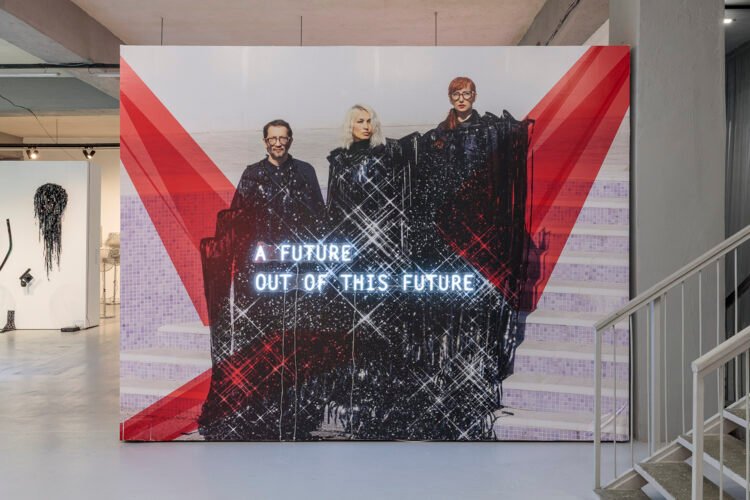
“A future out of this future” reads the artwork at the entrance of the exhibition, the neon words hovering over an image of three glowing, ethereal figures floating down a staircase. I couldn’t quite decide whether to read it as a promise or as an invitation; maybe both. I began to question what I have already accepted as reality, and whether imagination could become a tool for building a different future. So, how do we begin dreaming of the future?
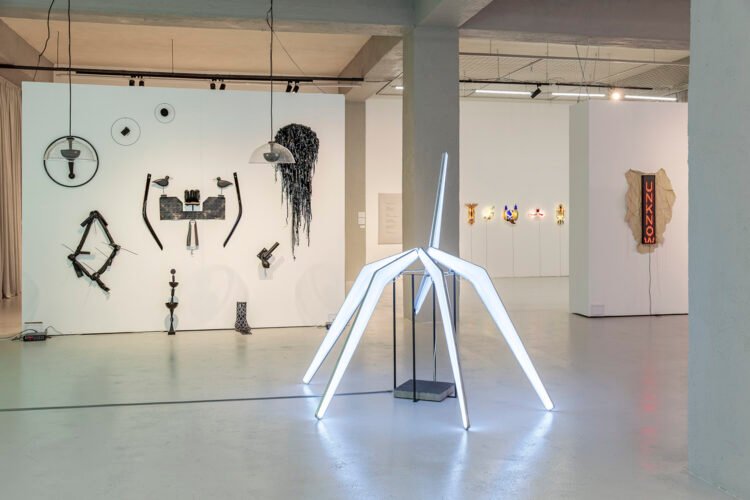
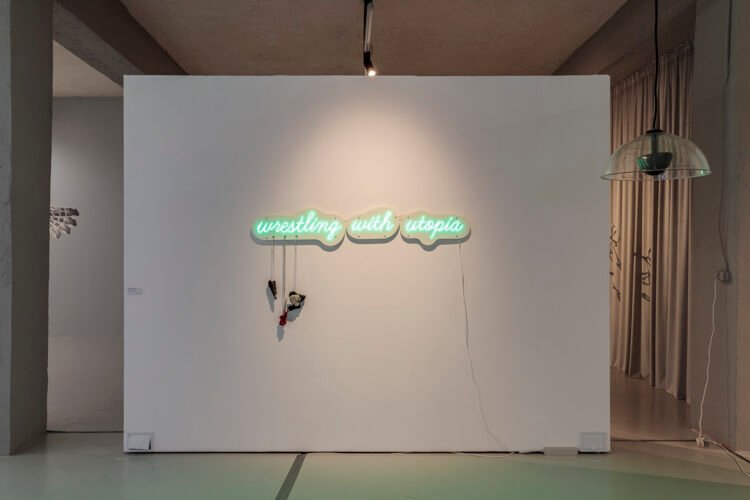
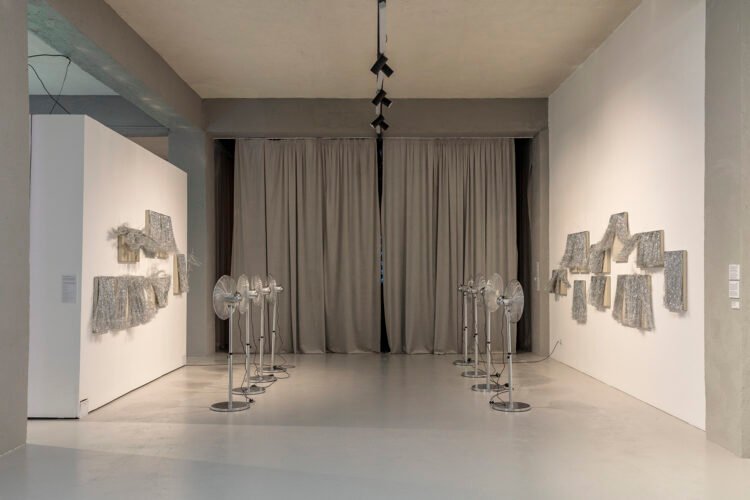
“Wrestling with Utopia”, the latest exhibition by the transdisciplinary art collective Apparatus 22 (Erika Olea, Maria Farcaș, Dragoș Olea, together with the late Ioana Nemeș), does not hand out certainties. Hosted at Artwill, it brings together a non-linear retrospective of works presented internationally since 2015, most of them premiering in Bucharest, alongside new installations, all dealing with utopia, a central subject in the collective’s practice for years. The exhibition proposes a different framework of thinking, one in which radical imagination becomes a way of rehearsing other possible worlds and utopian universes. Yet, with the possibility of a dystopian future now entering the picture, utopia becomes something to wrestle with, as the title suggests, something to question and negotiate, rather than an ideal to be reached.
Enter Suprainfinit, a utopian universe constructed by Apparatus 22 through a transmedia allegory of hymns, hardcore minimalism, neon lights, disco metaphors, postcards, and monuments. Within this world, the artists speculate on the possibilities of a radical body, the shifting relationships between human and non-human forms of existing, rethinking institutional structures. But switching on utopian thinking may not be an easy task; dystopia, somehow, seems to require much less imagination, especially when the future seems increasingly difficult to imagine outside the conditions of the present. The artists guide us through a series of so-called “conversation pieces”, works that invite us to question our reality and explore possibilities beyond the present. Using questions as a working method, they suggest that imagining what the future could look like is something we can all take part in, turning it into a collective exercise of thinking and imagining.
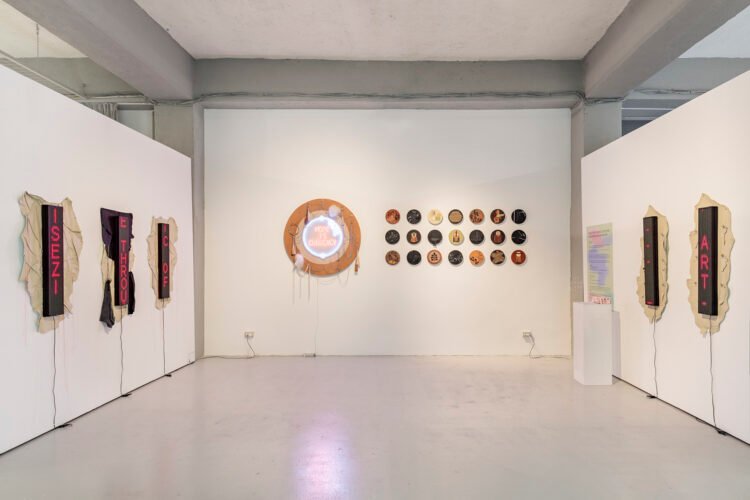
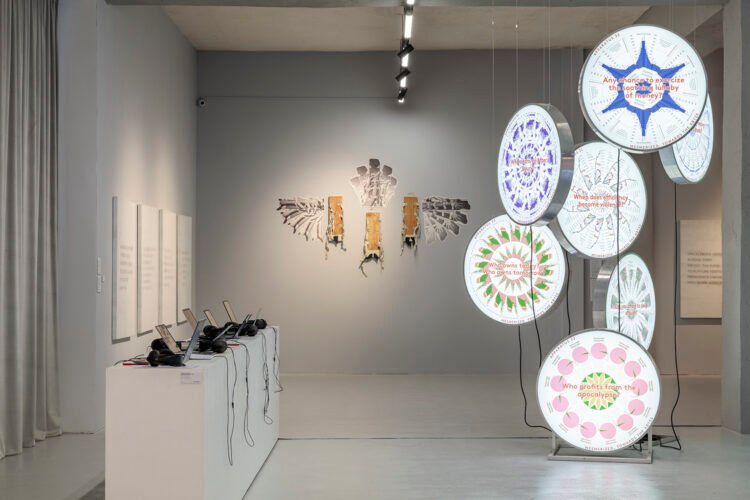
In Mesmerized, towards the abyss, a new series of lightbox-questions, unsettling dystopian perspectives interrupt utopian imaginary, questioning the pursuit of profit and luxury, unveiling harsh realities we live in that could lead to a bleaker future, one that reproduces or deepens the inequalities of the present. Is it easier to embrace fear or to remain hopeful when dreaming about the future? I believe that hope is something we can practice, even when the circumstances suggest otherwise. After all, hope requires commitment and collective effort, becoming a tool for navigating the present and its possible futures. In Hope Is Currency, it enters the language of economics, while Hope Sunk Teeth into the Night brings it into the space of clubbing and dissidence, where alternative forms of togetherness can emerge. “Hope is the new oxygen” reads the final statement on the Suprainfinit utopia, suggesting that it could evolve beyond being just a state of mind.
But sometimes hope seems out of reach, and imagining a different future feels too difficult to do alone. Speaking into the abyss might bring an unexpected answer. In Exchange Office: Postcards from Suprainfinit participants are invited to send their wishes and dreams of a brighter future, and receive a glimpse from the utopian universe in return. We are presented with an alternative of world-building. The simple gesture of exchanging postcards opens up space for collective dreaming, an exercise in generosity where individual wishes become part of a shared vision of the future.
When dreaming about the future we need to find ways of navigating the present, acknowledging its limitations while insisting on the possibility of imagining otherwise. But whose utopia are we imagining? The artwork Will you keep the lighthouse bright? guides the viewer to self-asses where they stand on the spectrum between utopia and dystopia. Through questions and poetic references in video format, the work challenges the idea of a universally desirable future. Among the quotes presented in the work, Arundhati Roy’s words resonated most closely to my understanding of utopia: “Another world is not only possible, she is on her way. On a quiet day I can hear her breathing.” The work brought me face to face with my own assumptions and made me feel hopeful.
“Wrestling with Utopia”, described as “an ambiguous construct halfway between a phantom ready to take its first breath and a partial vision of better worlds,” seems to continue to unfold beyond the exhibition space. We may not have found a map of the future, yet we received the impulse to question what we have come to expect and to begin imagining collectively. Can asking a question save the world? Probably not on its own, but it might unsettle the certainties that prevent us from imagining another one. The place where a future out of this future begins.
“Wrestling with Utopia” [Artwill, Bucharest, 12.09–18.10.2026]. Artists: Apparatus 22 [Erika Olea, Maria Farcaș and Dragoș Olea, together with Ioana Nemeș (1979–2011)]. Curator: KILOBASE BUCHAREST.


POSTED BY
Monica Dănilă
Monica Dănilă is a curator and editor based in Bucharest. In line with the projects she is involved in, she writes about collective and collaborative initiatives at the intersection of research and ...