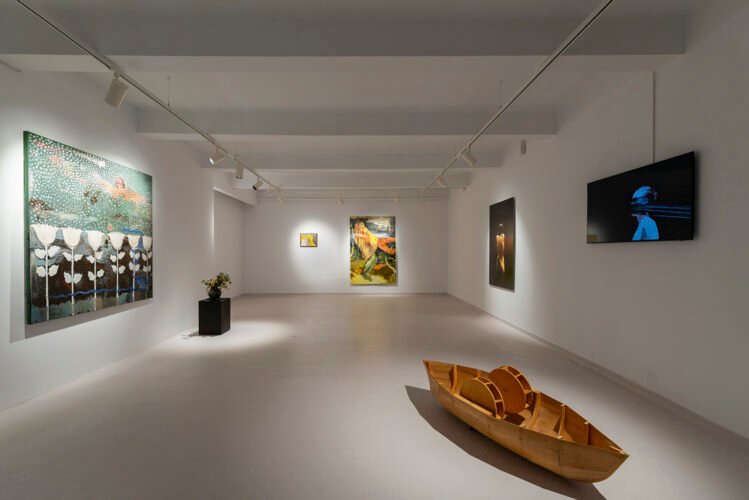
What is our self-image in the 21st century? How is it influenced by the various trends and challenges spreading across social media? In what ways does this environment perpetuate the discriminatory beauty ideals and stereotypical gender roles of patriarchy that have existed for centuries? What tools, opportunities, and safe spaces do we have to initiate and foster constructive dialogues on topics such as autonomy over the female body, queer identity, or death? Such questions may be raised by the thought-provoking works in the group exhibition “DAMAGED GOODS,” which can be visited through May 16, 2026, at the META Spațiu Contemporary Art Gallery in Timișoara.
The work by Viennese artist Eva Maria Schartmüller, titled Lost Authenticity (2018), explores the phenomenology of social perceptions of the female body through a jarring choice of subject matter and medium. One element of the composition is a black-and-white photograph depicting a bald female skull, which interacts with the installation made of felted hair. Navigating the boundary between presence and absence, between the visual and tactile perceptions of reality, the work presents human hair as a symbol of self-expression and self-identification, as an extension of personality. At the same time, it highlights how the act of being deprived of one’s hair can become a tool of oppression, stigmatization, and dehumanization. The composition reflects not only the inhumane methods employed in prisons and concentration camps but also the identity crisis caused by hair loss due to illness. Given that patriarchal beauty standards and the male gaze, legitimized and validated by the system, associate femininity, beauty, and “attractiveness” with well-groomed, long hair, this aspect is amplified in the case of affected women. This is because, unlike men, in addition to physical suffering, they must also contend with feelings of shame and psychological terror caused by the humiliations to which they are subjected.
The work by Serbian-born artist Emilia Jagica, titled Our Body (2018), addresses the issue raised by Schartmüller through a powerful analogy between the system’s attitude toward the female body and that toward the animal body. Created using the collage technique, the work offers, through its grotesque and surrealist mode of representation, a painfully familiar image of the tendencies toward exploitation, objectification, and dehumanization of the female body by capitalist, consumerist, and patriarchal society. In most scenes, the characters are depicted in a “processed” state, stripped of their skin, which further emphasizes their status as products or commodities, resonating with the exhibition’s concept. This also evoked the atmosphere of Margaret Atwood’s dystopian novel, The Edible Woman (1969), which is a social critique written with sarcastic humor directed at consumerist culture and gender roles. Jagica’s work, too, makes full use of sociocultural satire. This is best reflected in the depiction of that woman who, balancing on her heron legs emerging from her shadow, tries to keep her body within the boundaries of the image considered ideal by the male gaze.
Adrian Oncu’s work, titled Adriana Diamond (2026), also highlights the toxic, exploitative, and restrictive effects of the “male gaze” on self-expression and identity. The composition, which bridges the gap between photography and installation art, depicts the free, authentic, and self-assured artist she discovered as a child while trying on her mother’s clothes, and who “can break free” only during her drag performances. This emotional and physical bondage is symbolized by the metal bars that separate the photograph from the outside world. They also symbolize the stereotypical, discriminatory, and simplistic view of patriarchal society, which accepts the binary cisgender identity as well as the heteronormative sexual orientation as the only valid way of life, attempting to silence and render members of the queer community invisible. This work explores the vulnerability and strength of the body, its suffering and resilience, its pain and beauty, which is increasingly treated as a commodity in the 21st century. At the same time, the work protests in a thought-provoking way against labeling and categorization, advocating for a more inclusive, supportive, and open world.
Similarly, many other artists in the exhibition integrate their own bodies into their creative discourse, addressing important social issues and phenomena through this process of self-representation. One example is Alex Mirutziu’s photograph titled Denied (2024), which explores the motif of the fallen angel from multiple perspectives. The work carries the dual symbolism of the figures of Icarus and Lucifer, thus referencing both ancient Greek models and the Renaissance ideal of beauty. In the spirit of the aesthetics of fragmentation, the work deconstructs and reconstructs the image of the idealized body, a process evident in the sculptural details that evoke the masculine ideal envisioned by Michelangelo Buonarroti or Leonardo da Vinci. Furthermore, the image captures the dynamism of performance within the static medium of photography, creating the sensation that it has captured the moment immediately following a fall.
Josépha Blanchet’s work, titled L’attente (Waiting, 2017), gives physical form to the artist’s personal experiences and inner landscapes. The photograph, which resonates with the hikikomori lifestyle[1], originated in Japanese culture and becoming increasingly widespread, it commemorates the period when Blanchet moved from France to Romania. As such, the work symbolizes the artist’s emotional, cultural, and linguistic isolation, as well as her loneliness and vulnerability. She withdrew, however, not into her apartment, but into the soothing and liberating solitude of nature, through which she was able to rediscover herself. This process is symbolized by the parts of the body covered in moss and dewdrops. The expressive nature of the photograph also brings to mind the concept of memento mori.[2] The skeleton visible through Blanchet’s skin is presented from a perspective that destigmatizes the phenomena of transience and physical decay as part of a natural process, thereby seeking to dispel the taboos surrounding the subject. The artist’s approach draws our attention to the beauty that arises from duality, from the coexistence of life and death.
The video installation by Marina Oprea, titled Deposition (2026), also explores the relationship between human and non-human space. The work, part of the Metamorphic Unit series, employs the dual symbolism of revelation and burial to illustrate how the landscape and its image in the collective memory shape and reinterpret one another. Racoșul de Jos, which serves as the location for the video and consists of the Emerald Lake, the Extinct Volcano, and the Basalt Columns, is still under the influence of geogenesis, allowing the work to draw a parallel between the geological changes in the physical environment and the individual’s inner psychological metamorphosis. At the same time, the title’s multiple meanings play an interesting role in interpreting these concepts, since deposit can refer both to sedimentation—that is, the natural process of sediment accumulation—and to desublimation, which in thermodynamics refers to the direct transition of a substance from a gaseous to a solid state. Furthermore, it can symbolize the traces of both positive and negative human activities that we leave behind as a transgenerational legacy, much like time capsules. However, the work also incorporates the dynamics of the word pair deposition–reposition, representing the shift in perspective between subjective and objective time, between human and geological time. And the sense of distancing in the perspective created by Alexandru Mihai Gheorghe further emphasizes this aspect.
The video titled Schnittst (2025) by the artist Guadalupe Aldrete, who is of Mexican origin and based in Vienna, explores the role of human and non-human bodies in conveying messages and their narrative potential, at the boundary between fragmentation and continuity, between the past and the present. According to her statement, “in the context of the ‘DAMAGED GOODS’ exhibition, I approach damage not as something to be repaired or concealed, but as a condition that holds memory.” The film, which can be viewed as part of the exhibition, conveys this vision through the dialogue between geographical space, human physicality, and the natural and artificial materials in our surroundings, which can thus be interpreted as symbolic bearers of the imprints of trauma, oppression, exploitation, and the Mexican people’s search for a sense of home. At the same time, the work brings to light how imposed silence becomes the proud silence of resistance, commemorating the strength, struggles, and solidarity of a community. Aldrete calls this immersive state a “performative landscape,” created using transdisciplinary tools, as the environment evoked and set in motion participates as an active protagonist in the narrative of the artist’s rich and complex cultural heritage.
The exhibition space also features works that challenge our position as victims within capitalist society and highlight the cruel and unjust treatment we inflict upon nature and other species. One such example is the installation by Cosmin Haiaș, titled Mother (2019), which, through the haunting image of a sow’s hide, urges us to change our perspective or, at the very least, attempts to nuance it. It shows, in fact, that what we often consider merely a product on the meat market was once a living, sentient being who left behind a family. Furthermore, the work speaks out against the brutal methods of slaughterhouses and the meat processing industry and advocates for more conscious consumption habits, since, through our decisions, we too contribute to the perpetuation of these inhumane practices.
The work by Milanese artist Chiara Campanile, titled Anatomy (2022), explores the structure of the human body through the interplay between the verbal and the visual, between contemporary poetry and digital drawing. The composition captivatingly blends artistic expressiveness and scientific curiosity. The verses remind me of the objective lyricism of one of the most influential Hungarian poets of the 20th century, Ágnes Nemes Nagy, whose work also placed a strong emphasis on the interaction between poetic intuition and a demystifying scientific approach: “You must learn that duration, / where the crystal is already steaming, / and the tree floats in the mist, / like the body in memory.” (Nemes Nagy, 1967, trans. András Bandi). Campanile’s artistic vision is also characterized by a synthesis of magical and rational elements, as well as of the cosmic and the profane: “Microscopic choices. / An exponential system / where decisions / happen autonomously.”
The complex symbolic system of the painting And What If My Fly Would Be a Foreign Planet (2026) by Mirela Cerbu, an artist from Arad, connects distant temporal planes and spatial dimensions. The fly, which becomes the central figure of the work both visually and conceptually, embodies the dual dynamics of life and death, of change and permanence. On the one hand, the insect may refer to the role it plays in the decomposition of human and non-human bodies. Its larvae, in fact, trigger metamorphosis in individual organisms, yet it is precisely through this process that they maintain the stability of nature’s cycle. On the other hand, the symbol of the snake, which appears alongside the fly, directs the interpretation toward a mystical and spiritual meaning. Thus, the composition makes an interesting reference to the biblical story of the fall into temptation, since, in this case, the animal does not represent metaphysical evil or a demonized force, but rather the awakening of the human species’ conscience. Furthermore, it allows for an association with Ouroboros, the mythical creature from ancient Egyptian and Greek culture, whose form unites the beginning and the end on a cosmic level. Furthermore, the concept behind this work reminds me of Arthur C. Clarke’s short story titled The Star (The Star), which, like the painting, blends the duality of birth and destruction, joy and mourning, by juxtaposing scientific and religious perspectives. From an ecocritical standpoint, the work highlights the fact that, even today, we often mourn the passing of beings that seem insignificant, while they, upon their death, leave behind a microcosm of their own.
Sorin Scurtulescu’s painting, titled Irises I. (2025), in turn illustrates the cyclical nature of life and death, as well as the interchangeable nature of our place and role in the food chain. Irises are a recurring motif in the artist’s works. His solo exhibition, titled “Bloom,” which was on view from November 7, 2024, to January 26, 2025, at META Spațiu, also deconstructed and recreated the image of this flower, experimenting with numerous modes of representation, ranging from abstract to figurative. It is fascinating to observe how the artwork is enriched with new meanings in this different context, interacting with the vision of other works. The aforementioned exhibition focused on studying the plant’s structure from a natural sciences perspective and on illustrating the diversity of representational techniques, while, under the influence of the DAMAGED GOODS concept, the composition gives way to a much more poetic and philosophical approach. It brings to mind Iris albicans, known as the “cemetery iris” or “white iris,” a species traditionally planted on graves, often also called the “white flag iris.” As such, the work reveals how we give a part of ourselves back to exploited nature, nourishing with our bodies the flowers that may have met an early end in our vase, serving as natural decor.
In contrast, another work by Eva Maria Schartmüller, the installation titled I’m a real dirtbag (2022), reflects in a (self-)ironic and system-critical manner on the cult of the sacred/profane and the fetishization of the body, created by capitalist and consumerist society. This mindset, in fact, conditions our perception of our bodies as perfect products that must be maintained in an impeccable aesthetic, health, and every other respect. The artist, however, draws attention to the fact that our physical appearance, as well as our entire existence, is part of a natural process, just like aging and death, toward which we should adopt an attitude of openness and acceptance, rather than tabooing and demonizing. Furthermore, this T-shirt-shaped installation, made from compostable bags, draws attention to our wasteful consumption and hoarding tendencies, as well as their serious effects on the environment.
The works in the exhibition depict the processes of the human body and society’s perception of it in an extremely captivating and flexible way. They change, develop, decompose, and reconstruct, and they do so without the sense of shame and judgment that have been instilled in us.
[1] Hikikomori (from Japanese, meaning “to stay apart,” “to withdraw”) is a social phenomenon characterized by an individual’s acute withdrawal and total isolation from society, family, and friends, remaining shut away in their own room.
[2] Memento mori is a Latin phrase that translates to “remember that you will die” or “remember that you are mortal.” This is not a call to despair, but an ancient philosophical and artistic principle meant to remind us of the inevitability of death, urging us to cherish life, to be humble, and to live mindfully, to the fullest, in every moment.
Translated by Marina Oprea


POSTED BY

Yvett Toth
Yvett Toth was born in Arad in 1999. She earned her bachelor’s and master’s degrees in Hungarian and English language and literature from the Faculty of Humanities at Babeș–Bolyai University in...
Comments are closed here.