Several years ago, early in my curatorial career, lost in the thicket of post-conceptual practice and that aesthetic of inaccessibility, stemming from a misunderstood Rrose Sélavy, I found myself reflecting on the epistemological condition of art. Caught between the act of finding-choosing an object from the external environment and the act of covering a surface with a substance, and feeling that my grasp of this second order was slipping further away, I reached out to Cristian Dițoiu for an informal discussion. He was waiting for me in his studio, with a 16th-century icon, from the Athonite school, placed on an easel, awaiting restoration. “Tell me, what do you see?” I brought up iconography, school, the syntagmatic versus iconic, and so on. “No, what you’re seeing is a monk from that century, with no formal training, perhaps living in a cave, who devised a composition using exclusively primary colors (red, blue, yellow).”
A few years later, when I discussed the possibility of an ideal exhibition with the artist, he mentioned that he would like the text accompanying his works to be non-narrative, “not an essay, but a poem.” In a sense, the works explain themselves; for, as we shall see, their central characteristic lies in the intrinsic capacity of the form chosen by the painter to generate itself. Symptomatic, isn’t it?, of the state of our contemporary world, a world increasingly simulated rather than lived.
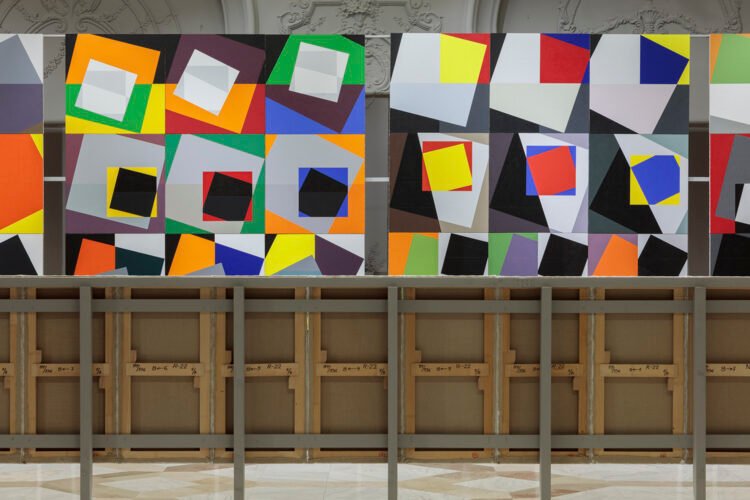
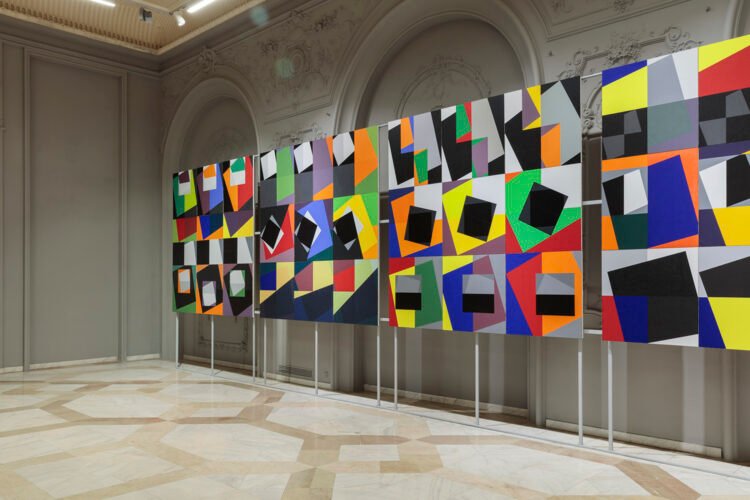
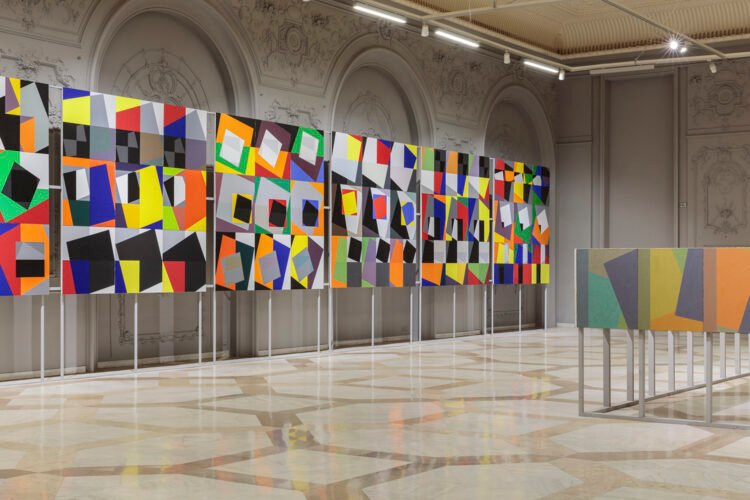
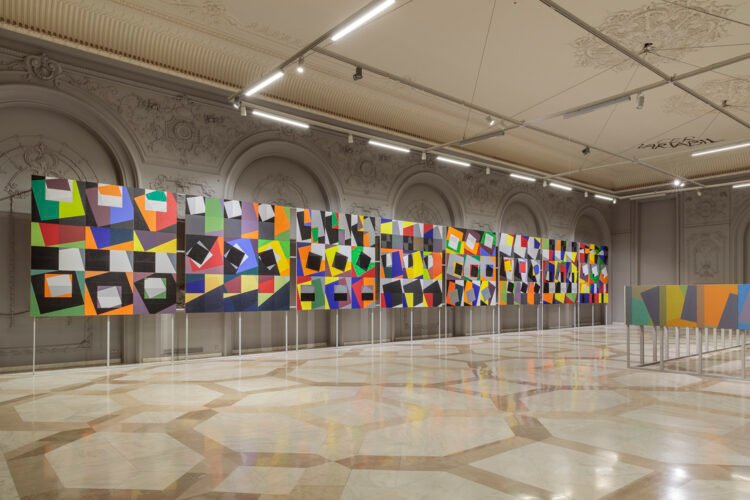
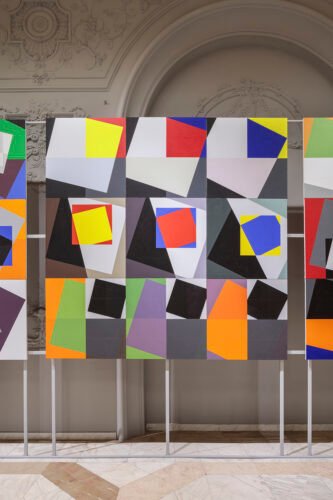
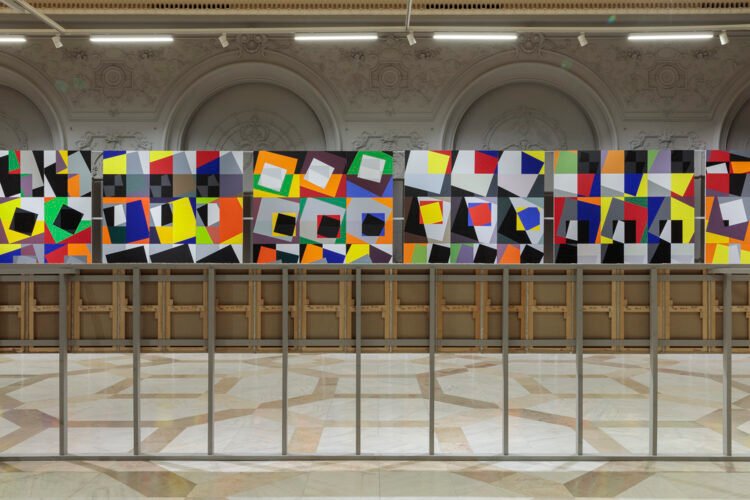
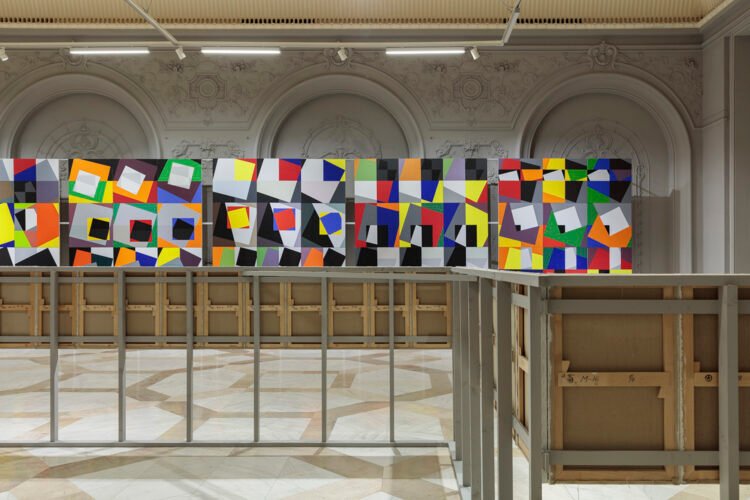
Thus, Dițoiu’s abstract-pictorial installations operate according to a rigorous, generative visual algorithm, based, in terms of form based on 1:1 and √2 ratios, and in terms of colour, on the creation of infinite hues derived from the primary colours. The fundamental structural unit is the 96×96 cm square canvas; within it the square-character, representing 1/4 of the area, is then reduced by the same ratio into another, receding in directly proportionally scaled units. By rotating these squares along their four sides, their points of contact shift, generating variable angles and secondary polygons, forming what might be described, using Alberti’s terminology, as an angular, vectorial velum.
Chromatically, the ensemble is organised via a trivalent permutation system: the works are grouped into series of three canvases, depending on the specific installation, ensuring that each of the primary colours has an equal right to exist and unfold within the secondary ones. These are invariably linked by neutral colours (white, black, gray). In their morphological arrangement, ascending diagonals emerge, carrying a material black deliberately added for its quality as a heavy, corporeal colour, while, in a mirror-like fashion, the descending diagonals contain a void-psychopomp-like white, devoid of gravity.
The illusion is created not only through the representation of generative polygons but also through the tactile quality of the painterly material. The treatment seems merely similar to that of an Ad Reinhardt who sought to strip the oil out of… oil paints, aiming for an elemental, dusty, and earthbound tactility. In this case, however, it is merely an illusion that Dițoiu sustains through technical virtuosity. On a canvas previously primed with gesso, the successive application of five to seven layers of oil paint, using a palette knife, results in a rich, opaque texture, where the characteristic luster of the medium, a quality sought after by most painters, is effectively nullified in this process. A dilemma I often return to, as the artist is notably also an accomplished painting conservator who has led or contributed to key departments within various public and private museum institutions, is that, should one of his own works become damaged, it would be impossible to restore, even by his own hand. The impossibility stems precisely from the use of unique colours, impossible to recreate, and subtle secondary and tertiary tones, such as a mint-china-green that sets in the mouth like a late sun, alongside vibrant, indeterminate shades of manganese violet and an incandescent orange.
Regarding morphological choices, it must be noted that the shifts and challenges of the contemporary world transcend what the traditional tools of visual representation can offer; this inevitably leads toward an abstraction rooted in deeply analytical structures, statistical and probabilistic in nature, that interrogate the immediate reality through a diagrammatic and abstractly geometric interface. Drawing, which historically served as the foundation wherein the line delineated the figure from the background, thereby ensuring the continuous integrity of the form, thus loses its classical expressive function (see Peter Osborne). The line, rather than serving as a mimetic representation, now assumes an indexical function, becoming a potential vehicle for the transmission of information, much like how it is employed within data and information systems.
In Cristian Dițoiu’s practice, drawing no longer seeks to reproduce the form-world; instead, it functions as form-colour through continuous generation with just two fundamental elements, line and colour, or, more precisely, the straight angle and the primary colours. These can yield an infinite number of solutions, much like a binary, Bootlean system, which, using only two values, can simulate our world. What more concrete example could I offer than the fact that these Illuminations, in the initial, sketch-like form in which Dițoiu conceives them on graph paper, are always monochrome, rendered in pencil? Or, in the presentation of a modular installation, part of the same series, which serves as a central focal point in the exhibition THE TWIST. Five Provincial Stories from an Empire (curated by Călin Dan and Celia Ghyka), the artist discovered, without having planned the arrangement a priori, that the ratio of the vertical side to the horizontal side is precisely 3.14, the irrational Π meaning the ratio between the circumference of any circle and its diameter, a numerical constant of an element with which Dițoiu does not work, but which was automatically generated by the rigor of the compositional algorithm. We might say De Mathematicis Neoplatonicis or to borrow from the terminology of modernism, this is an approach grafted onto the premises of that zero degree of painting, yet pushed to its ultimate potential.
In conclusion, returning to the discussion regarding the ideal exhibition envisioned by Cristian Dițoiu, beyond the inclusion of a poetic text, it would undoubtedly take place at the Museum of the Square. Officially known as the Josef Albers Museum Quadrat and located in the city of Bottrop, the museum is notable for an architectural design inspired by the famous “Homage to the Square” series.
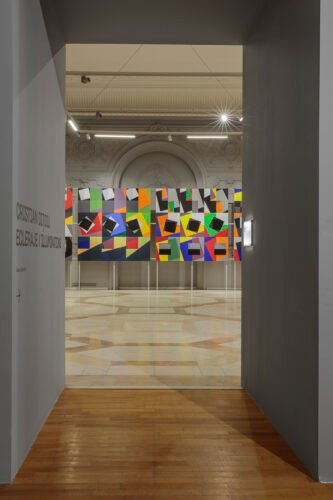
Cristian Dițoiu. “Illuminations” [National Museum of Contemporary Art, Marble Hall, Bucharest, 23.05–18.10.2026]. Curator: Călin Dan.


POSTED BY
Horațiu Lipot
Horațiu Lipot (b. 1989, Alba Iulia) is a curator and cultural journalist. As of 2021, he works as an independent curator, collaborating with venues either from the ON or OFF art- scene in Bucharest, ...