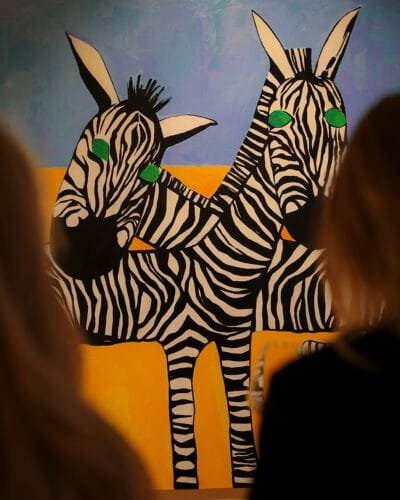
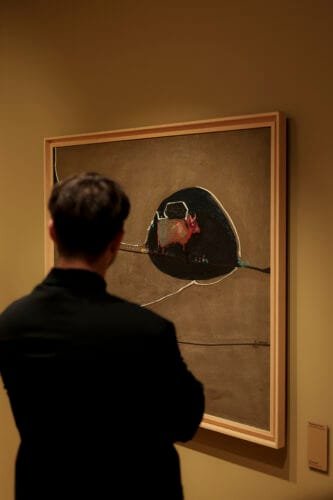
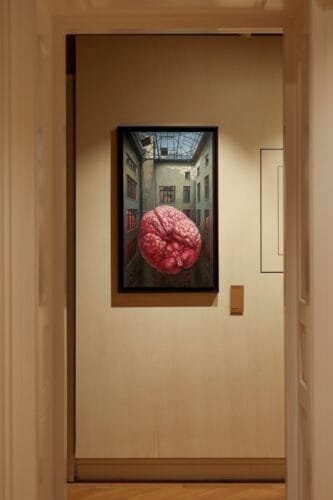
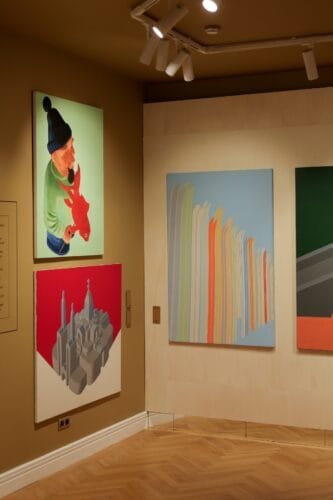
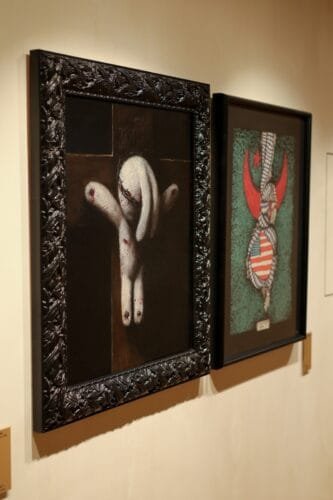
I would have preferred to maintain a sober, almost academic tone, as the exhibition “Only Painting. The Collectors” merits such an approach; however, I decided against that path because I cannot be impartial, and the “Chronicle Between Us” column format affords me this freedom.
I appreciated the selection of works, the display, and the architecture of the exhibition path, but above all the interviews with the people who give substance to this project, from collector Daniel Ștefănică to artists such as George Anghelescu, Roman Tolici, and Codruța Cernea. What curator Erwin Kessler succeeds in doing very well is giving the project a scope that extends beyond a mere exhibition about Daniel Ștefănică or a simple lineup of important works. It succeeds in constructing a narrative about the time that has just passed, a time most of us have not yet had the chance to reflect upon seriously. Some are still too close to it to call it history, while others are too far removed to call it the present.
It seems to me that the significance of the exhibition “Only Painting. The Collectors” goes beyond the mere presentation of a body of works. It marks one of the first instances where a collection, built almost in real-time alongside the artists who created the pieces, begins to function as a document of a generation. Beyond the artworks and curatorial decisions, we also witness the choices of the collector, the person who actively stepped in to carry a visual idea forward. We see a collector’s taste and the relationships between artists, as well as the beginnings of a history that, until recently, was still the “present.”
What I disliked was the controversy surrounding this initiative, sparked just before the opening, which seemed to suggest that certain places, and by extension culture itself, are not for everyone. I found the phrasing unfortunate and the message one that risks excluding the very audience art typically seeks to bring closer. This is all the more true within a fragile cultural ecosystem, where so many people constantly invest time, energy, and personal resources to produce and support contemporary art. They do so year after year, despite financial pressures, unequal competition with better-funded cultural scenes, and a context in which arts education and access to culture still require support.
At the same time, I believe the discussion about access should not be confused with the discussion about value. It seems natural to me for an exhibition to have an admission fee; it is common practice in Bucharest and everywhere else in the world. The issue is not the existence of a ticket, but rather how we choose to talk about the public and about who feels welcome in a cultural space. However, there is also a perverse side effect to things being free: it leads us to believe that certain events have no value, and that no one is paying the bill… Yet, in reality, every venue owner and event organiser has rent to pay, bills to settle, security staff to hire, and so on. It may seem like a mystery, but someone else is always paying out of pocket for all of this, be it the venue, the gallery, the artist, the curator, or their families. And then, someone else walks in, blithe and dismissive, and says: “Is that all? I deserved more, and better!”
And I believe Daniel Ștefănică knows exactly what I am referring to, both he and the artists featured in the exhibition. That is likely why I find it so difficult to view the exhibition with detachment: I worked with some of these artists for over 13 years at H’art Gallery (Dan Popescu’s gallery), where I organised dozens of solo exhibitions, presented the work, and welcomed everyone, all free of charge. It was a valuable and interesting lesson. It is a surprising experience to see familiar, and indeed very well-known, works again, now integrated into a refined curatorial narrative and a context completely different from the one in which I first discovered them and where I developed professionally. The artworks, freshly installed for the artist’s solo exhibition, are either wrapped in bubble wrap or temporarily hanging in my office. This is, perhaps for the first time, a moment of direct encounter with recent history. I observe, almost firsthand, the difference between history as it was lived and history as it has already been constructed through memory, selection, and interpretation, the gap between what I thought the 2010–2020 period meant and the way collectors, curators, and ultimately the artists themselves choose to remember it today. And I believe this exercise is just the first in a long series yet to come.
The thought I would like to conclude with is that this exhibition speaks of that “something extra,”of the choices Daniel Ștefănică has made and the trust he has placed in artists over the years. It is a trust built very tangibly, month by month and year by year, through acquisitions, support, and active presence. It is a pace that is almost frenetic, and, considering how much support a single person is expected to offer, likely unsustainable. We have grown accustomed to looking at models like that of Roger Akoury, who transformed his collection into a museum.
In Ștefănică’s case, however, the gesture was more understated and personal. He recognised the potential of certain artists before others validated it and understood the sacrifices behind their work. Perhaps his greatest quality was knowing how to make them visible and relevant without ever seeking the spotlight for himself, quietly biding his time. And as events in recent years have shown, the collector is an incredibly cool figure, and Ștefănică was one of them from the very start.
“Only Painting. The Collectors” [La Mița Biciclista Stabiliment Creativ, Bucharest, 21.05–20.09.2026]. Artists: Nicolae Comănescu, Gili Mocanu, Dumitru Gorzo, Ecaterina Vrana, Roman Tolici, Florin Tudor, Bogdan Vlăduță, Ștefan Ungureanu, George Anghelescu, Ioana-Carolina Ursa, Ciprian Paleologu, Codruța Cernea, Angela Bontaș, Tara von Neudorf, Simona Vilău, Adrian Preda, Suzana Dan, Anca Mureșan, Florin Ciulache, Alina Pențac, Cristian Todor. Daniel Ștefănică Private Collection. Curator: Erwin Kessler. Architecture and design: Attila Kim.


POSTED BY

Ioana Marinescu
Ioana Marinescu (b. 1988) is an art historian and curator. She completed her PhD at National University of Arts in Bucharest in 2022, focusing on the biographies of artist couples. Since 2008, she has...