Recent findings from the scientific community paint an unavoidable picture: over the past 70 years, human activities have caused climate change at a faster rate than ever before in the planet’s post-glacial history, with major consequences for life on Earth. Global warming, melting glaciers, rising sea levels, widespread desertification, the extinction of species and ecosystems, and massive population migrations are just a few of the consequences that place the final horizon of a habitable Earth and human civilization, as we know it, around the year 2050[1]. Meanwhile, the world’s multi-billionaires are planning to terraform other planets and are heavily investing in developing the necessary technology – for transportation, communications, acclimatization, and military purposes – while significantly contributing to the accelerated destruction of our own planet to extract the resources needed to carry out this plan. The Anthropocene is the name scientists have given to the current geological epoch, the result of a globalized economic system geared toward unlimited accumulation, colonization, and the depletion of all bodies. This is the real story, the common thread linking the past to the present and the future. In this context, what kinds of strategies and mechanisms can we employ to manage anxiety, trauma, and loss, to foster solidarity among depleted bodies, and perhaps prevent disaster?
From September 25 to October 16, the solo exhibition “SIZE & SCALE” by artist Adrian Preda, curated by Ioana Marinescu and Weronika Kobylińska, took place at MATKA Satellite at the “Dimitrie Leonida” National Technical Museum in Bucharest. The program was complemented by workshops for various age groups and for people with visual impairments, discussions, guided tours, a poetry recital, and a concert by the experimental artists Diana Miron and Laurențiu Coțac. The exhibition marked the conclusion of an important phase in Preda’s career, a phase that consumed his creative interests for a decade, from 2015 to 2025.
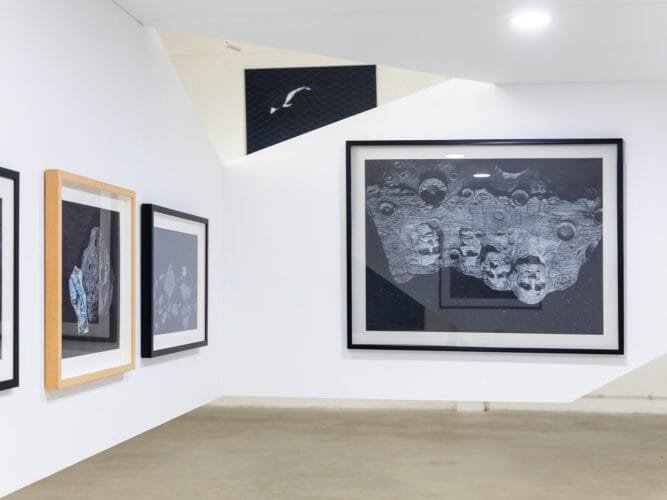
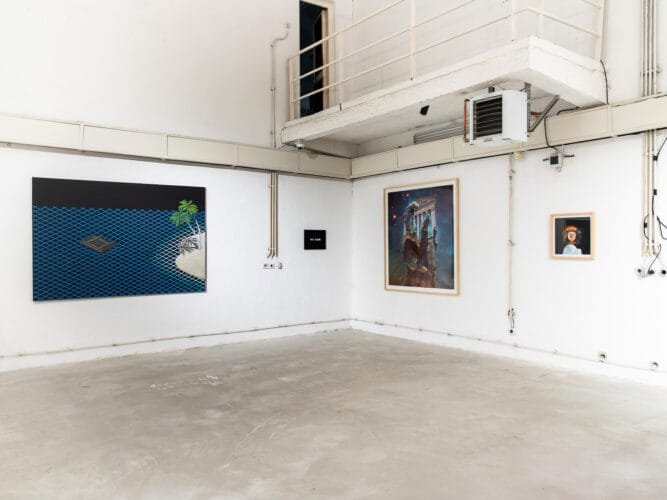
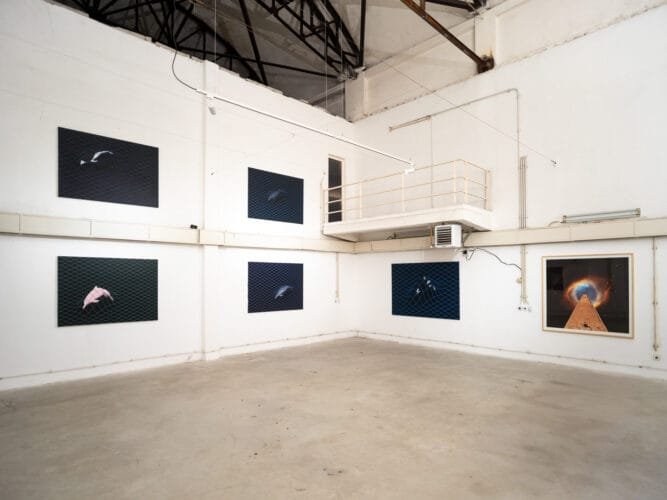
“SIZE & SCALE” featured paintings, drawings, and mixed-media works, divided into subsections based on the subjects depicted and the techniques used. Thus, at a first glance, the exhibition comprises series of partly intercalated works whose subjects are marine mammals and planets – acrylic and oil on canvas, nebulae – acrylic paintings on digital prints, asteroids and exoglife – pencil and pastel drawings on black paper, and a series of small-scale works, also acrylic paintings on canvas, but geared towards words, small inserts that guide the reading. As we have come to expect, Preda maintains an extremely meticulous and detail-oriented working style, a meditative practice aimed at comprehending the precise form of the object.
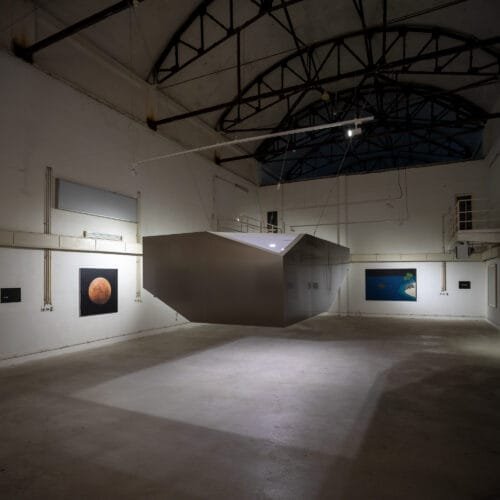
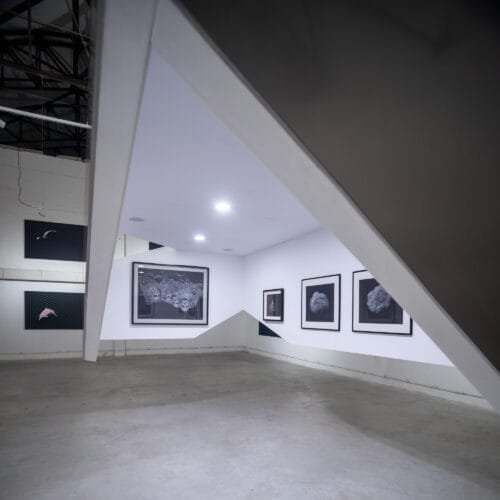
Over the ten years of developing this body of work, some of the pieces were presented in several solo exhibitions that also marked the various stages of the process: “On Heavenly Bodies” (2015, H’art Appendix, Bucharest), “Distance and Duration” (2019, National Museum of Maps and Old Books, Bucharest), “Mass and Weight” (2020, Atelier am Eck, Düsseldorf), “Bound to Spacetime” (2020, H’art, Bucharest), “Asteroids and Exoglyphs” (2025, Fundacja Archeologia Fotografii, Warsaw). Nevertheless, the juxtaposition of these sub-series creates a coherent whole, highlighting the growing appetite for research and the various approaches to the common subject: the use of science for the purposes of capitalist extractive interests and the repercussions of such practices for community life. Complementing the two-dimensional works, the exhibition space is dominated by a large-scale central installation designed by architect Vlad Ștoica – a sort of exhibition hall inside a spaceship from the future – which extends the exhibition space into an undefined time and place. The sci-fi atmosphere is amplified by the sound works created by Moduler, inspired by spatial sounds captured by NASA instruments.
Fascinated by space, the laws of physics, the workings of the natural world, human knowledge, and technological development, the artist uses the cosmos as a backdrop for an ecological critique of capitalist exploitation, the destruction of habitats and the environment, consumerism, and the relationships between the human and the non-human – that is, the way we relate to resources, the environment, animals, and technology – themes that are, in fact, recurrent in his artistic practice. Minimalist architecture and metallic textures are, once again, elements specific to Preda’s aesthetic and serve to recreate the sensation of the cold void of outer space, where we find relics of 21st-century human civilization. While in past exhibitions the artist has generally confined himself to the space of the canvas or paper, this time he employs various scenographic devices to create an immersive, co-participatory experience, as a form of presence – visitors become active performers and a collective subject within the future created by the artist. In such a setting, I imagined myself visiting the exhibition as an alien or a person from a more or less distant future, in which Earth has become uninhabitable, entering a space museum of a history that must not be repeated.
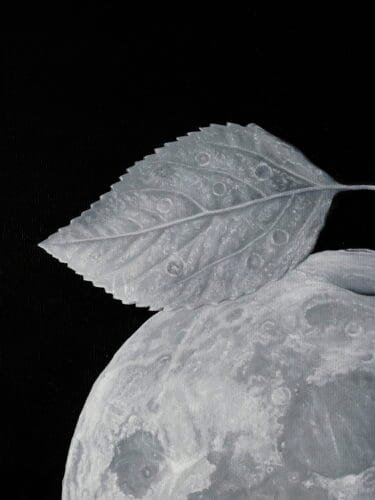
Right at the start of the journey, we encounter a symbol that opens up a multidimensional interpretation of the concept proposed by the artist: the Moon in the form of an apple that seems to float in a vacuum, separated from the other celestial bodies that sustain its trajectory. The apple, a recurring element in René Magritte’s paintings, introduces, on the one hand, a surrealist dimension that invites our gaze beyond what is visible, drawing attention to the hidden aspects of reality – which, here, could signify precisely the use of science for exploitation and destruction for the sake of profit, but also a critique of individualism and the overspecialization of scientific disciplines – a fact that makes it difficult to observe the whole and the interdependence among the elements that compose and sustain life. On the other hand, in this instance, the apple seems to reconcile the conflict between spirituality and scientific knowledge – the tree of knowledge from the Bible (knowledge as a curse) and the apple that revealed the theory of gravity to Newton (Perpetual Fall, 2016), a fundamental discovery for the space sciences. We thus find ourselves between an objective reality, which exists even in the absence of humanity, and a dystopian imagination, in a speculative scenario where there is no longer any hope (No Hope, 2015), and the Earth It’s gone (2025) as a result of human action, as the artist implies in the works under the same name.
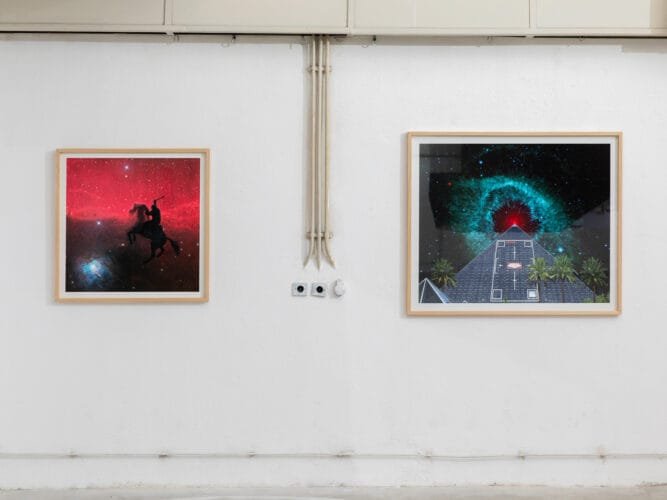
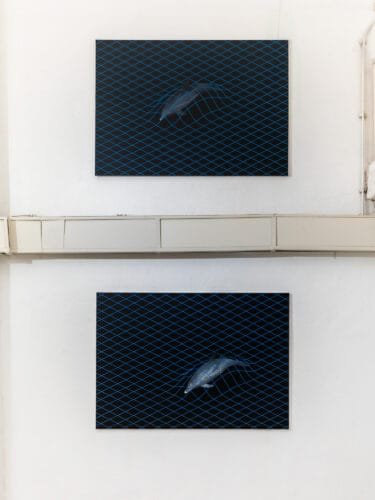
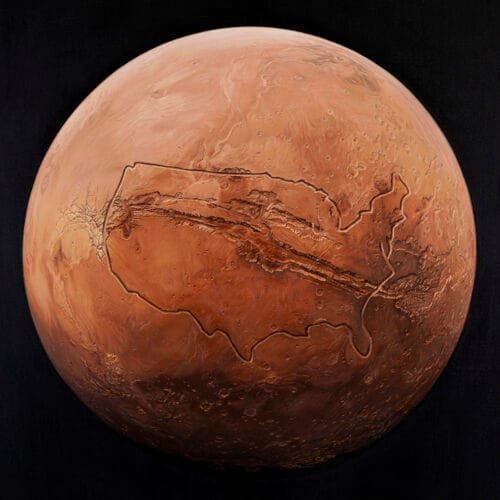
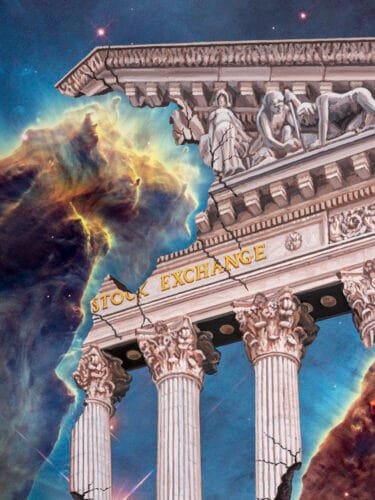
A series of marine mammals – various species of dolphins and a beluga – appear caught in the space-time net, much like in the nets of commercial fishing vessels. The American dream of colonizing other celestial bodies is stamped onto the surface of Mars, and the export of capitalism conquers space in the large-scale digital prints rendered in acrylic, which superimpose symbols of profit over iconic images of cosmic phenomena captured by NASA telescopes. This superimposition is suggestive of the typical mechanisms of colonization, naming, and appropriation – once a space is “newly discovered” and named or renamed by the colonizing power, it becomes a subordinate, inferior space that must be “civilized,” where civilization always means the import of capitalism. Thus, the history of American colonization continues through the colonization of outer space, and nebulae known in popular culture as the Pillars of Creation or The Eye of God / of the Universe are ironically associated with the ruins of the New York Stock Exchange (Creation and Destruction 2, 2025). A pyramid-shaped casino in Las Vegas (Eye of Providence, 2025) stands in tension with another pyramid, this time an ancient Nubian one (Reaching Back 2, 2025), signaling humanity’s millennial dream of knowing the secrets of the universe, and thus, in a certain sense, to conquer the cosmos. In the same series, we also find the image of a mounted gendarme in battle stance, characteristic of equestrian statues of heroic leaders – an art form representative of military propaganda and the glorification of war –, with the phallic symbol of the baton raised above his head in place of a sword, ready to bring order to the universe (Order and Chaos 2, 2025). Even if we find ourselves in a time-space that can be associated with the metamodern – defined by a shift from the individual toward the shared spaces in between, through the investigation of the multiple perspectives and networks that both enable and affect existence in its complexity –, all this iconic imagery belongs, as Jameson indicates, to that hyperspace defining postmodernism, affiliated with late capitalism. Thus, these constructions “respect the fabric of the American city,” which means that they – the represented constructions, not the works – “no longer attempt to insert a new utopian, different, distinct, and elevated language into the strident and commercial sign system of the surrounding city, (…), but rather seek to speak precisely that language, using its specific lexicon and syntax, learned in Las Vegas.” In other words, late-capitalist construction transfers its economic culture into space. These edifices “aspire to be a total space, a complete world, a sort of miniature city,” to which “corresponds a new collective practice, a new way in which individuals move and gather, a sort of historically new and original practice of the hypercrowd”[2] – more precisely, the practice of consumerism organized in malls, casinos, resorts, and other such organisms, networks of exploitation and distribution.
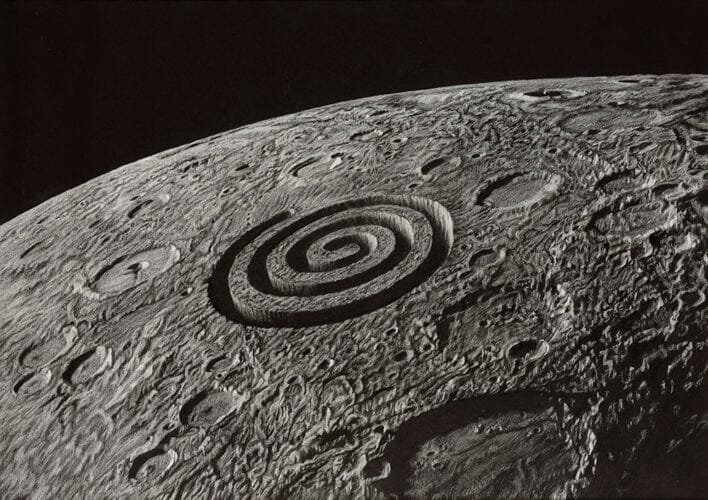
The journey takes us further into a series of meticulous pastel drawings, introduced by images of ancient mystical symbols engraved on the surfaces of planetary bodies (Exoglyph 2, 1, 3, pastel on paper, 2019) – a kind of giant S.O.S. signal transmitted to unknown civilizations, as the final terrestrial disaster approaches. The three symbol – Triquetra, Spiral, and Chakra – keys to interpreting the universe situated at the intersection of profound knowledge and magical thinking, contain concepts considered universal, such as the cyclical nature of life, spiritual evolution, or interdependence, and also remind us that humanity is merely an ephemeral element in infinite space-time. At the same time, they reveal the artist’s interest in such forms of knowledge, but also an acknowledgment of the difficulty of fully understanding them, or extracting their full meaning within the experiential world. As Weronika Kobylińska also mentions in the curatorial text, the series “explores the essence of communication between various forms of life and cultures” and is inspired by humanity’s (as yet) failed attempts to initiate dialogue with extraterrestrial civilizations by transmitting sounds and images representative of the myriad forms of terrestrial existence. Such a reflection raises questions regarding the practice of acknowledging the other, in the sense proposed by philosopher Judith Butler in Frames of War: The Figures of the Human and the Politics of Suffering. Thus, the practice of acknowledgement should incorporate an understanding of shared precariousness beyond the apparent differences that separate us, specifically that “precariousness implies living in society, that is, the fact that one’s life is always, from a certain point of view, in the hands of another”[3]. Whether we consider society at the micro, macro, or universal level, interdependence in precariousness remains a unifying principle, which brings to mind, in the context proposed by Preda, Liu Cixin’s dark forest in the trilogy Remembrance of Earth’s Past. Here, the message transmitted by humanity into space is ultimately received by extraterrestrial civilizations, which destroy both Earth and the Milky Way in the name of self-defense – which brings to mind recent and current earthly conflicts (U.S. interventions in Iraq and Afghanistan, the Israeli genocide against the Palestinian people, among other possible examples). Preda, however, offers us no clues as to what happened, nor even whether humanity and Earth have completely vanished into a two-dimensional space, as in Liu’s novel, but only regarding the cause of the disaster – the greed for progress understood in a capitalist sense and the infinite exploitation of finite resources. He uses this tension between the real and the dystopian imaginary to bring to light urgent issues related to living together in interdependence and thus aligning himself with important current artistic and theoretical trends that view the dynamics of life as a continuous nature-culture manifested across all layers of existence, which calls into question the possibility of possession or ownership of anything, whether human or non-human. Ultimately, they will rebel against those who attempt to possess them, destroying them at the risk of their own extinction.
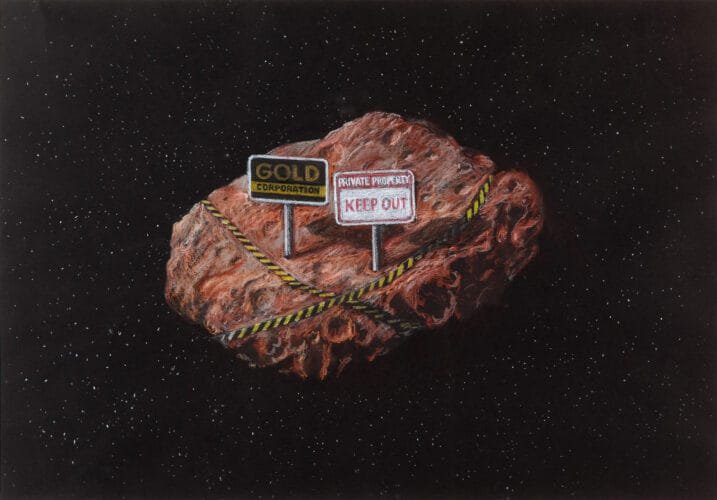
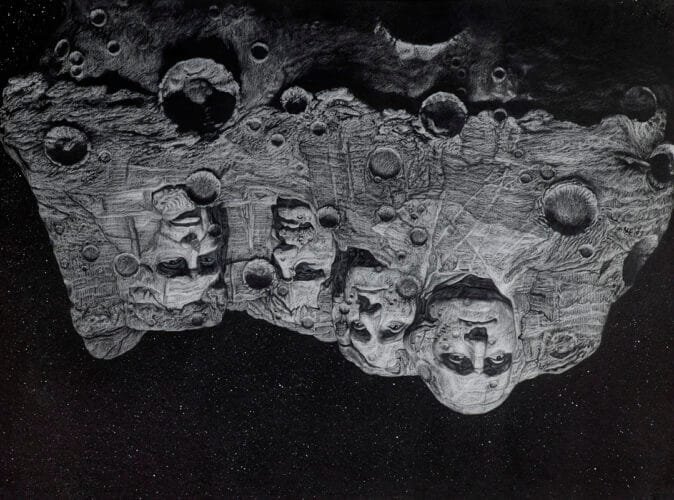
With this in mind, we enter the central spaceship and conclude our journey with the series of asteroids colonized by humanity following the partial or total migration into space: cities built on extraterrestrial bodies, the faces of the five American presidents from Mount Rushmore carved into rocks floating through space, just a few AU away from Măneciu Pământeni, passing through the plastic waste released into the infinite ocean of the cosmos, near the gold mines of the Gold Corporation – whose plan to exploit the gold deposits at Roșia Montana was halted by massive protests in Romania in the fall of 2013. The artist thus extends his anti-capitalist critique to a – frankly inseparable – critique of the Eurocentric claim to universality, transposed in recent history into civilizing missions through violence (militarization) and exploitation (neocolonialism) for the purpose of imposing capitalism as the natural evolution of democracy.
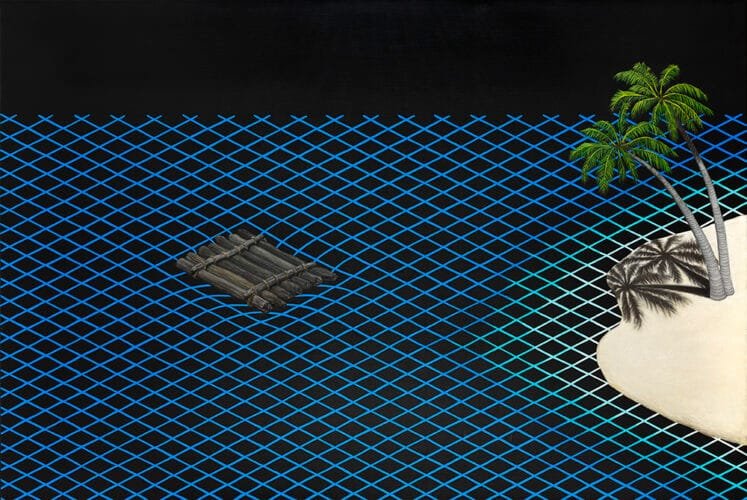
And yet, where can hope still be found in a landscape that seems devoid of hope? Amid the posthuman ruins of technological capitalism, it is glimpsed in the form and vital energy of others, in those undulations and leaps of marine mammals, which distort history and knowledge that seemed immutable, which challenge precisely the linearity of time, the hierarchies, and the categories that produce dissociation from what is understood as otherness and, thus, leave room for its exhaustion. Science and technology under the power of capital become the greatest enemy when they infiltrate daily life to stimulate, in the most subtle ways, the severing of bonds and the discriminatory consumption of life, a kind of tacit consent masked in individualism, competition, progress, and well-being, against the backdrop of a more or less visible violence. But at the same time, they – science and technology – can also be our best allies in a process of reconstruction based on the vital interdependence of bodies and spaces. Regardless of whether humanity crosses the threshold foretold by the grim conclusions of scientific analyses, most likely, what lies beyond the human, devoid of truth and binaries, will continue to weave its rhythms into infinite spectra imperceptible to socially conditioned senses, as a demonstration of the evident ignorance of human claims to superiority and domination. Hope lies in the possibility of broadening perspectives and identifying those methods responsible for solidarity with exhausted bodies, beyond the induced need for unlimited consumption and what seems to set us in opposition, toward what connects and sustains life in an essential way. Somewhere within this tense landscape, Preda places a raft (Raft, 2019), a primitive technology, an invocation of hope, of movement, and, once again, an overlap of times, somewhere at the crossroads between the known and the unknown, marked by the black space at the top of the work. It is unknown whether anyone will board the raft or where it would sail, given that navigation is always an act of collaboration with various elements outside ourselves, which can take on unpredictable forms. Nevertheless, the symbolic presence of alternative possibilities calls upon the creative imagination to forge new connections – empathetic, neurological, in everyday practices, but above all in modes of social and communal organization. Is it still possible today to imagine a future different from the capitalist path to exhaustion?
Adrian Preda is an artist deeply rooted in the contemporary world. His themes have always drawn attention to such tendencies, which have shaped his development during Romania’s extended transition to a ferocious form of capitalism, more characteristic of the U.S. than of Europe. For this reason, Preda remains a relevant artist both within the Romanian context and on the international stage, should such avenues truly be open from here. He succeeds in connecting and communicating across geographies, politics, and micro- and macro-organizational forms, highlighting the connections and networks that shape our existence, amazed and humbled by the grandeur and the impossibility of full comprehension and understanding, while maintaining a constant critical stance toward the necropolitical mechanisms that destroy habitats and ecosystems. Preda proposes an active ecological, social, and political consciousness and presence, and approaches dystopia as a technique for breaking the deadlock, for pushing the imagination to its limits, in order to bring it back into a consciousness beyond the individual, beyond the immediately perceptible and known, to signal the urgency of responsible action in the present.
[1] ”We project that the safe and just climate ESB [Earth-system boundaries] will be overshot by 2050, even if everybody in the world lives with only the minimum required access to resources (no more, no less), unless there are transformations of, for example, the energy and food systems. Thus, a safe and just corridor will only be possible with radical societal transformations and technological changes”, Prof. Joyeeta Gupta, PhDa,b, Prof. Xuemei Bai, PhDc, Prof. Diana M Liverman, PhDd, Prof. Johan Rockström, PhDe,f, Prof. Dahe Qin, PhDh,i,j, Ben Stewart-Koster, PhDk et al., A just world on a safe planet: a Lancet Planetary Health–Earth Commission report on Earth-system boundaries, translations, and transformations, 2024, available here, last accsessed on 02.12.2025.
[2] Fredric Jameson, Postmodernism or the Cultural Logic of Late Capitalism, trans. Alex Văsieș, Vlad Pojoga, Sibiu, “Lucian Blaga” University Press, 2021, pp. 39–41.
[3] Judith Butler, Cadre de război. Figurile umanului și politicile suferinței, trans. Lelia Marcău, Cluj-Napoca, Casa Cărții de Știință, 2014, p. 25.
Translated by Marina Oprea


POSTED BY

Mihaela Cîrjan
Mihaela Cîrjan / Michelle Panthère is an independent interdisciplinary cultural worker based in Bucharest, co-founder of several local initiatives such as the MATKA Association, Malmaison Studios, T...
www.mihaelacirjan.com
Comments are closed here.