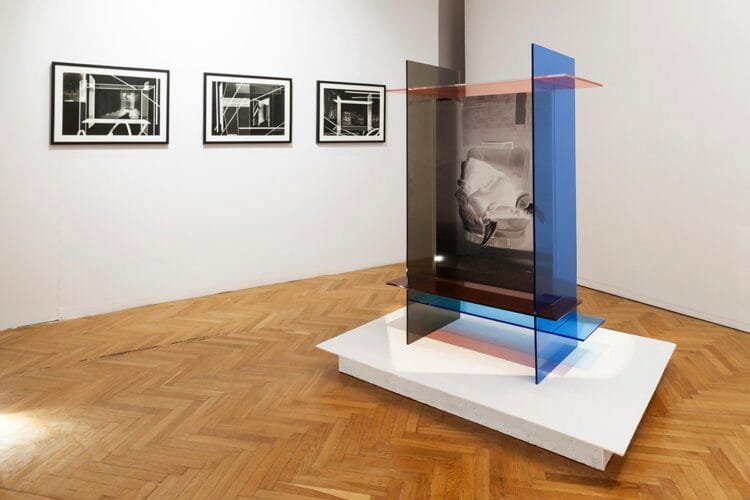
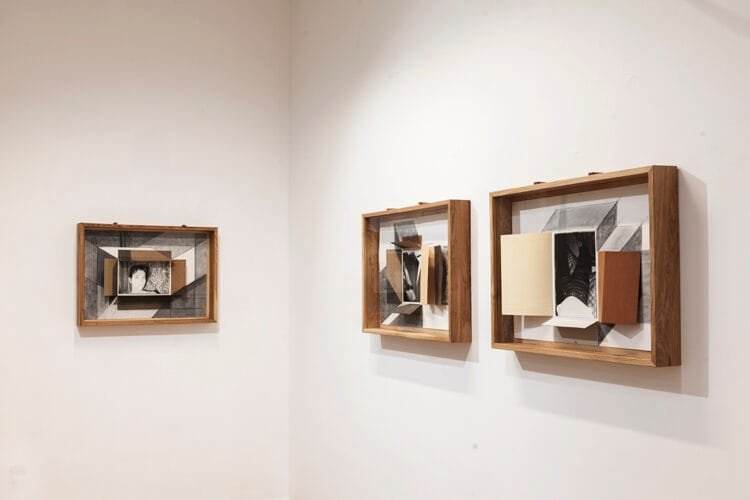
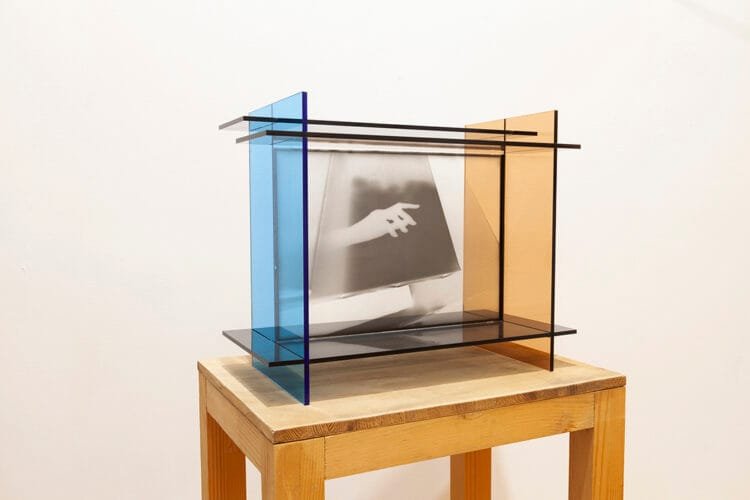
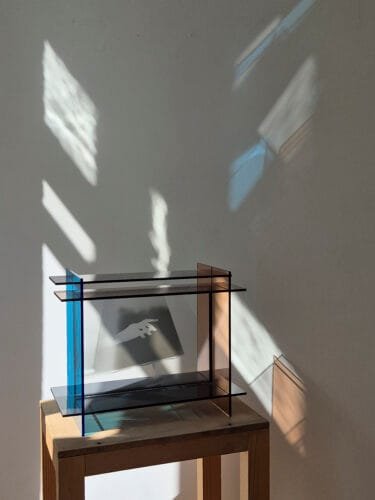
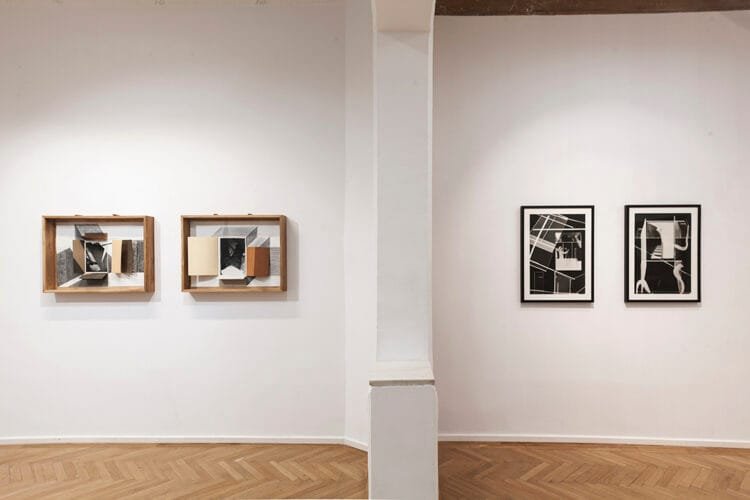
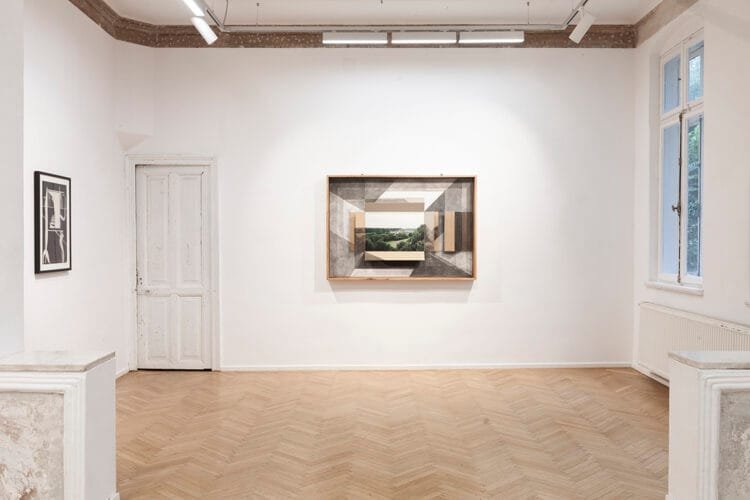
Entitled “Beyond the Photographic Frame,” Aurora Király’s exhibition marked the opening of the Anca Poterașu Gallery’s fall 2025 season with a project that is both visually fascinating and theoretically substantial. As curator Sonia Voss judiciously remarks, the artist “starts from recent, everyday photographic ‘notes’ as well as intimate self-portraits from the 1990s, which she reframes and recontextualizes using cardboard fragments and hand-drawn sketches, transforming the original images into artifacts that open up in space. These three-dimensional objects also contain a reflection on the photographic medium itself: they evoke the camera (the body of the camera) and its ability to carry us through layers of time, through the meanders of our memory.”
Indeed, the exhibition represented (also) a profound reflection on the photographic medium as a potential instrument of knowledge, establishing (un)predictable relationships with the venerable painting (with which photography has confronted since its appearance, undermining it or, as the case may be, exalting it). More than that, however, I believe that Aurora Király went further, exploiting the technical possibilities of photography in their haptic dimension. On the other hand, an obvious focus of the exhibition was the dialogue between bi- and three-dimensionality, proposing as key points (stars) objects that dominated the space, in which the valences of photography were even more highlighted.
Seeing the exhibition and listening to Aurora on a guided tour on October 9 (conducted with her characteristic competence and nonchalant rigor), I realized that the visual spectacle staged in the gallery surprisingly illustrates an older theoretical proposal by the late Peter Weibel.
In 2012, the author announced the “noetic turn,” in which a layer of artistic production, that of art as technē, was to (re)gain a central position in our understanding of its broader significance.
On the other hand, it is important to remember that, at the beginning of the last century, Aby Warburg inaugurated what was to become the new discipline of image interpretation, expanding the boundaries, tools, and possibilities of art history. Of vital importance to both moments, which still shape artistic theories today, is the constant tendency to revisit past times, perceived as still active (or waiting to be activated). This type of perspective supports an additional layer of reception, allowing for the simultaneous existence of artistic positions from different places or “fixed” (artistic) historical moments of image production. Cultural (and social) constructions belonging to different eras and, above all, their transmission effect become, more than just a passive heritage, transformative places where artists develop new strategies.
Aurora Király’s exhibition discreetly revisits (you had to look carefully) significant moments in European art history (with a focus on artistic modernity). What unites the works seems to be the author’s belief in artistic practice as a place of rational (rationalising), self-reflective (experimental) knowledge, but also assuming emotional strategies or states of the subconscious.
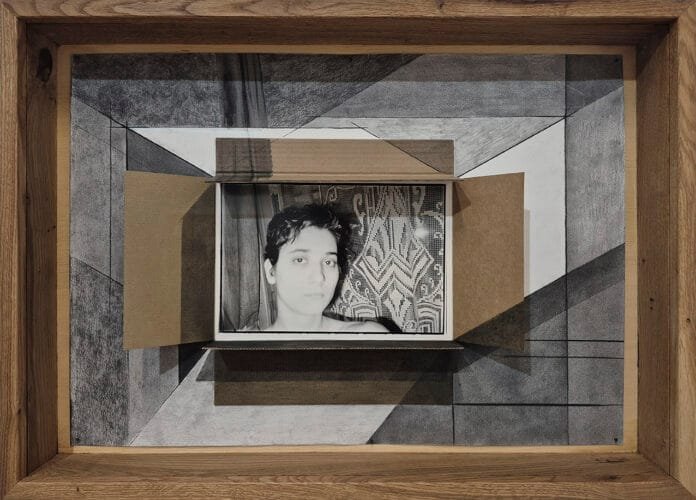
Thus, the artist draws on early self-portraits (from the late 1990s), but also recent everyday photographic impressions, recomposed in/through three-dimensional collages, cardboard, and charcoal drawings, mixing different temporalities and states, brought together in complicated artifacts that encompass, exhibit, or hide the original photographs.
Several works particularly caught my attention. Firstly, the sculptural object Viewfinder – Clash #11 (Selfportrait after a fall), which dominates the space, despite – or perhaps precisely because of – the transparency of the walls and the photographic negative of the human silhouette. Here, the artist has deliberately cultivated the ambiguity of the image, which is difficult to decipher at first glance.
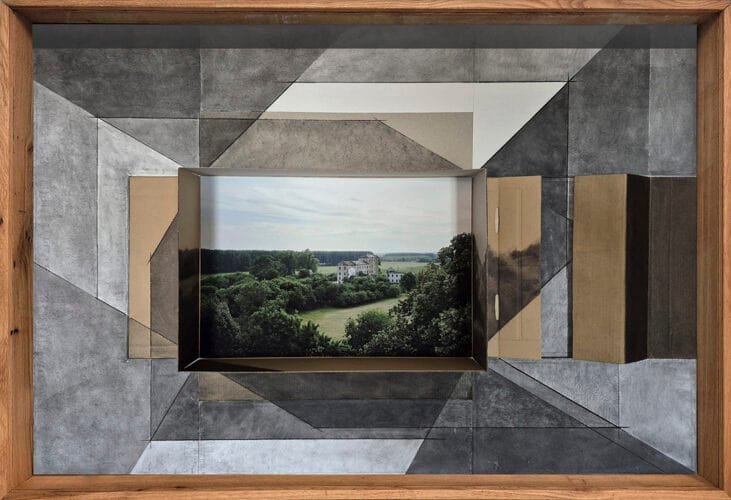
Then there is Viewfinder #29, where the 1998 photographic self-portrait seems to burst out of a dense, oppressive structure, in which the geometric charcoal drawing is encased in a massive wooden frame. Last but not least, Viewfinder #33, in which an image taken in 2017 at Cetate
– Dunăre (depicting a landscape dominated by the abandoned mill of the Barbu Drugă estate) is embedded in a sophisticated visual ensemble, framed by two small landscapes made in charcoal on cardboard using the same haptic strategy of the massive wooden frame. Here, the artist speculated the pictorial qualities of the landscape, while also meditating on the meanings of the genre in European artistic modernity through the allusive dialogue suggested between photography (her favorite medium) and drawing (as genus proximus of the visual arts).
Returning to noetic turn, I believe that Aurora Király has managed to respond convincingly to the questions posed by Peter Weibel: How do images of the past reappear in current representations and for what purpose? How does art today shape its own instruments? Equally, the artist has demonstrated her ability to adapt, adopt, and develop specific tools in confronting the past (immediate or distant) while remaining firmly anchored in what shapes her present. Technē, in this sense, becomes a fundamental element when we look at the evolution of her artistic production.


POSTED BY
Ruxandra Demetrescu
Ruxandra Demetrescu is an art historian, professor of art history and theory at the Department of Doctoral Studies of the National University of Arts in Bucharest....
Comments are closed here.