Any interpretation of a work of art is purely subjective. The interpretation of one’s own artistic emanation is equally subjective. And therefore inexact. Exhaustive interpretations do not exist, and the limits of interpretation are difficult to determine—much as a work of art has no serial number unless the artist decides to assign one, a decision they may always revisit. Since AI consciousness has inserted itself into nearly every aspect of daily life, interpretation can be delegated to an analytical program that collects and extracts data and produces, in turn, its own interpretation. So what, then, is the key to understanding a work of art? Heidegger wrote that “only something which has been truly thought has the good fortune to be understood better and better, more so than it has understood itself. But, then, this better understanding is not the merit of the interpreter, but the gift offered by the very object of interpretation.”[1]
In other words, we begin from the work to understand the artist. And/or vice versa. This is how I approached my (re)encounter with Magdalena Pelmuș, the artist behind the exhibition “Gendered Blood”, curated by Adriana Oprea, on view at Új Kriterion gallery in Miercurea Ciuc from 16 December 2025 to 10 February 2026.
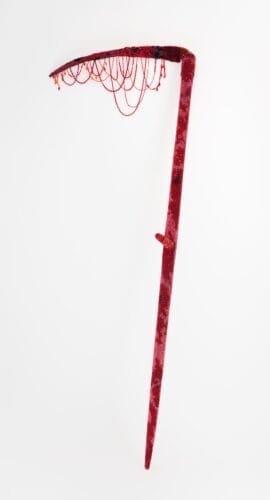
On a cloudy May afternoon, I arrive in a space crammed with canvases, notebooks, books, and fragments of installations draped in red beads and blue textiles—a small studio the size of a studio flat in the city centre, not far from the National Archives, Bucharest. It is a space well organized on a vertical axis, making the most of found objects, books, fragments I recognize from various gallery installations, like a cabinet of curiosities, somehow ready to receive visitors. The last and most visible object, a scythe covered entirely in red beads, leans against a wooden post.
In front of the studio’s only window, the same table I have known there for several years—perfect as a workbench for sewing a hammer handle or a circulatory system network onto a human torso, stretched across blue textile fabric. Magdalena listens to music at low volume and says this is her usual working mode: she does not spend too much time scrolling reels on social media, which she consumes quickly over morning coffee, focused on psychology and personal development.
I get straight to the point, sparking a conversation of some four hours in which I try to reconnect with Magda, whose studio I had not visited since 2024, when I invited her to an AFCN project at plusC, in the basement of the Peasant Museum, with the series Fragile Anatomy. A series of fragilities behind which masks had already been added long before the pandemic with its entropic rules of physical isolation.
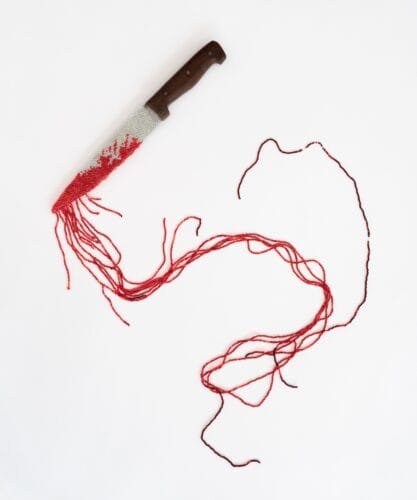
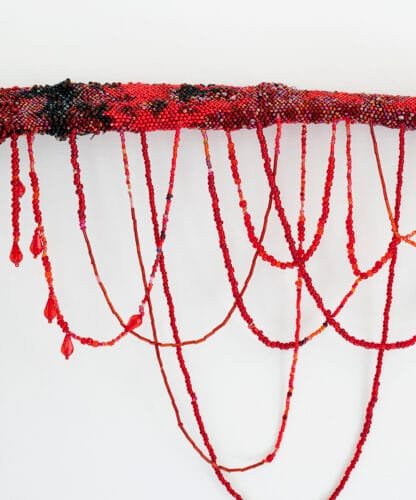
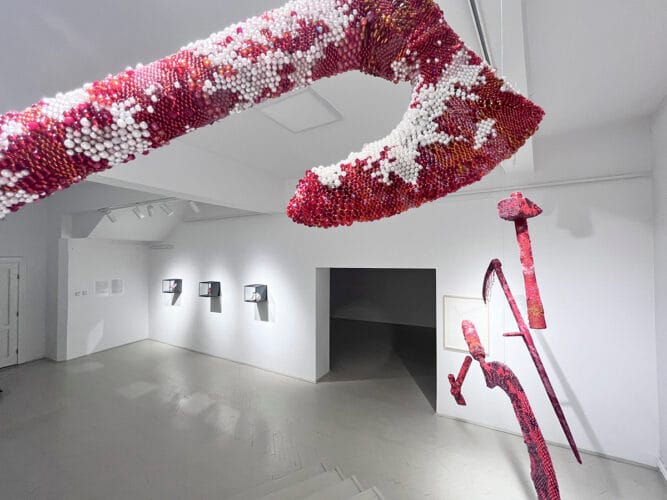
I ask Magdalena about her most recent exhibitions, about her collaboration with Ars Monitor, where she formed a “common body” with her life and studio partner, Bogdan Pelmuș. She shows me a precious, nearly square hardcover catalogue, with ingeniously conceived reproductions on tracing paper of threads of red bead embroidery, worked with an ostentation for detail taken to paroxysm. Magdalena acknowledges that, were she to realize the most ambitious mental sketches for her objects, she would need a team of skilled hands, like Liza Lou or Igshaan Adam, just two names from the multitude of international artists who have brought the bead-work manner into major museums and biennials. But above all, Magdalena insists on process: “It is a purification ritual, one I stubbornly stay with until it is finished. As if I were resolving something. Like suturing an open wound.”
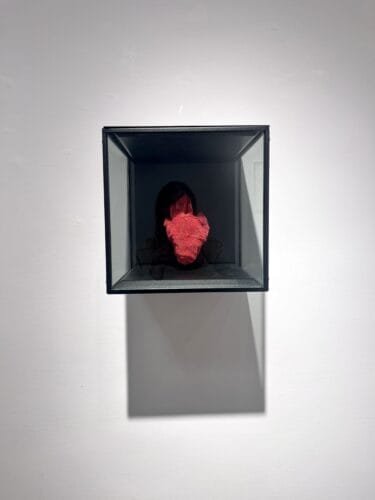
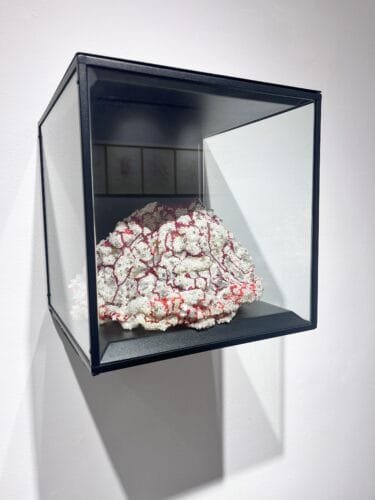
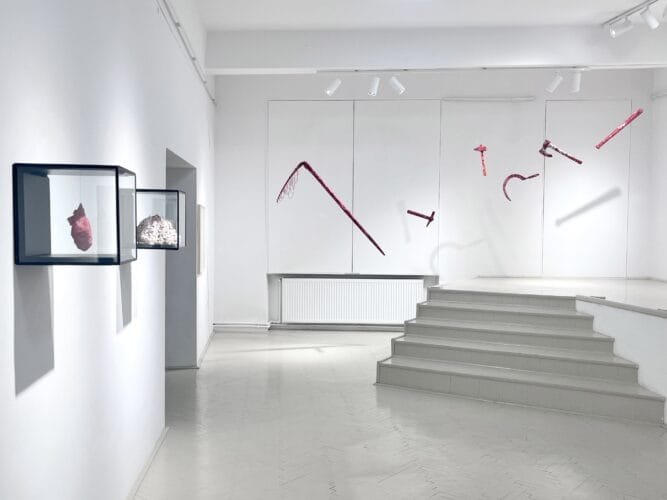
I press further to discover where this theme of the open wound originates: a wound that overflows onto the object, consuming it symbolically with a kind of internal parasitic casing that annuls its utility. A scythe and an axe are no longer useful as instruments of intervention in nature once covered by a thick layer of red beads. They become precious objects of a visible fragility. “The scythe, the axe: these objects are heavy, iron and wood inside. On top are these fine, delicate beads that bring to mind jewelry and a refined, feminine handcraft. They have a utilitarian purpose; they have been used throughout history in wars, to kill, and in the household, to feed. And once you aestheticize them, they lose their ordinary meaning but acquire new valences. They become fragile at the same time.” On the white walls of the Új Kriterion space, displayed alongside one another: these ordinary, utilitarian or violent instruments, drawings tracing bloodied paths and internal organs encased in glass boxes, as if in a laboratory cabinet of curiosities.
Ambivalence is the key word in Magdalena’s work, she says so herself. The red that predominates in her recent works carries within it this double nature: “I see it as something that can symbolize both life and death at the same time. It can be alive, when it is inside the body, or it can be something that has drained from the living – the very moment of death. It can symbolize violence or it can symbolize the nourishment of life”. And in the series of works with circular forms, conceived specifically to evoke the act of looking through a microscope, red becomes an internal movement of cells.
We proceed chronologically and I slip toward the foundations of the artist’s drawing. She shows me the sketchbooks preserved by her grandmother. The drawings inside reveal a refined rococo sensibility, a grandeur in the treatment of the image with decorum that you can only identify in children with a gift for detail. Adorned princesses, roosters wearing crowns, chandeliers with little beads, figures gazing from a window at an inaccessible outside. An obsession with dots, circles, and repetitive details shines through. “I had not realized until now that I had an obsession with dots”, says Magdalena, looking at the yellowed sheets as if they were exhibits from a file she has opened too late. She adds: “I had an eye for detail from an early age. And I have now returned to that, to meticulous, painstaking detail.”
The continuity between the kindergarten sketchbooks and the scythe covered in hundreds of red beads is not metaphorical—it is literal. The same hand that drew compulsive little circles on paper in Balta Albă district of Bucharest, now sews bead by bead onto objects found in the countryside, at Bogdan’s grandparents’ home. “It is like a meditation. I enter a kind of flow state. I focus only there and detach from everything else. I love feeling the patterns as they unfold: the nuances, the textures, I introduce them where they belong. It is a real-time decision and I would deprive myself of the joy of making them if I delegated that to someone else.” One wonders to what extent the repetitive act of sewing also serves as a quasi-Sisyphean penance, almost unconsciously self-imposed.
There is, of course, a deeper reverberation to this practice, which Magdalena articulates with an economy of words that says everything without revealing anything: “What I do is connected to my life. All this fragility that I carry, I clothe it with beads that shimmer, that are beautiful, that cover it gently and transform it into something more precious.” The shell that bleeds, yet gleams. The mask through which you recognize yourself more than without it.
When asked about her choice of this very specific material, the American artist Liza Lou has stated: “The thing about the material is that there’s a preciousness to it. Beads have a lot of connotations before you even make anything with them—around beauty, preciousness, and even labor. They’re made with a lot of care; they have their own value. It’s very, very laden. If I drop beads on the floor, I scrounge around and pick them up. I don’t just sweep them into the rubbish”.[2] In a quasi-digitalized world, the practice of sewing seems an act of stubborn insistence on labor and handcraft—carried out alone or in community, in the tradition of the collective sewing circle. Liza Lou is known for projects in which she enlists groups of sewers, being the author of large-scale objects and installations.
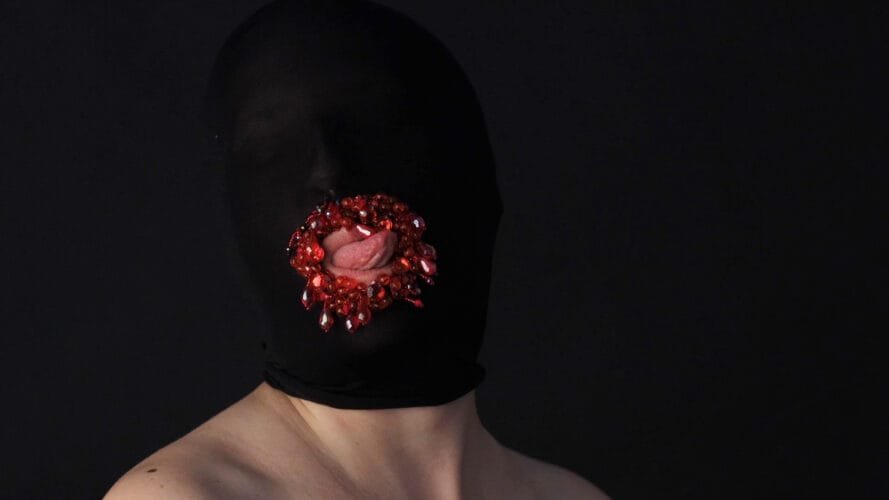
The idea of the mask, recurrent throughout Magdalena’s body of work, appeared long before the pandemic, around 2011, when she began sewing onto photographs. “The idea of the mask came to me as a form of protection. The first time, it was because I was working on photographs as a way of transforming the image and protecting the figure from remaining visible.” An anonymization, rather than a concealment. The distinction is important.
The blue series she is currently working on, which appears tentatively in the corner of the studio on a textile support, is a deliberate shift in register: “I felt the need to do this in blue as a counterbalance to red. This figure is connected to the nervous system. I wanted it to convey a calm, something different. It is like the weave of a nervous system while also resembling both a human and a plant.” A chromatic respite, for Magdalena says she has not tired of red, and will continue with it. I believe her, seeing that in her early sketchbooks only red lives as an accent.
Around five in the afternoon, the studio darkens. The childhood sketchbooks we have just examined cover to cover offer a clue to the missing link, in the context of the stacks of recently printed “Corp Comun/ Shared Body” catalogues. The scythe with its thousands of beads sits imperturbably beside the catalogue piles. There is a coherence to the whole that is difficult to articulate in words but floats in the space: an artist who has built, over thirty years, a language capable of holding contrasts without resolving them—a balance, a dance between life and death, fragility and resistance, refinement and violence, the visible and the hidden, discretion and ostentation. A princess who knows exactly why she cannot sleep.
The exhibition “Gendered Blood” by Magdalena Pelmuș, curated by Adriana Oprea, was on view at Új Kriterion gallery in Miercurea Ciuc from 16 December 2025 to 10 February 2026.
[1] Martin Heidegger, Heraclitus: The Inception of Occidental Thinking and Logic: Heraclitus’s Doctrine of the Logos, trans. Julia Goesser Assaiante and S. Montgomery Ewegen (Bloomsbury Academic, 2018), 50.
[2] Sarah Cascone, How Liza Lou’s Obsession With Beads Transformed a Village in South Africa, ArtNet, 2018, https://news.artnet.com/art-world/liza-lou-clouds-lehmann-maupin-1345115


POSTED BY

Ilina Schileru
Ilina Schileru is a Romanian artist, curator and cultural manager. She has a master's degree in graphics at the University of Arts in Bucharest, completed in 2010. She lives and works in Bucharest and...
Comments are closed here.