When I first entered Gloria Grati’s studio, through a garden in full bloom, I had the feeling of stepping into a space suspended somewhere between reality and myth. Wings (of birds, or perhaps of angels), ceramic eyes gathered in overflowing baskets, and fragmented bodies lay scattered across the walls and worktables, as if unearthed from an imaginary archaeology. Her artistic practice evokes the sense of a world in which fired clay preserves the traces of an original archetype, as the artist herself explains:
“Looking broadly at my artistic practice, I can observe my preference for smooth, organic forms with rounded, spheroidal or figurative shapes. I seek to convey ideas of protection, vigilance, and introspection through archetypal symbols such as the eye, the wing, the key, the cloud, the heart, and various figures, especially female ones inspired by prehistory. I am drawn to chromatic harmonies and natural tones, and I use patinas reminiscent of archaeological objects in order to emphasize their terrestrial and archetypal value.”
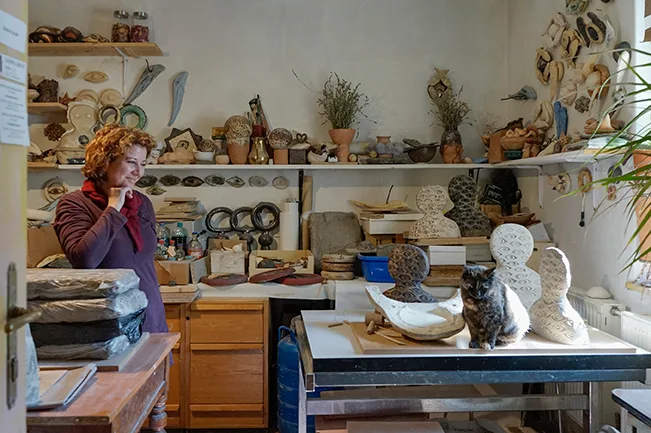
Detached wings, disembodied eyes, a cat weaving through precariously stacked ceramic objects, and the ceramic kiln transform the studio into a place of metamorphosis. Around the kiln, everything revolves around anticipation: the clay is about to pass through fire and permanently alter its nature. After this first visit, I continued to follow Gloria’s artistic journey through numerous solo and group exhibitions, as well as through her work as professor of ceramics at the Faculty of Arts and Design in Timișoara.
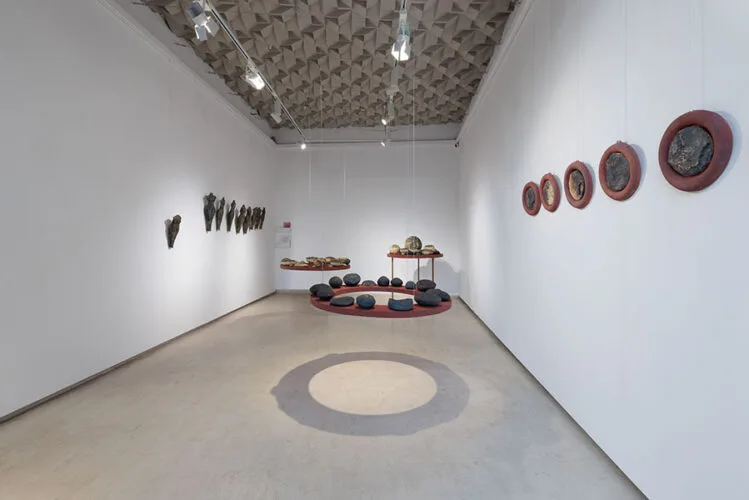
On March 13, 2026, I visited her latest solo exhibition, “Solaris”, presented at Galateea Gallery in Bucharest, Romania’s only gallery dedicated exclusively to ceramic and glass art. Intrigued by this new series of solar goddesses, which seem to overturn the traditional image of the maternal, chthonic, lunar goddess, I set out to unravel the meanings behind these new works.
The goddess theme continues a line of research that Gloria Grati developed in her doctoral dissertation, “Archaic Anthropomorphism and Contemporary Artistic Practice”. Drawing on prehistoric sculpture—particularly the Cucuteni culture—and the theories of archaeologist Marija Gimbutas, the artist investigates how the female body became, over millennia, the bearer of representations of fertility and regeneration, recalling the polytheistic religions of Old Europe, where female divinities occupied a central place.
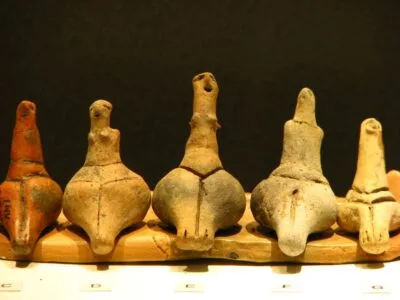
Cucuteni Ceramic
Gimbutas argued that modern interpretations of Neolithic figurines are often constrained by our own cultural prejudices. Today we tend to associate nudity with eroticism, reducing female representations to mere “fertility figurines”. In reality, the female body had a much broader religious significance. “The many sophisticated Neolithic art forms accentuating the female body unveil a natural and sacred sexuality neglected by modern culture.
In religious art, the human body symbolizes my riad functions beyond the sexual, especially the procreative, nurturing, and life enhancing. I believe that in earlier times, obscenity as a concept surrounding either the male or female body did not exist. Renditions of the body expressed other functions, specifically the nourishing and procreative aspects of the female body and the life-stimulating qualities of the male body. The female force, as the pregnant vegetation goddess, intimately embodied the earth’s fertility. But the sophisticated, complex art surrounding the Neolithic goddess is a shifting kaleidoscope of meaning: she personified every phase of life, death, and regeneration. She was the Creator from whom all life, human, plant, and animal-arose, and to whom everything returned. Her role extended far beyond eroticism”.[1]
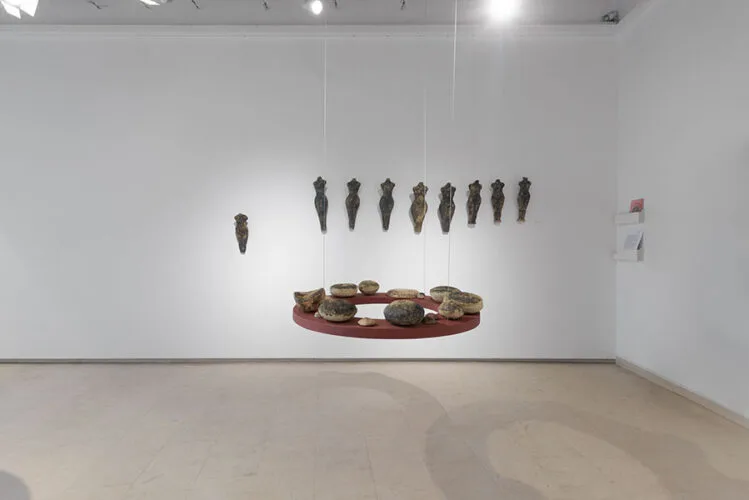
Like their Neolithic predecessors, the goddesses in “Solaris” are headless, handless, and without feet, yet their silhouettes are much closer to the anatomy of the contemporary female body. Their skin bears the imprint of sunflower heads which, from a distance, resemble fish scales or reptilian skin. These hybrid beings, situated at the intersection of the vegetal and human realms, are modelled in stoneware and patinated with copper and cobalt oxides. Together, they form what feels like an altar dedicated to the Great Goddess.
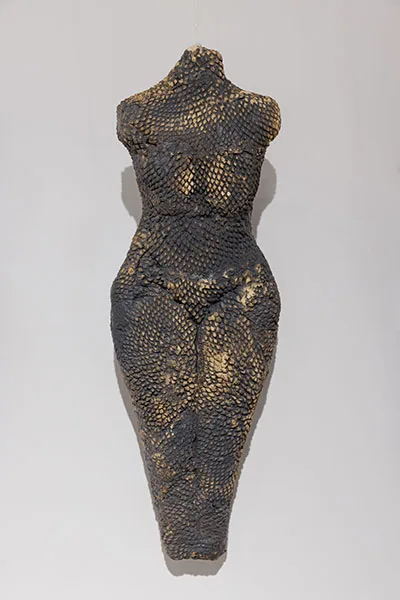
Photo credit: Verronica Negrilă.
Yet this Great Goddess is no longer exclusively chthonic. Traditionally associated with the earth’s fertility and endowed with the power of self-generation, here she becomes a solar presence. In doing so, Gloria Grati reverses one of the deepest symbolic oppositions in Western culture, where the sun has long been identified with the active masculine principle, while the moon embodies the passive feminine.
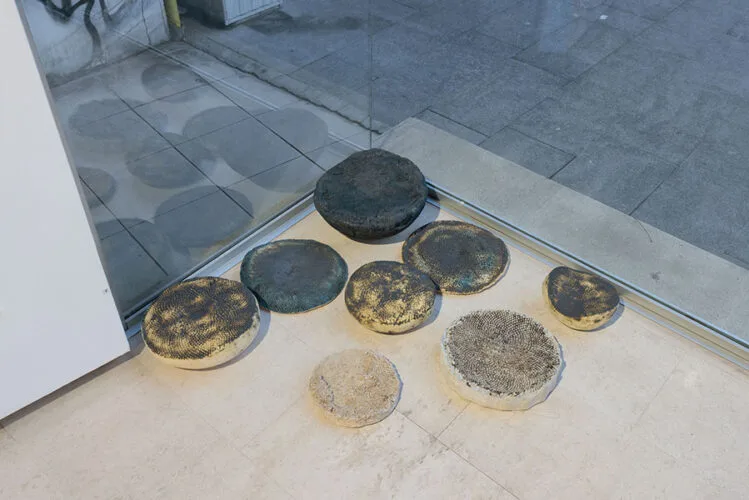
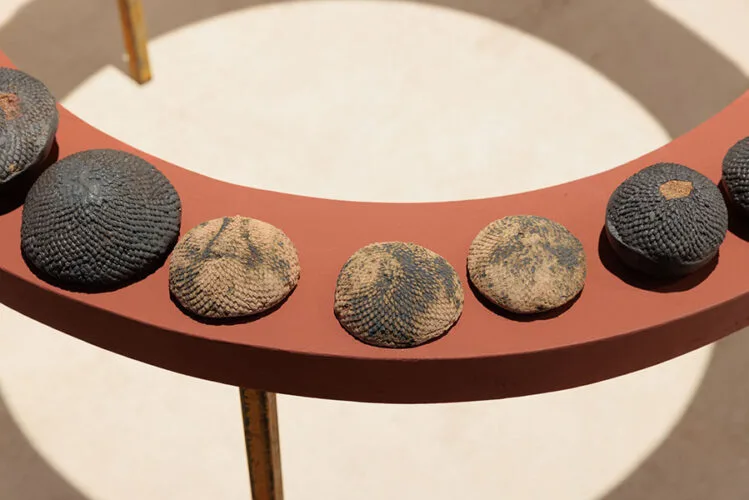
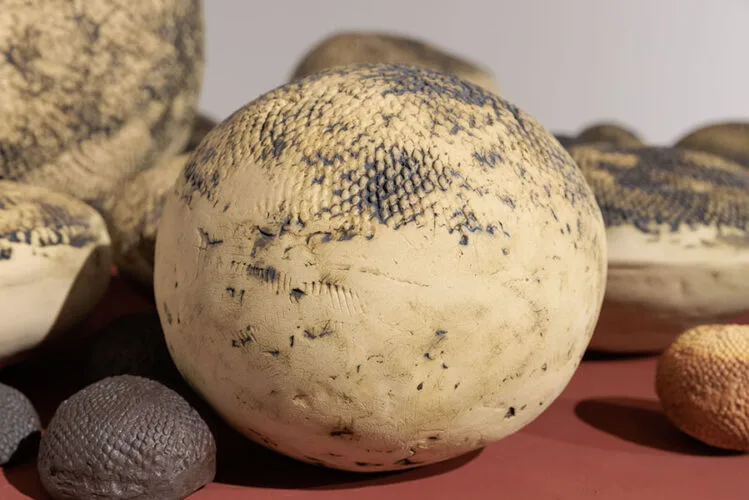
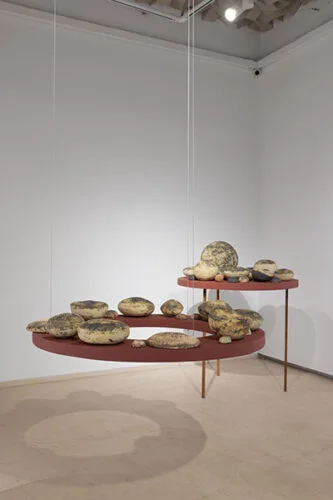
At the center of the gallery lie sunflower heads modelled from different stoneware bodies and fired into shades of black, ochre, and red. They preserve the imprint of flowers collected from the fields surrounding Timișoara—imperfect forms, pecked by birds or fragmented by time. Displayed alongside ovoid volumes reminiscent of planets and arranged in a circular suspended installation, they evoke a miniature solar system.
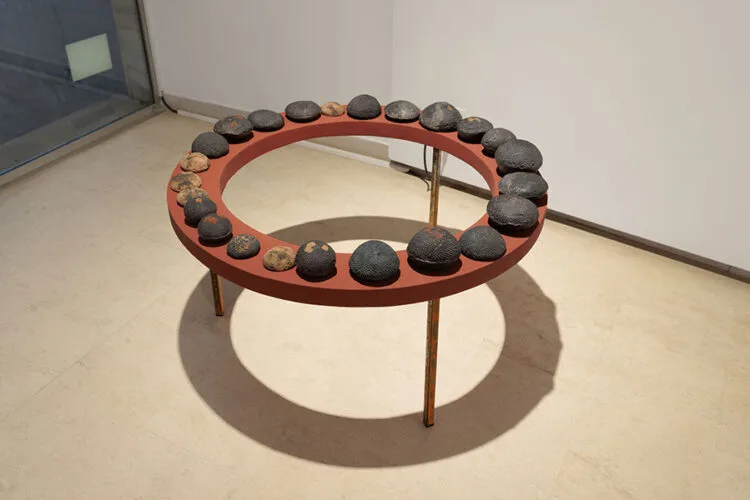
Photo credit: Veronica Negrilă
Here, the woman becomes the sun itself—the royal symbol, the giver of light and life, the star around which our planetary system revolves. This imagery invites comparison with Gaia, the personification of the Earth in Greek mythology, mother of Uranus (the Sky) and progenitor of the first generation of gods. Her Roman counterparts, Terra or Tellus, likewise embody the earth, agriculture, and fertility. The title of “Mother” bestowed upon these goddesses transcends biological motherhood; at times it is even attributed to virgin deities, signifying not maternity itself but the reverence owed to the creative source of life.
In this new body of work, the woman-goddess—a being suspended between the human and the cosmic—returns as a symbol of universal fertility and creation. Through clay, one of humanity’s oldest and most earthly materials, the terrestrial element is transformed by fire and ultimately becomes solar.
[1] The Living Goddesses, Marija Gimbutas. University of California Press, 2001.


POSTED BY

Gabriela Mateescu
Gabriela Mateescu is a Romanian artist and author who lives and works in Bucharest, working with video, installation, drawing and performance. Her work is feminist, autobiographical and self-referenti...
spam-index.com/
Comments are closed here.