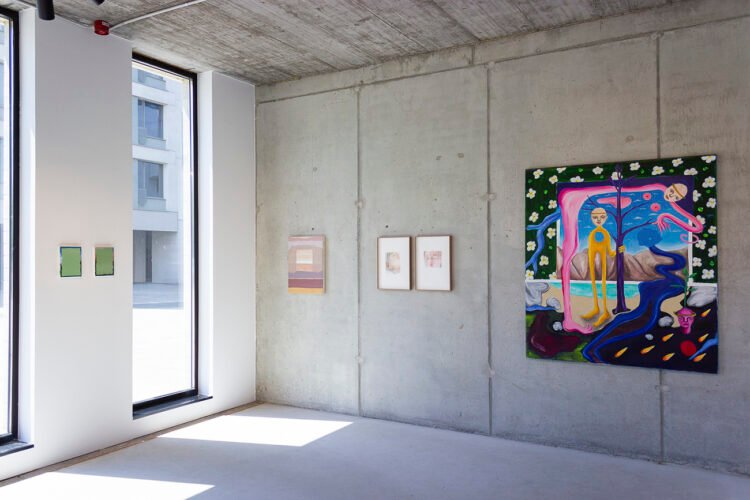
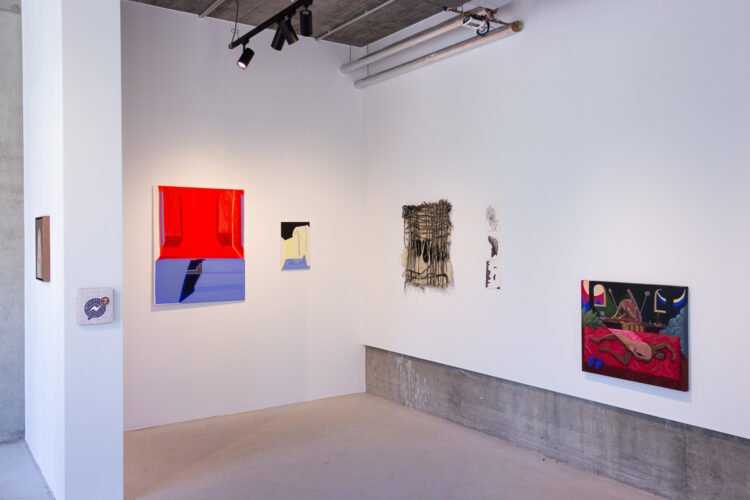
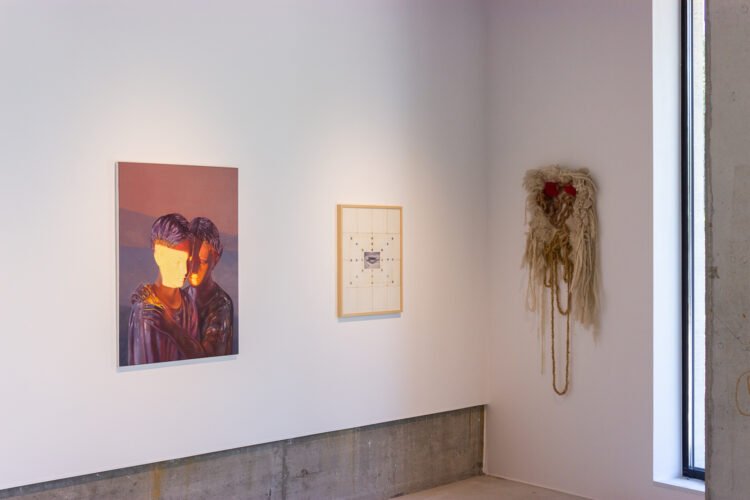
This summer, in Timișoara, the “Summer Show” took place at Jecza Gallery and Himera Gallery. The aim of this exhibition, which spans two exhibition spaces, is to promote young artists at the beginning of their careers and to offer them visibility in a professional setting. Below, I will focus on the exhibition at Himera Gallery, which features works by artists Alexandru Borcuți, Dana Guzu, Ana Maria Szollosi, Sebastiana Coman, Alecsandra Sîrbu, Dan Isăila, Elena Waldorf, Oana Tudose, Andreea Ioniță, Bamby Tony, Claudiu Ciobanu, and Anca Țintea.
Looking back, we see that such exhibitions have played an important role in establishing new generations of artists. One example is the “Salon des Refusés”, held in Paris in 1863, where artists rejected by the official Salon, including Édouard Manet, exhibited their work. Later, the “Salon d’Automne”, founded in 1903, became an important venue for modern artists; the 1905 edition was linked to the emergence of Fauvism through artists such as Henri Matisse and André Derain.[1]
The jury, consisting of Norbert Filep, Andi Popescu, and Andrei Jecza, had to make its selection based on certain criteria. An interesting discussion arises regarding the criteria underlying the selection of works: is it oriented more toward aestheticism, in the spirit of the “art for art’s sake” principle, or toward concept? In the case of aestheticism, the emphasis is on the visual experience and the beauty of the work itself. Color, composition, form, materiality, and harmony become essential elements, and the work does not necessarily have to convey a message or address a social theme. The idea of “art for art’s sake” presupposes precisely this autonomy of the work, which finds its value in its aesthetic qualities and in its ability to produce a sensory experience.
At the opposite end of the spectrum, a conceptual approach emphasizes the idea behind the work. In this case, the visual aspect may take a back seat to the message, process, or question the artist raises. A work may be intentionally simple, unconventional, or even lacking in visual appeal, if the chosen form serves the concept. From this perspective, the value of a work lies not only in what we see, but also in what it prompts us to think. Thus, between aestheticism and conceptualism, there is a debate about what makes a work relevant: beauty and the visual experience, or the idea and its ability to provoke reflection.
The universal concept for each artist, as presented by curator Norbert Filep, is that of time: “Almost already tomorrow”. Although, at first glance, it seems merely a title for an exhibition, closer analysis reveals a phrase with a distinct meaning. The pressure indirectly placed on the artist is found in already, a statement suggesting that time is passing so quickly that the entire creative process must either evolve or stagnate. Tomorrow is a new day, when things settle down, and the artist starts over. On the surface, this seems like a temporary solution, but almost instills a sense of uncertainty. In this sense, time in Almost already tomorrow is not merely a theme but becomes a condition of artistic practice: time passes, and what remains in its wake is the creative process, materialized in works of art.
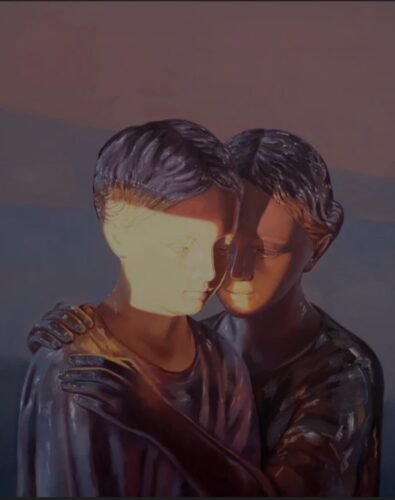
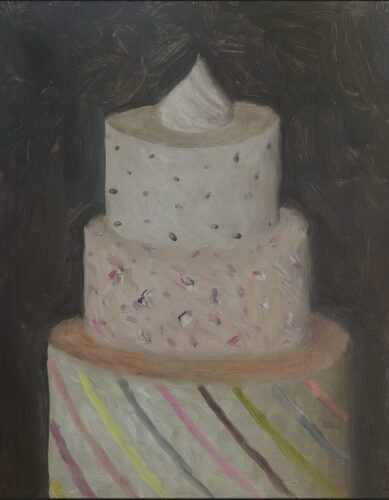
With regard to the idea of tomorrow, I would analyze Ana Szollosi’s Desire Room, Cartoon Portal through the lens of memories, a quiet, familiar place where the safety and intimacy of personal space draw you into a world of imagination, and where tomorrow is closely linked to yesterday, and the time that passes today will be added to tomorrow. Similarly, in the spirit of tomorrow, in Claudiu Ciobanu’s work, Meeting, the light covering the child’s face draws the viewer into a hyperrealistic world, a painting executed with a sensitivity evident at first glance, by capturing a moment that will pass and change tomorrow. Tomorrow will also bring a surprise: a very colorful cake, Untitled, by Dan Isăilă, decorated with straight and diagonal lines and dots, creating a visual interplay between direction, rhythm, and color. If this cake is cut and eaten, the remains that are left will represent the aspects that will be improved and will evolve in the future.
A new day brings new plans, and Andreea Ioniță’s drawings are conceptual blueprints for playful ideas. In one drawing, we see a vertical view of grass, which uses art to shift our perception of familiar things that we usually observe from only one angle, causing us to forget our playful nature, which offers us more options and helps develop our ideas and imagination. Andreea challenges our gaze beyond the image and prompts us to ask: How does playfulness transform the way we view and interpret a work of art? How can the idea of play be incorporated into a contemporary art exhibition?
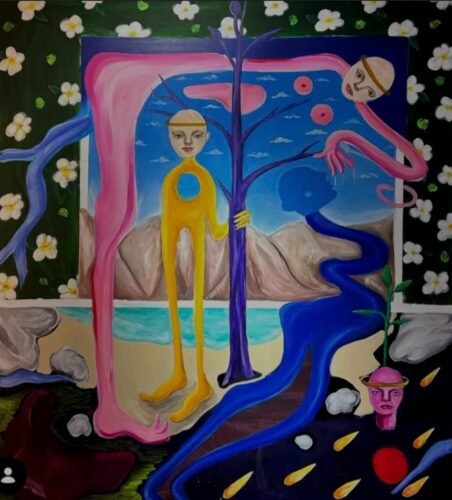
Tomorrow Is Near, and artist Alecsandra Sîrbu, with her work The Rivers of Heaven, approaches a new world full of symbols, where the human being takes the form of a new creature, trying to adapt to a universe still anchored in perceptible reality. The elongated figures, the rich color palette, and the framing of the landscape within a floral border suggest the allusion and illusion of two parallel worlds—a portal between the self and the surrounding environment, between the artistic act and the visual artist.
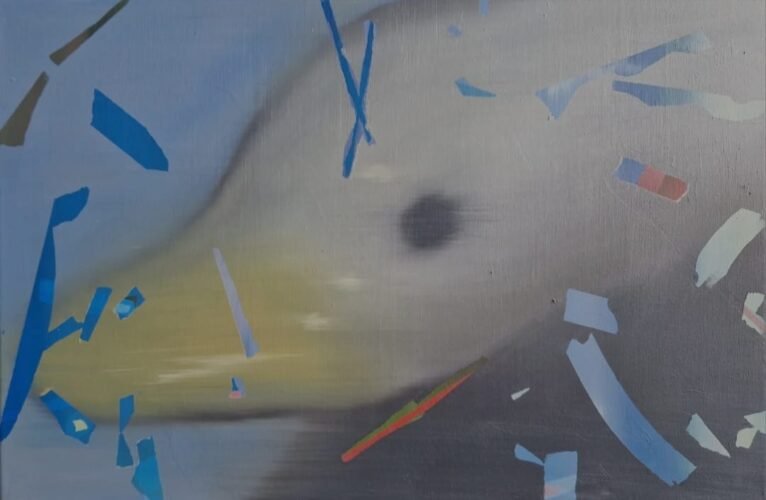
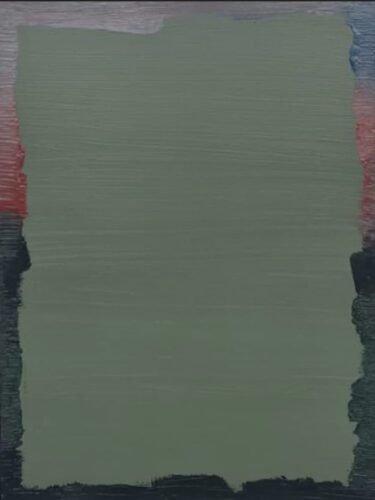
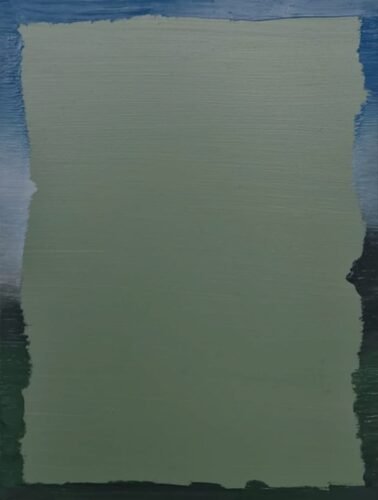
Dana Guzu is also featured here; through a photorealistic depiction disrupted by abstract interventions, she captures a simple image: a goose. But this bird is set against a background where splashes of color cover the canvas, perhaps a reference to reducing the image to observe what lies hidden behind it, or even a nod to Rayonism? Perhaps these chromatic interventions do not merely seek to conceal or fragment the image, but to reconstruct it through light, color, and direction. Similar to the principles of Rayonism, in which visible reality is broken down into beams of color and energy, the background here becomes more than a mere space for representation: it becomes a field of tension between what is seen and what lies beyond the image. The goose remains recognizable, yet it is caught in a universe where form begins to dissolve and color acquires its own language. The artist’s abstraction continues in the works Landschaft, where the background is already reduced to a single color, outlined by a border that seems to have broken down an image that refuses to be revealed.
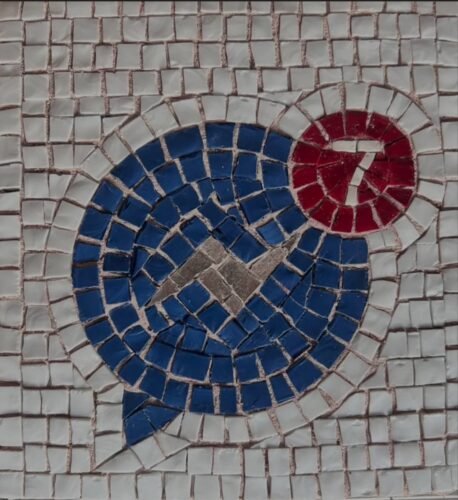
Online communication is one of the most accessible and widespread forms of social interaction today. Elena Waldorf’s mosaic, Messenger, is, in turn, a form of visual communication in which each fragment contributes to the construction of meaning, and the final image is revealed through the relationship between its parts. The convergence of these two elements gives rise to a work of art in which tradition and precision of execution find their place in the present. A return to classical art forms not only bridges the gap between different generations but also contributes to the preservation of an artistic and cultural heritage.
Art is already undergoing transformations from one decade to the next, and the speed with which a message is transmitted and received has become a recurring theme in contemporary communication. Nevertheless, texts about art retain their role in the relationship between the artwork and the viewer. The 2022 study by Luise Reitstätter, Karolin Galter, and Flora Bakondi, Looking to Read: How Visitors Use Exhibit Labels in the Art Museum, shows that visitors continue to read exhibition texts, albeit to varying degrees. The research highlights that the inclusion of additional explanatory texts can increase the time spent both on the artwork and on the information accompanying it, contributing to a deeper understanding and even a shift in its interpretation. As such, in a context dominated by rapid communication, the art text remains a tool through which the viewer is invited to slow down, observe, and construct meaning beyond the first impression.[2]
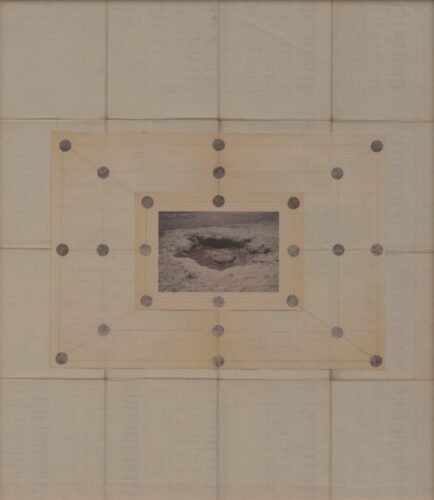
This already, evident in the exhibition’s title, brings together the work by Anca Țintea, where the time spent with the artwork merges with the information provided prior to encountering it. The Mosquito grid—a sort of mathematical study of the image that restricts its dimensions and visualization—has already been found in famous works, yet its message and mode of presentation become distinctive hallmarks of this artist. The word already thus seeks to convey that, although certain elements of the works are recognizable and can be found in other pieces, the way the artist reinterprets them, the message she constructs, and her execution ultimately become a personal hallmark.
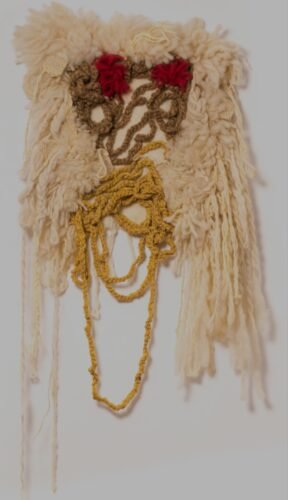
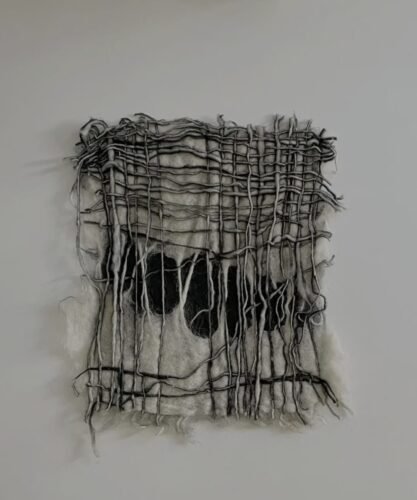
At first glance, Oana Tudose’s woolen objects can have various meanings: African masks, dolls, a female figure, undefined and empty spaces, or simply a traditional woolen rug. Upon closer inspection, they reveal an anthropomorphic mythological figure, The Hag, but in the form of a modern three-dimensional tapestry, in relation to the abstract form of the work Untitled. By reinterpreting a mythological and traditional form through an abstract and contemporary language, the work evokes the principles of the Arte Povera movement. This connection is manifested first and foremost through the work’s materiality. The artist uses simple, irregular fibers and raw wool, materials considered modest, transforming them into central elements of her artistic language. Already, the loose weave, full of knots and unfinished edges, eschews industrial perfection and highlights the controlled imperfection of handcrafted work.
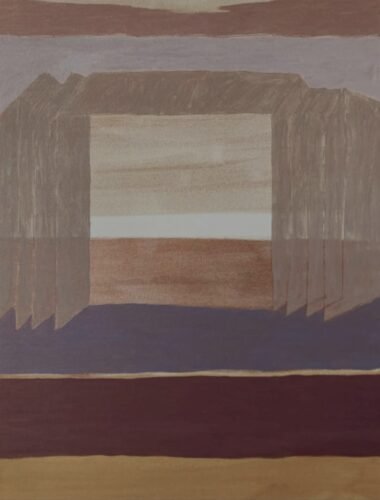
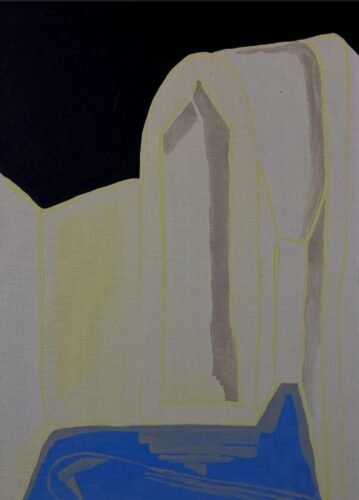
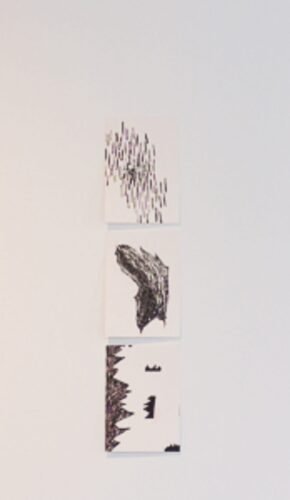
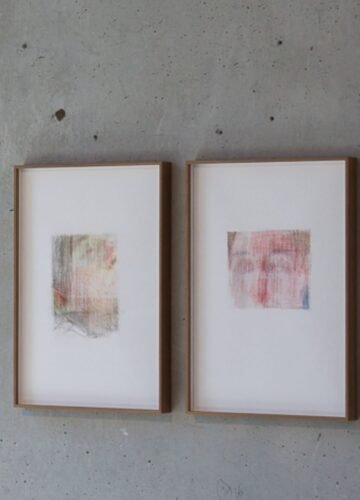
Time is already running out, and Sebastiana Coman presents two drawings: in the first, the figure gazes toward the exhibition, aware of the pressure to create as an integral part of artistic practice, while the second is an abstract drawing in which the delicacy of the line creates a space where precision and accuracy guide the artistic perspective and attempt to blur the line between control and expressiveness. We can imagine a scenario where the perfection of artistic practice has been achieved, where every line and every gesture is carefully controlled. However, the meaning of the work cannot be fully controlled, as it changes depending on the perspective and experience of each viewer.
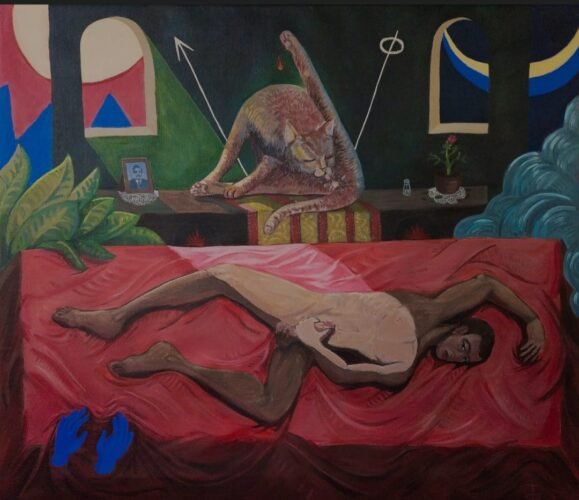
Bamby Tony immediately captures the idea of the passage of time, while Late Morning suggests a form of stagnation, embodied by a man lying on a bed. The sunlight bathing his body does not spark his desire to turn this late morning into a day devoted to creation, but rather accentuates his state of passivity and suspension in time. The surrealistic hands, which delicately touch the bed, may express the character’s desire, closeness, or even inner tension. At the same time, the cat facing the man stands in contrast to him: while it seems attentive to his presence, the character has his back turned and pays it no attention. This creates a subtle distance between the two figures, which accentuates the character’s isolation. Late Morning can be viewed as a work with Symbolist overtones, filled with elements that center around the main character and offer clues about his inner state.
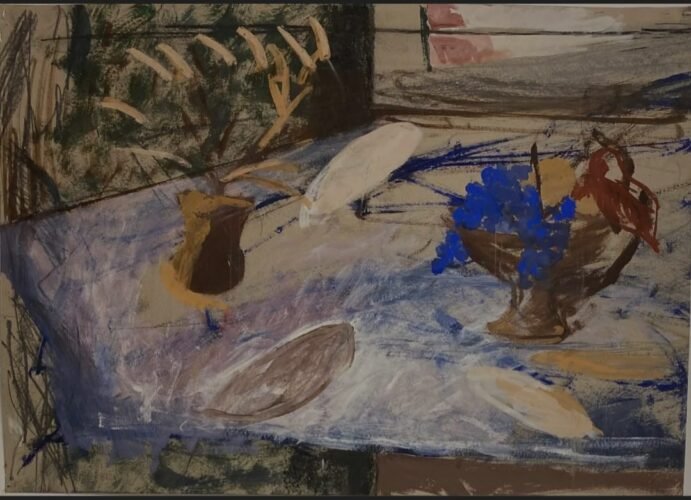
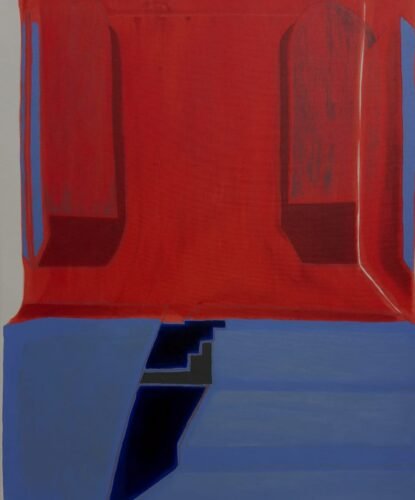
Alexandru Borcuți’s abstract still lifes already transcend the strict rules of composition, with objects giving the impression that they are floating in an unstable space. The color palette, dominated by brown, blue, yellow, and white, creates an autumnal atmosphere and suggests the season’s connection to nature. In comparison to Paul Cézanne’s still lifes, where objects are constructed through volumes, geometric forms, and carefully balanced relationships between compositional elements, Borcuți seems to take this departure from traditional representation in a freer and more abstract direction. While Cézanne’s objects still retain their recognizability and occupy a space constructed through relationships of form and color, in Borcuți’s work they seem to break free from gravity and the conventional rules of space.
There is a playfulness in this exhibition, relating both to the overlapping of dimensions and to the juggling of various artistic media. Large-scale paintings, such as Claudiu Ciobanu’s 100 × 80 cm work or Alecsandra Sîrbu’s 160 × 140 cm piece, stand in contrast to Dana Guzu’s works, which measure 24 × 18 cm. These contrasts reflect a personal preference regarding how a work of art is perceived by the public. A large-scale work compels the viewer to look at it, automatically standing out; in contrast, a small-scale work offers the viewer the option to choose whether to approach it or not.
At the same time, the mix of artistic media—drawing, painting, mosaic, and textiles—gives the exhibition a rich palette reflecting the preferences and interests of young artists. The presence of these media highlights the freedom to experiment and the way in which each artist develops their own artistic language. This diversity allows us to observe how different media assert their presence in contemporary society, as well as which is more dominant. The answer given by this exhibition seems to be painting, which stands out visually in relation to other forms of artistic expression.
Ultimately, “Almost already tomorrow” is conceived as an exhibition about time, but also about how time shapes artistic practice and the relationship between the artwork and the viewer. From memory and nostalgia to anticipation, stagnation, and transformation, the idea of tomorrow appears in the artists’ works as an open space, in which the present is constantly influenced by what has been and what is yet to come. At the same time, already introduces a tension between the familiar and the new: many of the forms, techniques, and languages encountered in the exhibition have already been explored in art history, yet each artist reinterprets them through their own sensibility and their own way of constructing the image.
[1] Grand Palais. (2020, November 6). Le scandale du salon d’automne de 1905 au Grand Palais: La naissance du Fauvisme!
[2] Reitstätter, L., Galter, K., & Bakondi, F. (2022), ”Looking to read: How visitors use exhibit labels in the art museum”, Visitor Studies, 25(2), 127–150.
Translated by Marina Oprea


POSTED BY

Miruna Robescu
Miruna Robescu, a graduate of the Faculty of Arts and Design in Timișoara, specializing in Heritage, Restoration and Curatorship in Visual Arts, is a cultural mediator and writes about art with one e...