To Dragoș, Sandra, Jana, Catrinel

Blu-Tack marks above my bedroom heater
Restless prologue
Walking through the Ioana Nemeș retrospective exhibition All Times at Once at MNAC Bucharest*, walking not simply for the pleasure and, sometimes, feeling of scrutiny one gets when seeing an exhibition in one’s free time. Walking, instead, with interviewing Sandra Demetrescu of KILOBASE Bucharest as the show’s co-curator, walking with writing in mind, my hunch was that my essay would speak about the artist’s relation to the archival. Arriving home from the museum, however, I quickly shifted to something broader—instead, the piece was to be about Ioana’s artistic research more encompassingly. In particular, I would write about her practice as if an enchantment of daily objects and quotidian routines. Then, being in the midst of a doctoral research trip to Romania, I assumed a more self-reflective orientation. I made myself aware, in feminist (post)qualitative researcher fashion,[1] of my positionality as a sociologist rather than art critic in relation to exhibitions, striving to write-with rather than about art. Instead of committing myself just to the art field, I wondered what sort of epistemic spices might make certain works of art, alongside certain works of sociology, social critique. And where and how art and sociology, each as its own mode of social critique, might touch. Whether I could hint to these questions in my essay.
Certainly, Ioana’s meticulous series had something to say about—arguably socially critical—sociological themes, such as the neoliberal quantification of the self (Monthly Evaluations, 2004-2010), commodification (Expensive Fiasco, Cheap Success, 2010), the peripheral condition (Letters to a Young Artist in the aforementioned series), and exoticisation (Relics for the Afterfuture, 2008-2009). However, not unlike its predecessors, this latter train of thought quickly derailed and veered into something else. Reflecting yet again on my positionality, I no longer envisioned myself as a rational researcher, but as crip, an autistic person with complex trauma, and with an almost superstitious way of relating to Ioana’s practice ever since I discovered her work in 2019. Writing merely about the archival, merely about artistic research, merely about art-sociological connections, could not contain my long-lasting, imaginary dialogues with her art. It went against the odd and haunting feeling of identifying with the fiction of someone I had never met, against the deep sadness, even sense of paranoia, that her death produced in me.
My research trip to Bucharest ended and I returned to London, where I spend most of my days these days. In my tree-kissed, mid-sized bedroom located on the upper floor of a council estate, I hung up, using the most ordinary type of Blu-Tack, an archival poster that Sandra was so kind to gift to me during our exhibition tour. This poster showed a work from Ioana’s Monthly Evaluations, an extensive series where the artist self-evaluated each of her days according to physical, emotional, intellectual, financial, and luck factors. In the series, the resulting sum between the aforementioned factors—a net minus (-), plus (+), or zero (=)—would get assigned a colour, following the Lüscher colour test in personality psychology, alongside a succinct text. From this carefully catalogued archive, Ioana extracted individual evaluations, turning them into murals or three-dimensional objects.
Reproducing one of her murals that is ambivalently double coloured, my poster read: Dreams do dream us, don’t they? We are not the ones in control. The quote had me obsessed for months; I would turn it around and around in my head, dangerously but happily. Where does agency reside in this bold aphorism? Is it within the subject still if it is contained by our dreams, or is agency somehow subject-less? Does the subject evaporate, in an empiricist way, in the tinier ‘particles’ that make up (the illusion of) the conscious mind? Or does the subject, through the “our/we”, sublimate into a collective being? Between different deadlines and other personal circumstances, a year had passed and this essay remained a mere collection of disparate notes. Writing it felt outside my reach. Then, in the middle of a depressive episode, I decided to hang the poster upside down. I guess I wanted to feel, again, a sense of command over my sleep. A classic case of malfunction by dried Blu-Tack reuse, the poster collapsed on the floor almost immediately, and it was then that I could pen down this piece.
Knowing through, with, and in pain: Spinning ‘round towards one negative cripistemology
What if I took my act of turning the Dreams poster upside down more seriously? Transmute it into a method of engagement that can seep into writing, enliven my text and provide a modest sense of command over the page. Perhaps, I can follow this soothe-seeking gesture to make sense of my words by spinning around not an object, but the chronological narration of the prologue. I could then begin with its final, more timidly suggested proposition, of embracing a crip-theoretical relating to art.[2] One that is entwined with my partial perspective as someone who has thought and, importantly, felt alongside Ioana’s practice. Already, the prologue has been a verbose place of emotional excess, uncontained and leaking. Having amongst others outed myself as autistic and pained, I am now no longer able to speak to the reader from the Enlightened position of an emotionally composed person of knowledge. I have traced to you, the reader, with the pathologised detailedness and incapacity at concealment that is often charged at autistics, my obsessions, circular attempts to find a way out of the conundrums of my thoughts. Yet all of this makes me feel enthusiastic, even safe, to snuggle in—what may be theoretically ascribed to—a field of negative cripistemologies.
Now, before I turn back, or forward, to sensing with the Monthly Evaluations, I feel indebted to prolong this moment, and take a minute to briefly explain what I mean by the aforementioned juxtaposition of terms: negative / crip / epistemologies.[3] First, critical disability studies scholars Merri Lisa Johnson and Robert McRuer use the notion of cripistemology to describe ways of knowing that are constructed in relation with experiences of non-ablebodiedness. They argue for the theoretical urgency of crip knowledges at a time when body politics of (dis)abling—governing who gets to live and who gets to live (un)well—mark global contemporary crises.[4] Cripistemology stresses the material conditions of uncertainty shaping crip lives, arguing for a way of theorising that does not turn away from situations of conceptual instability.[5] Second, the notion of crip negativity, as J. Logan Smilges writes:
…refers, on one hand, to the many bad feelings that disabled, debilitated, and otherwise nonnormatively embodyminded people encounter with some regularity: pain, guilt, shame, embarrassment, exhaustion, fear, and anger, to name just a few. On another hand, crip negativity names how these bad feelings are felt: deeply, slowly, tearfully, fitfully, sleeplessly, suicidally, hungrily, among the long list of excessive and pathological ways that crips feel (Forrest 2020).[6]
At the same time, Smilges’ crip negativity is a later companion to the previously theorised notion of queer negativity, an antisocial conception of queerness where the logic of assimilation into a heterosexist system in LGBT politics is rejected. Drawing from this, crip negativity is further skeptical of the focus on accessibility and recovery in liberal disability politics, of the possibility that it re-instates a system of compulsory ablebodiedness.[7] However, where queer negativity argues for a total refusal of the future,[8] crip negativity reimagines this antisocial temporal structure as an impermanent break from future-oriented optimism. This pause allows for “the dis/affective lag between the grief of the present and the hope of the future” to be experienced.[9] Similarly, to Johnson and McRuer, crip knowledges are always formed in-relation, crucially between knowing through pain, and knowing through “the joy produced by working with and around the needs”[10] of those significant others who suffer. Thus, knowing through ‘the pause’ of negative cripistemology may be highly convivial with emotions that are socially signified as either negative or positive.
Overall, stitching together these proximate, crip-theoretical perspectives on negativity and epistemology, here, I want to make peace with my interruptions and deviations in writing, and let myself be guided by these affected breaks—convivially peering back into the Monthly Evaluations, I follow that which doesn’t let me write what and how I oftentimes think I should be writing: linearly, coldly, securely. However, and importantly, as someone who passes as mentally and physically able, whose psychiatric diagnoses have always been on the spectrum of the so-called ‘high-functioning’, I write from pain which is just merely visible, deeply interiorised, and oftentimes marginal in my own conception of myself.
Then, I rely on a second method to advance through my writing. To tap into my margins and enact a shift in focus towards bad crip feelings, I borrow from a somatic dance practice that encourages participants to see through their peripheral vision. I have previously practised this method in one session of the Embodied Theory Lab that my academic supervisor, Jana Melkumova-Reynolds, ran together with choreographer Elisabeth Motley. The session encouraged more somatically attuned relatings to theory: as we walked, crawled, and moved other parts of our bodies really slowly, we were urged to observe the room and the other participants through the corners of our eyes only. Here, I wish to convert this illuminating movement practice to thinking and remembering–tracing the peripheral in myself, in my imaginings of the Monthly Evaluations. Moving my learned ways of writing to the side becomes a technique to make-visible through rather than in spite of cognitive dissonance, obsession, dysregulation, anxiety. My embodyminded responses to Ioana’s evaluation practice, the case of the Dreams poster being just an example, are unstable loci that re-situate ways of tending to the series.
What lurks in a text, a sign, a color?
One (last?) confession: I always find my first drafts quite embarrassing, and due to this I tend to seek reassurance from my friends. This time, when I briefly told Dragoș over email that I wanted to engage with Ioana’s practice from a crip-theoretical lens, he absolutely did not want to discourage me, but he said it was a niche take. At the library and in Google Doc comments, Catrinel was positive that I should push forward with this work, although we could not find full clarity on the exact threads which had to be further pressed on. Two little ‘sanity’ checks for the present text, these more reluctant conversations further prompted that a crip way of knowing does not simply emanate from Ioana’s practice. Instead, they further suggested that cripistemology is something that lurks through her work.
To begin, the idea of lurking cripistemology in Monthly Evaluations extends to art what Johnson and McRuer have argued in relation to contemporary theory. They claim that, in the global context of the present bodypolitical crisis, cripistemology already appears everywhere once you start searching for it, and even when disability is not explicitly remarked upon. In their Cripistemologies article, they instantiate this by referring to queer theorist Eve Kosofsky Sedgwick’s Epistemology of the Closet.[11] In particular, they cite a paragraph where Sedgwick describes the distinction between homosexuality and heterosexuality governing Western thought in the 20th century as something endemic, chronic, and fractured.[12] One day, I was sitting at the library not knowing where to begin, but thinking about the ghostliness with which theoretical language makes illness and brokenness its metaphors—like a reservoir that is not-yet brought to criticism, unwittingly circulating text. I began scrolling through my lengthy document of paragraphs and annotations. My eyes landed on a Monthly Evaluation I had copied and pasted from an image folder that Sandra and Dragoș had sent to me.
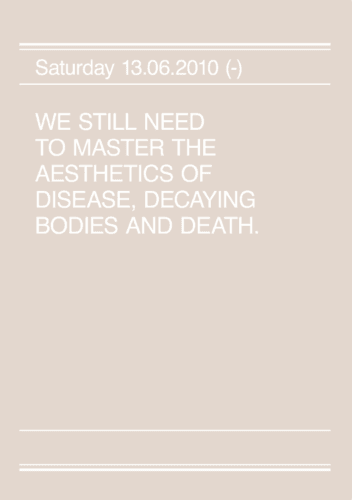
On 13.06.2010, Ioana described her day in the negative (-), without mentioning a factor-based calculation. She wrote: We still need to master the aesthetics of disease, decaying bodies and death. I read this evaluation as one of the few explicit articulations of the not-yet-but-already-here of crip in Ioana’s work. What lurked here to me was a hint, a clue towards crip as an aesthetic alongside an epistemological project of negative feeling. But what separates those fields so neatly, aesthetics and epistemology, that they might seem distinct projects? I instinctively returned to the early works of Michel Foucault: his histories of knowledge, and particularly of how, in the classical age, reason and unreason came to be distinguished from each other in discourse—how order became order, and madness became madness.[13]
Discussing the place of literature and aesthetics in Foucault’s early writings, anthropologist James Faubion claims that, to Foucault,[14] in the dyadic relationships between order and madness registered in classical—and later, modern—thought, the literary orientation towards the expressibility of feeling “has obliged literature to share some portion of the fate of madness itself”.[15] To share some of madness’ marginality in relation to knowledge. Then, aesthetics, understood in the more etymological sense of the Ancient Greek aisthesis, that which has to do with feeling rather than that which has to do with beauty,[16] becomes an impasse, at friction with knowing, this time in the modern sense of the verb.
This friction, between feeling and knowing, suffering and rationalising, joy and self-management, is I believe at the lurkingly crip heart of the Monthly Evaluations practice. First, Ioana’s method of evaluation draws from Max Lüscher’s psychology colour test, a mid-20th century technique to discern a patient’s psychological vulnerabilities, oftentimes used as a complementary tool to make the diagnosis processes more efficient.[17] The series then emplaces itself in the close proximity of the measurement methods that are so characteristic of how the body has been medicalised in modernity, where what is pathological in the individual is established in relation to a wider social body.[18] Importantly, Ioana did not only produce individual evaluations, but also monthly calendars together with graphs. By turning self-monitoring into a performative, more-than-textual practice, these measurements can be subjected to the gaze of wider publics. Here, lies a desire for regulating, even mastering, the uncertainty engendered by navigating life when one self-perceives as eschewing normative standards of sociality. However, as curator Marti Manen has noted, it is precisely the establishment of this grid for optimisation that, in Ioana’s works, allows “brutal feelings” to escape from boxes.[19] And, to Manen, this is not unlike the emotions engendered by the writings of Kathy Acker.
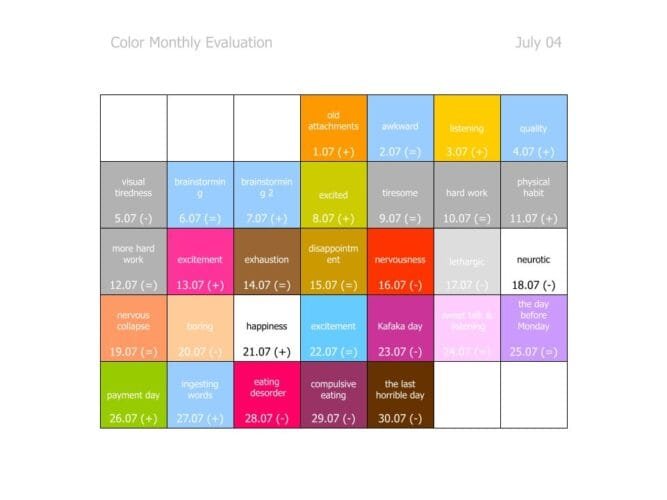
Monthly Evaluations (July 2004)
All in all, there seems to be a deep connection between Ioana’s evaluative practice and literary expressivity. In the earliest evaluations from 2004, a confessionary immediacy is catalogued. There, the micro-insertions of text on blocks of color may be easily interpreted as hurriedly written diary jottings marking an event of the day, such as “a sandwich: READING SLEEPING READING”, “food intoxication and some socializing duties”, or “lost in my own incapacity of understanding ANYTHING”. Further in the series, whilst some evaluations have more syntactic complexity, what persists, however, in their aphoristic form, is an instability of the sign, a vulnerability to fabulation and interpretation that makes the texts highly intersubjective—through their semiotic fragility and the fracturedness in linear meaning-making, they may open to other life histories, to transfers of the emotional order.
Here, I would like to stop again—as I mention emotional transfers, I feel a little awkward. Looking back, the previous phrase does not appear to be simply a critical remark about the function of an artwork. No, it certainly has something to do with me, and I become a little paranoid that I am assuming too much regarding the experiences of others. Far from an unusual sensation when writing interpretatively, however, in this instance, the feeling of insecurity has a stronger grounding, that makes me obliged to disclose my original encounter with Ioana’s work. It was 2019, at MNAC. Then, I was interning at Scena9 Magazine and working, with one other colleague, on a short piece recommending seven works to be seen in the museum’s new display of its permanent collection, titled Seeing History – 1947-2007. And there I saw it, the diorama, one of the few object-based Monthly Evaluations. Inside the diorama, there lay a black-and-white decor for a cemetery with only one grave stone, and the text (as I remembered it): She cut herself with a kitchen knife. This inscription would return to mind with varying strength. I would shamefully recognise something of my own in this landscape, fearful of the potential tragedy of a demise by my own making (oh, she fucked up again, this time too hard). Only that this was not, in fact, what the artwork was saying! Years later, when I crossed paths with the diorama, once again at MNAC, in the All Times at Once exhibition, I became aware of my misreading. Instead, the Monthly Evaluation went:
He tried to cut her throat with a kitchen knife.
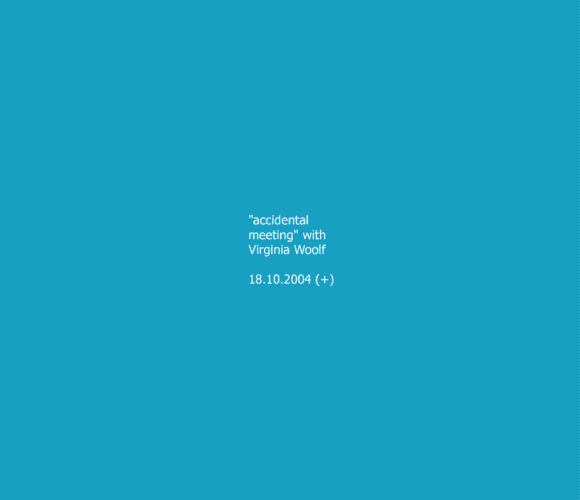
This fake memory fascinated me: it triggered a new understanding, concocted between the different realities of the two texts. With it, I learnt that male aggression had already turned inwards, that violence had become self-referential within the body to the point of mis-identification, of making-fiction of a real artwork. Perhaps what is relevant here, on both aesthetic and epistemological accounts, is not so much the internal integrity of my-self as someone who ‘reads’ a work of art; in other words, what matters is not my authority over an object. What counts is the encounter with the negative feelings and experiences of another, how it engenders new learnings with and about systems of oppression. What matters is the crossing of paths, the “accidental meeting” in pain with another.
I began this text with the usual expectation that I would be writing as I generally do, in the style of cultural analysis. Slowly, it became apparent that my own emotional pain wouldn’t let me. By way of negative cripistemology, instead, I allowed the text to transform itself in relation to emotionally-charged memories that had already latched onto the artworks I was desperately trying—and failing—to tame within my own grid. Thinking-with Ioana’s highly emotionally expressive work, I have come to recognise a way of understanding theory that structured my thinking, where feeling had been expelled from critique.
Part II to follow.
*Ioana Nemeș (1979 – 2011) was a handball-player-turned artist. At the age of 21, after a serious knee injury, she began studying photography at the National University of Arts in Bucharest, Romania. She has been widely exhibited internationally and acknowledged as one of the most important Romanian artists of her generation. Throughout her career, her practice gravitated between individual and collaborative work, the latter with collectives such as KILOBASE Bucharest or Apparatus 22.
The “All Times at Once” exhibition at the National Museum of Contemporary Art of Romania (MNAC) was a 2025 retrospective exhibition dedicated to Ioana’s practice. It brought together different bodies of work in a non-chronological path, describing Ioana’s different becomings as an artist. The exhibition was curated by the current members of the curatorial collective KILOBASE Bucharest, Sandra Demetrescu and Dragoș Olea.
[1]Postqualitative research describes a particular strand of social science research that wishes to abandon a humanist understanding of the subject and social relations. See for instance Elizabeth St. Pierre, ‘Why Post Qualitative Inquiry?’, Qualitative Inquiry, 27(2), pp. 163-166, 2021.
[2]The crip in crip theory encompasses “a broad spectrum of disability, one which accommodates individuals who do not readily fall into clear disability categories.”
[3]Motley, Elisabeth, “Crip Aesthetics and a Choreographic Method of Leakiness”, Dance Chronicle, 47(1), 2024, p. 70.
[4]Johnson, Merri Lisa and Robert McRuer, “Cripistemologies: Introduction”, Journal of Literary & Cultural Disability Studies, 8(2), pp. 127-147, 2014.
[5]Ibid., p. 132.
[6]Smilges, Logan J., Crip Negativity, University of Minnesota Press, 2023.
[7]Ibid.
[8]See for instance Lee Edelman’s book No Future: Queer Theory and the Death Drive, Duke University Press, 2004.
[9]Smilges, Crip Negativity, p. 26.
[10]Johnson and McRuer, ‘Cripistemologies: Introduction’, p. 142.
[11]Ibid., p. 130.
[12]Ibid., p. 130.
[13]In the preface to The Order of Things, Foucault writes the following referring, first, to his earlier book Madness and Civilization, and then to the project at hand: “The history of madness would be the history of the Other (…) whereas the history of the order imposed on things would be the history of the Same”.
[14]Foucault, Michel, The Order of Things: An Archaeology of the Human Sciences, Routledge, 1970, p. xxiv.
[15]Faubion, James, ‘Introduction’, in Michel Foucault, Aesthetics, Method, and Epistemology, 1998, p. XX.
[16]Ibid., p. XV.
[17]Scott, Ian, The Lüscher Color Test: The remarkable test that reveals personality through color, Random House, 1969, p. 18.
[18]See for instance Michel Foucault, The Birth of Biopolitics: Lectures at the Collège de France 1978-1978, Palgrave Macmillan, 2008; Davis, Lennard J., Enforcing Normalcy: Disability, Deafness, and the Body, Verso Books, 2014.
[19]Manen, Marti, “This Quality of the Real”, Ioana Nemeș Archive, 2025, p. 3.


POSTED BY

Maria Persu
Maria Persu (born 2000) is an independent cultural researcher and a member of the editorial and artistic collective specula. She is currently working as a curatorial assistant at Suprainfinit Gallery ...
Comments are closed here.