Between May 9 and July 15, the exhibition “Walk so silently that the bottoms of your feet become ears”, by artists Alexandra Coroi and Bogdan Dumitrescu, was held at Gușterița Verde in Sibiu. The exhibition explores the perception of nature, both the good and the bad, the diverse and that which supposedly requires correction, as well as the role of language as a filter in these distinctions. The title is a paraphrase from Pauline Oliveros. The exhibition is strongly linked to the space in which it takes place, namely, the expansive garden in the courtyard of St. Andrew’s Lutheran Church, which belongs to the Evangelical Parish A.C. in Sibiu. Gușterița Verde aims to be a space focused on the environment, alternative education, and spirituality.
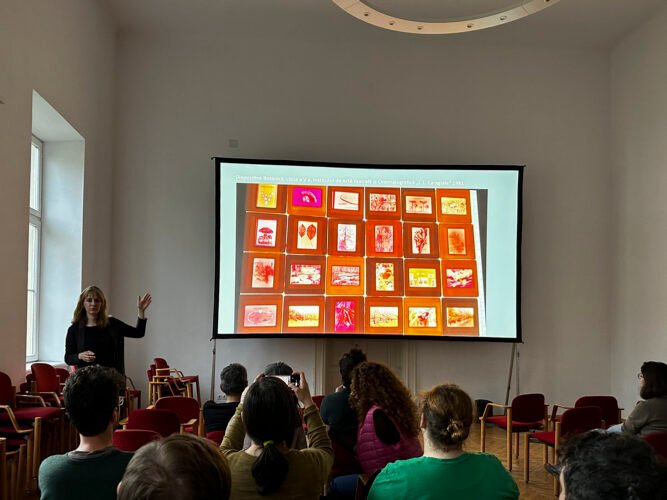
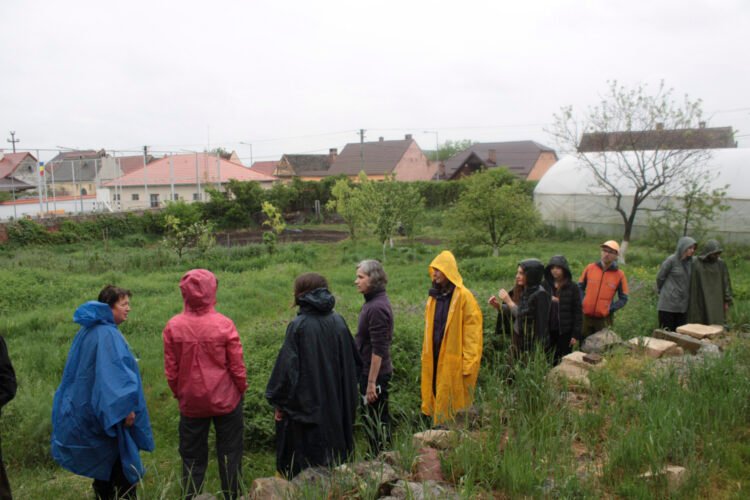
The exhibition opening took place as part of Good Grass, Bad Grass, a gathering where, for one day, a small community came together around a shared interest in the environment, gardening, and participatory art. One of the core activities was a workshop on disorientation in nature, developed in collaboration with Sorina Tomulețiu, who, at the same time, was presenting another exhibition, “Nature’s Artifacts,” hosted inside the church. The workshop featured a walk through the church garden, drawing on the concept of the Situationist drift, transposed from an urban setting to a green environment. Amidst heavy rain and downpours, participants, who set out in search of herbs and snails, could record their impressions in a small notebook designed specifically for the experience. Inside the church, a short concert took place, performed by organists and musical collaborators of the Evangelical Parish; the performance utilised instruments improvised from natural materials and centered on a garden-related theme. A presentation on the history of the institution was also given by head priest Kilian Dörr. The program continued with a lecture and a discussion centered on a slide presentation by Alexandra Ilina, who showcased agricultural and ecological materials from the communist era, including filmstrips produced by forestry districts. In these images, accompanied by text, nature was categorised into “useful” and “harmful” organisms, and the relationship with the environment was framed as a constant struggle to eliminate undesirable elements. The screening, complemented by a children’s story about a grain of wheat, sparked a discussion on how mindsets and our relationship with nature have evolved. The day also featured a workshop on local herbs and aromatic plants, where participants blended various botanicals and explored their properties, as well as a screening of the film Il pianeta azzurro (1982) by Franco Piavoli. In this way, the program wove together walking, observation, memory, dialogue, and artistic experimentation into a single day, during which the garden served not merely as a backdrop, but as an active participant, a catalyst for specific situations, rhythms, and forms of communion.
The starting point for the exhibition “Walk so silently that the bottoms of your feet” become ears is the ecological concept of shifting baselines, according to which each generation constructs its own image of nature based on childhood experiences, an image that then serves as the benchmark against which environmental changes are measured. The problem is that the environment can degrade so slowly that the transformation becomes almost imperceptible. An example provided by the artists involves traveling by car. During Bogdan Dumitrescu’s childhood, a long journey, such as the one between Bucharest and Sibiu, meant a windshield covered in insects. Today, that same trip might end with a clean windshield. For those who experienced the former, that insect-covered windshield has remained a point of reference; for younger generations, their absence may seem normal. This gives rise to the question of how a shift in the frame of reference can be translated into language. Nature is not merely what lies outside us; it is also the result of a layering of images, experiences, readings, and accounts. Through language, we represent the world to ourselves and construct our beliefs about it. In the exhibition, this idea is also expressed through the metaphor of shelter: language serves as a space where beliefs about the world can be built, protected, or even barricaded.
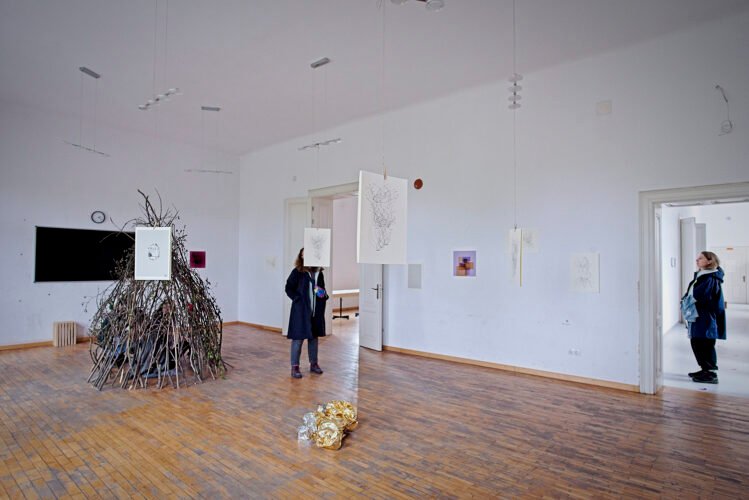
A series of prints transforms the concept of a shifting baseline into a game of dictionary definitions. The process begins with a word of ecological relevance, for instance, “root,” then selects a word from its definition, followed by another from the definition of that second word. This creates multiple layers of interconnected words, each increasingly distant from the original term. The resulting diagram appears coherent and almost scientific, yet this appearance is deceptive: its meaning quickly goes astray. The work calls into question the cold, hierarchical frameworks through which we attempt to explain nature, such as food chains, levels of importance, or the classification of organisms as “higher” or “lower,” which risk stripping away the very complexity and interdependence of ecosystems.
Another series stems from an obsession with lawns and the excessive mowing of grass to prevent the emergence of weeds. Such uniformity can be visually pleasing: an impeccable lawn, fields of rapeseed or lavender, or flowers cultivated in dense clusters. From an ecological perspective, however, these images may conceal monocultures or even environmental disasters. In these works, the word “lawn” is repeated until the image begins to be overrun by terms associated with weeds. These terms spread from various points, as if staging an uprising against uniformity. The series thus shifts from repetition to proliferation, from monoculture to diversity.
An abstract work is constructed from colors extracted directly from the garden in Gușterița. The artists photographed lichens, moss, flowers, and other elements found on-site, then digitally identified the colours and layered them into geometric compositions. Each colour actually contains the text of the code that defines it; this text is scaled down and compressed until it becomes nearly indecipherable. It remains present within the image, yet hidden inside the colour, thereby establishing a relationship between information, representation, and the limits of the visible.
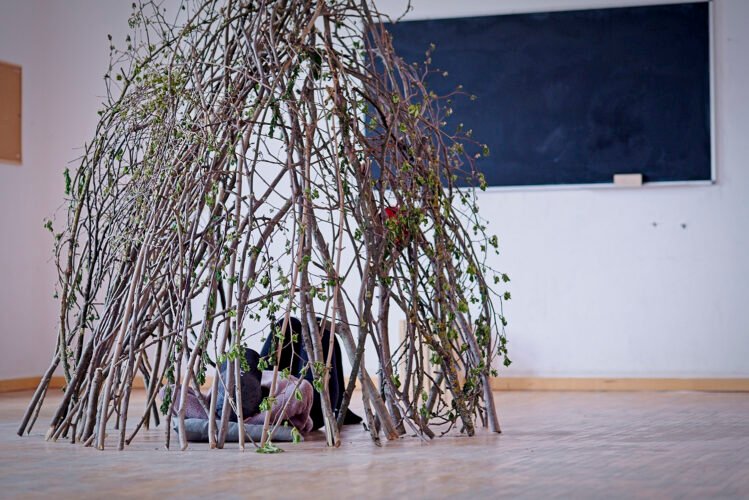
Within the exhibition space, a shelter was constructed from branches gathered in the garden, paired with an emergency thermal blanket. The work contrasts the natural with the artificial, yet unites them through their shared function of providing protection. Nearby, there was a first-aid kit and a voice recorder, which visitors could use to leave or listen to messages. In a former classroom, the clock above the blackboard was intentionally left in place. Beneath it, a speaker played a recording of a ticking sound, occasionally layered with additional, offset ticks. The effect, almost musical, created a “subtle disorientation,” akin to an extrasystole disrupting one’s familiar heartbeat.
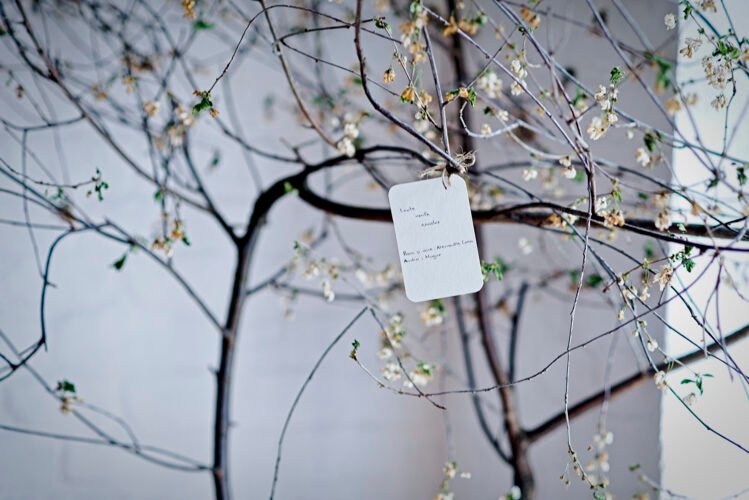
Another work, built around a small tree equipped with headphones, revisits the idea of nature as experienced in childhood, an emotional touchstone that can no longer be rediscovered in its original form. The exhibition also featured a soundtrack, created by an artist who chose to remain anonymous; it was based on a looped poem composed of memories, heavily fictionalised, much like the way a dream is reconstructed when we recount it, with fragments linked and fleshed out to form a coherent whole.
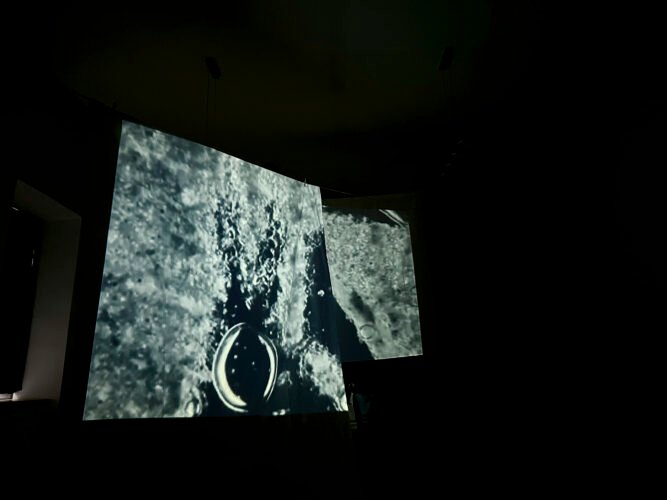
In another room, there was a video installation created in collaboration with Mihai Băcăran, who lives in Sofia. The artists sent him soil, branches, leaves, and lichens from the garden in Gușterița. He kept the materials in water, filmed the growth of bacteria under a microscope, and produced an abstract video. The installation was then connected to an air quality sensor and an algorithm that altered the imagery in real time: colours shifted, glitches appeared, and during sustained increases in CO₂ levels, the video would slow down, darken, and its sound would fade, entering a state akin to hibernation. Once the visitors had left and the air returned to its baseline state, the image reverted to its usual form. The work also relates to the concept of “digital waste.” The video was intentionally compressed, in the spirit of a video art festival that encourages minimising the amount of data used for storage and transmission. This low quality is not a flaw, but rather an ecological choice, and a question regarding technological standards: how much resolution is truly necessary when images are viewed on a phone, rather than being enlarged or printed on a large scale?
The exhibition “Walk so silently that the bottoms of your feet” become ears explores how nature is observed, classified, and reconstructed through language, memory, and technology. The project by artists Alexandra Coroi and Bogdan Dumitrescu invites an examination of the participants’ own reflexes, directing attention toward what is labeled nature, what is deemed useful or harmful, what is allowed to grow versus what is targeted for removal, and the extent to which the external world is, in fact, constructed through images and words.


POSTED BY
Bogdan Bălan
Bogdan Bălan is a cultural journalist, art critic and cultural worker. He has collaborated with Goethe-Institut, Savvy Contemporary, Scena9, among others....