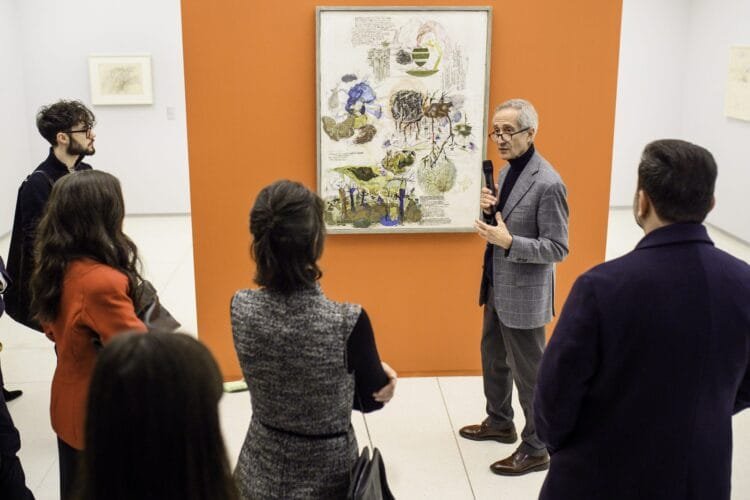
Since early February, amid a cultural thaw, the Museum of Recent Art has re-entered the local exhibition scene with a new solo show aimed at rediscovery. “Ștefan Bertalan: In Tune with the World” is not intended to be yet another predictable revisitation of a visual body of work, but rather a manifesto for the rediscovery of an artist who, we are told, despite being at the forefront of Romanian experimental art, has remained on the periphery of the official art world. From Bertalan’s iconic status to the prestigious institutional framework and renowned curator Bernard Blistène (honorary director of the Centre Pompidou in Paris), the project had all the makings of a successful rescue mission. However, despite all the evident efforts, the retrospective fails to transcend certain constraints of the Procrustean bed to which the Eastern European artist has so often been subjected. After two visits to MARe, I noticed that, contrary to my usual expectations, other artistic stereotypes had been ticked off, and I was surprised to find them resurrected.
Before turning our attention to the exhibition, it’s worth noting that this is not Bertalan’s first retrospective, nor by any means his first catalog. What MARe is hosting (through May 3) is a reconstituted and traveling version of an initial exhibition organized in 2025 by the Art Encounters Foundation in Timișoara, but merely the latest in a long string of solo and group exhibitions held in recent years at various venues both in Romania and abroad, often followed by dedicated monographs. In fact, Bertalan is also one of the first names encountered by anyone with a serious interest in postwar Eastern European art, thanks to his inclusion in some of the most important internationally published overviews. (For those who are curious, I’ve included a list of titles at the end.) It is no exaggeration, therefore, to recognize Bertalan as one of the major artists of the neo-avant-garde movements that took shape in the 1960s in Romania and other Eastern Bloc countries and that decisively altered the trajectory of art history in the region. Nevertheless, it seems that even his image required a series of narrative devices to bring him back into the spotlight.
The Artist’s Biography as Fiction
The narrative that shapes how we view Bertalan’s artistic past is provided by Bernard Blistène, an art historian with extensive experience in France’s institutional art scene. It is evident, from the texts greeting visitors at the entrance or scattered throughout the exhibition, as well as from the numerous interviews Blistène has recently given, that his intention was to engage us through a catchy and slightly romanticized retelling of the artist’s life, one that, however, veers too far into uncritical, conceptually diluted, and outdated territory. In the introductory curatorial text, we are thus told that “Bertalan’s work is, above all, the work of a restless and exiled man,” an idea later emphasized by the curator in an interview, in which he identifies the artist as “marginal, almost an outsider.”
The dramatic tone of these statements reminded me of a study I read in college, which became famous precisely for the way it demystifies the recurring anecdotes and preconceptions found in artists’ biographies from antiquity through modernity: “Legend, Myth, and Magic in the Image of the Artist,” by Ernst Kris and Otto Kurz. The artist’s heroic destiny, the self-isolated and tormented genius, the work of art so realistic that it merges with nature (see the passage about Bertalan’s ability to depict with “the precision of dissected natural organisms”) are tropes of the same selective fiction that both distorts and glorifies. It doesn’t even matter whether such statements are more or less grounded in a version of reality, because they transcend personal detail anyway and stem from a long tradition of mythologizing art history. The question remains, however: is this merely a discursive reflex or an attempt to carve out a place for Bertalan in the canon, among other mythical “geniuses”?
If we look at the constant comparisons between Bertalan and Leonardo da Vinci and, at times, Van Gogh and Rembrandt, the answer is perhaps clearer. Even if these artists were among Bertalan’s models, invoking them only serves to accelerate this quest for legitimacy through association with so-called universal authorities (the “unique, original, remarkable” triad in the curatorial text reaffirms this). We are thus dealing with a symbolic positioning within the lineage of the great “revolutionary” artists, the effect of which is all the more potent the more Bertalan’s supposed marginality is emphasized.
Suffering Is Aesthetic: The Eastern European Artist as Seen by the West
The somber tone with which the figure of the “restless and exiled” artist is portrayed, condemned to “inadequacy and haunted loneliness” (I laughed out loud when I read that), gave me the feeling that I was not merely about to see a retrospective, but to witness Bertalan’s martyrdom, immediately followed by his public canonization. The ambivalence toward the Eastern European artist under communism operates in the same vein: forced to perform an exhibitionist spectacle of self-exoticization, continually reaffirming stereotypical expectations about his own identity, inducing fascination, and, only thus, becoming visible and canonizable. According to the formula, the Eastern artist must practice an art of political resistance, explicitly anti-system, or, at the very least, bypassing the system through an “internal emigration,” and the great drama of his career lies in the fact that he aspires to a single thing, which, however, he will attain only temporarily or, perhaps, never at all—perfect synchrony with the West. His acceptance depends on a constantly negotiated tension between remaining sufficiently different, yet still comparable to the Western center. It is a classic colonial narrative, which MARe adopts without hesitation and where Ștefan Bertalan, the forgotten Eastern European artist (who is, incidentally, internationally renowned) but now “discovered” by a Western European curator, plays the leading role.
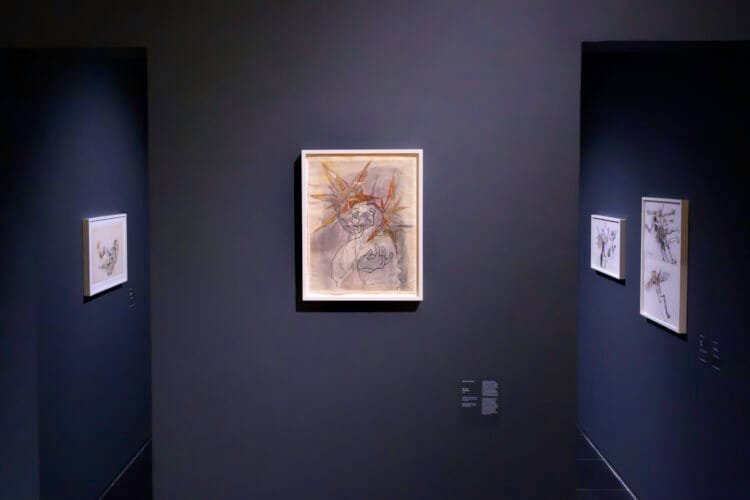
Of all the aspects of this staging directed by Blistène x MARe, one stands out in particular. Demonstratively painted black, abruptly interrupting the chronological flow of the exhibition, the room on the 1½ floor appears as a funereal embodiment of a new myth, that of the artist continuously persecuted under communism. Here we find a series of progressive metamorphoses-decompositions of the self into cauliflower blossoms, captured in bold strokes and dark colors, which Bertalan began working on following his politically motivated dismissal from the Department of Architecture at the Polytechnic University of Timișoara in 1981. The series is discussed as a sign of a decisive stylistic break, a sort of overturning of his rationality in the artistic realm into a visual universe of darkness and malevolent forms, into which Bertalan began to sink from that point on. Yet the exhibition also features works from the same period and later that do not fully confirm this shift, which is, in any case, contradicted by Bertalan’s cyclical returns to earlier projects.
Exhibitable, saleable, collectible
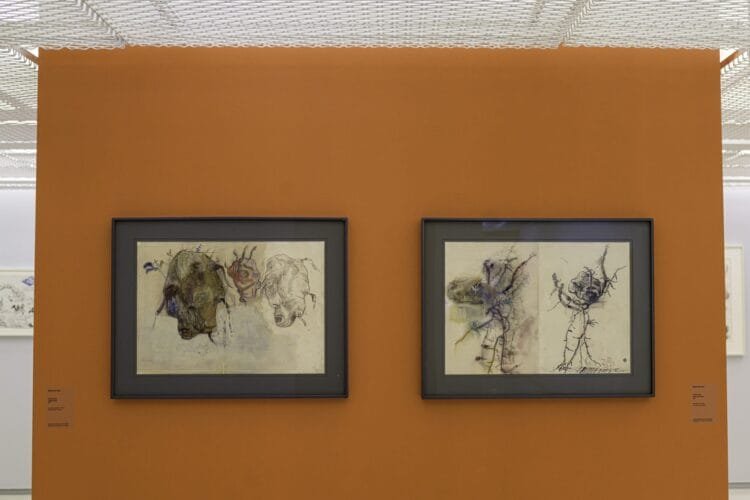
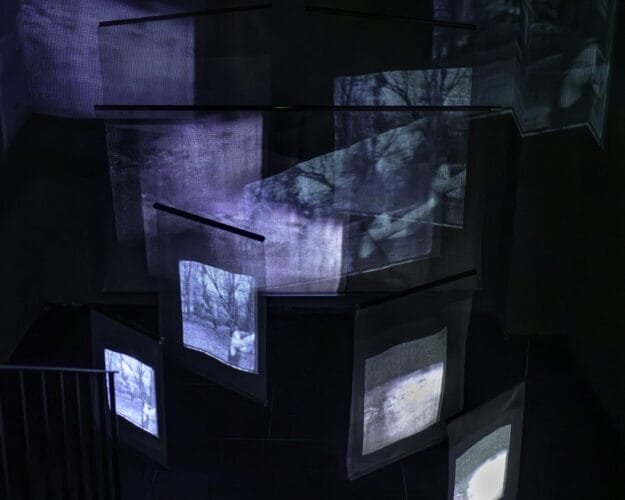
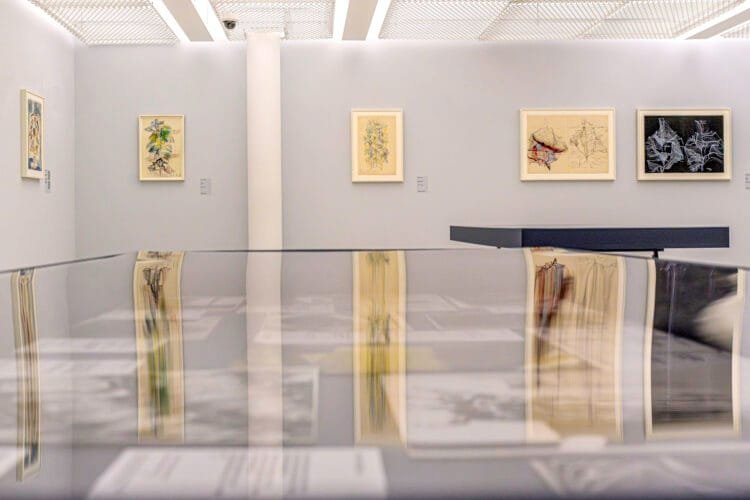
Most of the works follow a well-established pattern, partly the artist’s preference, partly a curatorial decision. Drawings, paintings, and a few photographs, in various techniques and serving a variety of functions, to be sure, are all medium- and small-sized, mostly two-dimensional, and arranged in a linear fashion on the freshly painted walls of MARe. The exceptions are truly a few works on the first floor and in the basement, which delve more deeply into the realm of the neo-avant-garde, particularly geometric abstraction, through various surfaces and overlapping multimedia grids, and which correspond to the period of collaboration within the 111 and Sigma groups.
Some are sketches—though not intended for exhibition in this format—but rather studies at various stages of investigating a biological phenomenon, a sort of artist-researcher’s journal that brings together calculations, geometric projections, and technical or theoretical notations. Others, merely alluded to, have a less tangible presence: environmental interventions in nature (during the Sigma phase), disguised as scientific tests and documentation of surroundings and sometimes rendered in drawing. In the first category—though not far removed from the second—is the project “I Lived 130 Days with a Sunflower,” begun in 1979, which, in its original sense, constituted a process of documenting and almost embodying the plant’s evolution and identity, having more in common with performance than with a finished artistic product. At MARe, however, the processual dimension and even the explicitly ecological connotations of Bertalan’s action were suppressed and reduced to a series of “aesthetic” safe, neatly framed, museum-like works, as if they were just right for hanging in a collector’s office.
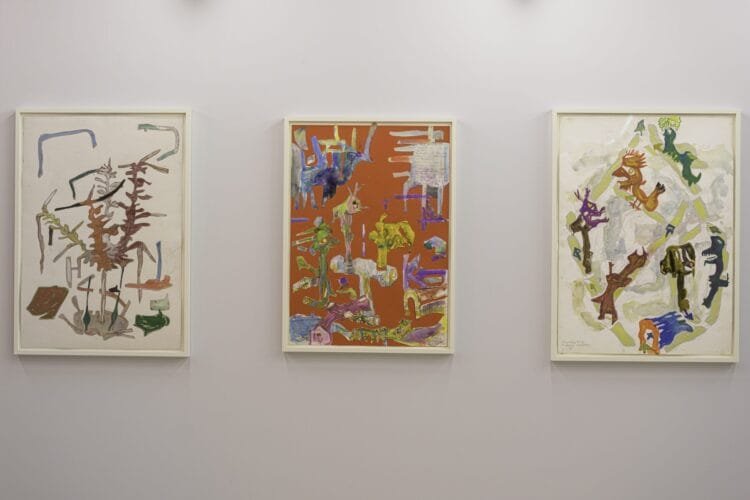
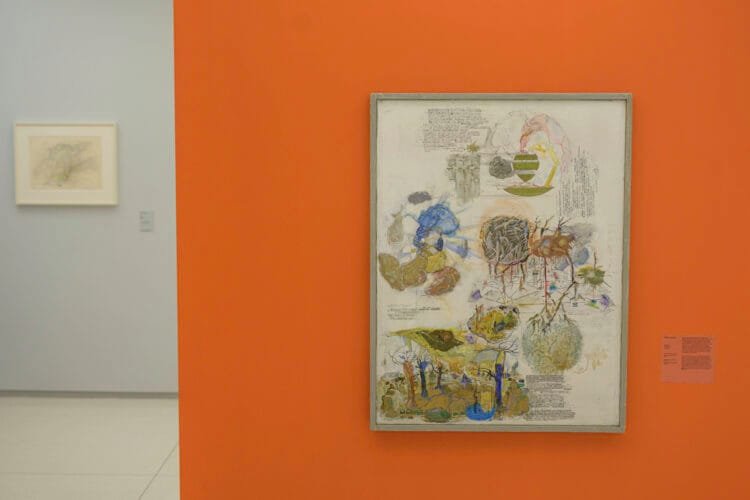
Far more suited to this conventional mode of exhibition proposed by MARe are the works from Bertalan’s late career (beginning in 1981), which are more accessible simply because they depict recognizable realities. From semi-apocalyptic landscapes with surrealist overtones to hybrid plant-like self-portraits resembling potatoes or sunflowers, we find a modernism that is not particularly radical but is chromatically exciting, crossing the entire 20th century in its various reinterpretations. While they differ formally, thematically, however, we observe multiple extensions of his earlier obsessions with the biological world, now fictionalized and freed from the lens of scientific rigor. But once you’ve made your way through the top floor (the works, with few exceptions, do not deviate from the established direction) and reached the end of the visit, the impression left is that of an almost overly polished coherence. And this happens because the visual selection relies on a single format—works of similar sizes, in 2D, arranged monotonously in a single row—imposing a viewing experience that reads as more continuous and less varied than it actually was.
“This retrospective reveals new aspects of his unique body of work,” the curatorial text reads, in its typical jargon, and I don’t deny that at all. We are, indeed, presented with an atypical representation, but not because it shows more, but rather too little of Bertalan. It flattens his sinuous journey, which weaves together a plurality of media and interdisciplinary explorations, and prioritizes only what is easily exhibited, sold, and collected. Probably also due to a lack of commercial potential and the difficulty of categorizing it within the sphere of the singular and original artist, the 111 and Sigma period, which highlights the collaborative aspect of Bertalan’s practice, is relegated to the basement. Even the most trivial attempt to nuance this one-sided perspective—the audiovisual archive of pedagogical experiments at the Timișoara Art High School, as well as Bertalan’s performances—somehow ends up being diminished by its isolation and decontextualization from the rest of the exhibition in the museum’s basement.
However, although the curatorial intent remains open to criticism, “Ștefan Bertalan: In Tune with the World” is an opportunity to revisit a (small) part of an artist’s body of work that ultimately leaves us with many open questions about the stakes of fictionalizing the past, the coexistence of the avant-garde and official aesthetic norms, and the still-active tensions between East and West.
Despite—or rather, as a result of—efforts to boost his appeal through myths and overused rhetorical clichés, we see a Bertalan who is largely oversimplified, homogenized, and flattened under the pressure to perform commercially. Nevertheless, his fresh perspective and the experimental continuum he has channeled into his art shine through here and there, resisting the institutionalization and limitations imposed by museums and galleries. And the newly aroused interest in the visual art of a region that has perhaps been even more ignored than that of the Global South is, of course, to be welcomed, but only as long as it does not take place within the terms of a power relationship that is passively maintained, without ever being questioned, deconstructed, or even acknowledged.
Translated by Marina Oprea


POSTED BY
Ileana Stanciu Scripcariu
Ileana Stanciu Scripcariu (b. 2002) is a researcher and art critic interested in postwar art and architecture in Central and Eastern Europe, as well as in current practices of “museifying” the soc...
Comments are closed here.